

Table of Contents
- What 'American Made' Really Means for Watches
- US Assembled Automatic Watches: What to Look For
- How to Verify Watch Origin Before You Buy
- Components, Movements, and Movement Sourcing
- Mechanical vs. Quartz: What Domestic Assembly Supports
- Price Points and Value in American Made Watches
- Maintenance, Serviceability, and Long-Term Ownership
- Frequently Asked Questions
Last Updated: September 12, 2026
What 'American Made' Really Means for Watches
The phrase "american made watches" gets thrown around loosely, and most buyers never learn what actually sits behind the label. This guide from Haim Watch Company breaks down the standards, the sourcing realities, and the questions worth asking before you spend real money.

American made watches are timepieces whose components and assembly meet the Federal Trade Commission's strict standard for domestic origin claims (the FTC). That standard is far narrower than most shoppers assume, and it explains why so few watches qualify outright.
The distinction matters because the label is legally regulated, not a marketing flourish. According to the FTC's Made in USA standard guidance, any unqualified claim must meet the "all or virtually all" threshold. In practice, that means every significant component and the labor behind the finished watch must originate domestically.
FTC Standards and the 'All or Virtually All' Rule
All or virtually all means no more than a negligible amount of foreign content remains in the finished product. The FTC evaluates where the product is assembled, where its components come from, and whether foreign content is significant.
For a wrist watch, that calculation is unforgiving. A dial, case, crystal, crown, and movement each carry their own supply chain. If a single major component is imported, an unqualified "Made in USA" claim becomes difficult to defend.
A common mistake is treating "assembled in the USA" and "Made in USA" as interchangeable. They are not, and the gap between them is where most confusion lives.
How the FTC Actually Evaluates a Watch Claim
The FTC does not publish a component checklist for watches, but its enforcement pattern across consumer goods reveals a consistent method. Investigators look at three things: the percentage of manufacturing costs incurred domestically, whether the final assembly happens in the country, and whether the last substantial transformation occurred here.
For watches, that last point is the killer. A movement built overseas and cased domestically has not undergone its last substantial transformation in the country, the movement is the watch's most complex and costly subsystem. That is why so few brands attempt an unqualified claim.
Qualified Claims: The Legal Middle Ground
Brands that cannot meet the unqualified standard have a lawful alternative: a qualified claim. The FTC permits statements like "Made in USA with imported movement" or "Assembled in USA" when they are accurate and clearly disclosed. These are not loopholes, they are the honest disclosure the regulation was designed to encourage.
A qualified claim must be specific. "Made in USA of domestic and imported parts" is acceptable if the imported parts are genuinely minor. "Almost Made in USA" or "American Made" without qualification is not, and the FTC has brought enforcement actions against companies that used vague origin language to imply full domestic production.
Why So Few Watches Qualify
The global watch supply chain is concentrated. Sapphire crystals, jewel bearings, mainsprings, and hairsprings are produced by a small number of specialized suppliers, most of them overseas. Even brands that machine their own cases and assemble their own movements often rely on imported components for these items.
That reality is why the practical definition of an American made watch in 2026 is narrower than the marketing suggests. A brand that discloses its imported components and still meets the "all or virtually all" threshold for the rest of the watch is operating at the honest edge of the standard. A brand that claims full domestic origin without that disclosure is either exceptional or overstating.
American Made vs. American Assembled
American assembled describes a watch put together domestically from parts that may be sourced internationally. American made requires domestic origin across the components as well, not just the final build.
The difference is meaningful for collectors. A watch assembled in a domestic facility with a Swiss or Japanese movement can still be an excellent timepiece. It simply cannot carry an unqualified domestic origin claim.
US Assembled Automatic Watches: What to Look For
A US assembled automatic watch pairs a self-winding mechanical movement with domestic final assembly. Automatic calibers wind themselves from wrist motion, so there is no battery to replace.
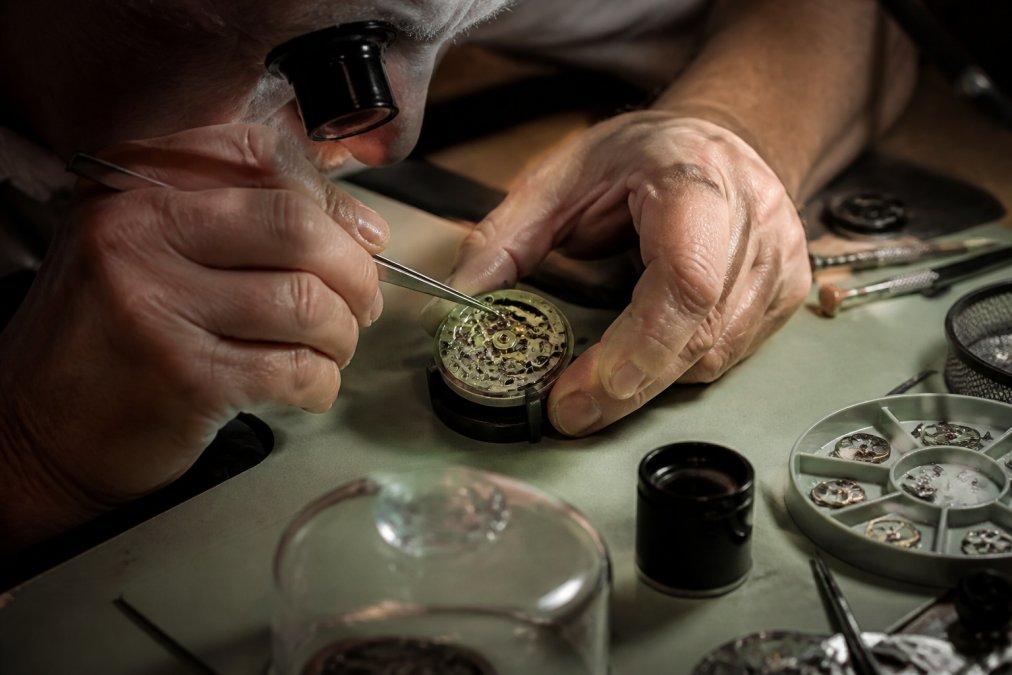
The movement is the heart of the decision. An automatic caliber contains a rotor, mainspring, and gear train that convert motion into stored energy. Domestic assembly of that caliber, rather than simple casing of an imported unit, is the harder achievement and the rarer one.
Look for three signals. First, a named in-house or custom caliber rather than a generic reference number. Second, documentation naming the assembly facility. Third, case finishing that shows hand work: chamfered edges, brushed and polished transitions, and consistent tolerances.
Haim Watch Company builds the Legacy Automatic as a 100% US-assembled timepiece, including its movement, with a custom-designed caliber and a hand-finished titanium case. That combination of domestic assembly and in-house caliber design is what separates it from watches that only case an imported engine.
How to Verify Watch Origin Before You Buy
Verification starts with the paperwork, not the marketing page. A legitimate origin claim is documented, and the documents should name specific facilities and component sources.
Reading Labels, Casebacks, and Documentation
The caseback is your first checkpoint. It typically carries the origin marking, the caliber reference, and the case material. Cross-check that marking against the brand's written claims, because inconsistencies there are a red flag.
Documentation is your second checkpoint. Ask for the assembly location, the movement's origin, and whether the caliber is custom or catalog-sourced. A brand confident in its supply chain will answer directly.
- Caseback origin marking matches the website claim
- Movement caliber is named, not described vaguely
- Assembly facility is identified by name or region
- Component sourcing is disclosed for dial, case, and crystal
- Warranty terms cover the movement specifically
If a seller dodges the component question, treat the origin claim as unverified. The FTC's guidance on Made in USA claims exists precisely because vague origin language misleads buyers.
Components, Movements, and Movement Sourcing
Movement sourcing is the single most revealing question you can ask a watch brand. A custom-designed caliber signals investment in horology; a stock imported movement signals a different business model.
Movement sourcing describes where a caliber's parts are manufactured and where it is assembled and regulated. These can be three different places, and the honest brands say so.
The Component Supply Chain, Piece by Piece
A mechanical watch has roughly a dozen significant components, and each has its own origin story. Understanding them is the difference between reading a spec sheet and understanding what you are buying.
The movement is the most complex and costly subsystem. It contains the mainspring, gear train, escapement, balance wheel, jewels, and rotor. A fully domestic movement requires domestic production of nearly all of these, a capability only a handful of American operations have ever sustained. Mastering the intricacies of these mechanical hearts remains essential for verifying American goods before selecting a timepiece that reflects true domestic craftsmanship.
The case is the second most visible component. Domestic case production means domestic machining, finishing, and often domestic titanium or stainless steel stock. A hand-finished titanium case reflects real domestic capability; a stamped case does not.
The dial is frequently imported. High-quality dials with applied indices, sunburst finishes, or enamel work come from a small number of specialized suppliers, most overseas. A domestic dial is a genuine differentiator.
The crystal is almost always imported. Sapphire crystal production for watch applications is concentrated in a few facilities worldwide, and domestic alternatives are rare. This is one component where even the most committed American brands often cannot source domestically.
The crown, pushers, and gaskets are small but count. A domestic crown is a minor win; imported gaskets are common and rarely disclosed.
Custom Caliber vs. Modified Catalog Movement
A custom caliber is designed from the ground up for a specific watch, with its own architecture, finishing, and regulation. A modified catalog movement starts as a stock caliber, often from a Swiss or Japanese supplier, and receives cosmetic or functional changes.
Both are legitimate. The distinction matters because custom calibers command higher prices, are harder to service outside the brand, and signal a deeper horological investment. Modified catalog movements are easier to service, have broader parts availability, and often deliver better value.
Ask a brand which one it uses. A custom caliber should come with a named reference, a documented service network, and a parts pipeline. A modified catalog movement should be disclosed as such, with the base caliber named.
What This Means for Resale and Service
Movement origin affects resale value in ways buyers often discover too late. A watch with a custom domestic caliber and documented parts support holds value differently than one with an undisclosed imported movement. Collectors pay for provenance, and provenance starts with the caliber.
Serviceability follows the same logic. A custom caliber with a domestic service network is easier to maintain than one whose parts must be sourced from overseas. Before buying, ask who services the watch, where parts come from, and what the expected service interval is.
The Honest Disclosure Standard
The brands worth trusting in this category disclose their supply chain without being asked. They name the caliber, the assembly facility, and the components they import. That transparency is not a weakness, it is the mark of a brand that understands the FTC standard and respects its customers enough to explain the reality of domestic watch production.
Mechanical vs. Quartz: What Domestic Assembly Supports
Domestic assembly supports both mechanical and quartz watches, but the economics differ sharply. Mechanical calibers reward domestic assembly because the value sits in regulation, finishing, and hand work.
Quartz movements are inexpensive to produce and largely automated, which reduces the incentive to assemble domestically. A quartz watch can still be assembled in the US, but the labor premium buys less.
Mechanical movements, by contrast, benefit from a watchmaker's hand. Regulation, timing adjustment, and finishing are skilled tasks. That is why US assembled automatic watches cluster in the mechanical segment, where domestic labor adds measurable value.
For collectors, this is the practical takeaway: if domestic assembly matters to you, mechanical is where it shows.
Price Points and Value in American Made Watches
Domestic assembly carries a real cost, and buyers should understand where the money goes. Skilled labor, lower production volumes, and domestic quality control all push prices above comparable imported watches.
Value in this category comes from three places: the caliber, the case finishing, and the serviceability. A watch with a custom caliber and a hand-finished case holds value differently than one with a catalog movement in a stamped case.
Haim Watch Company's Legacy Automatic sits at $1,350, with the Legacy Automatic: Azure at $1,349.99, both built around the Caliber HWC-1 and a 38mm hand-finished titanium case. The L2 Chronograph starts at $489, and the L2 Chronograph (Anniversary Edition) at $515, limited to 30 pieces per dial.

| Model | Price | Movement Approach | Best For |
|---|---|---|---|
| Legacy Automatic | $1,350 | Custom caliber, US assembled | Collectors wanting domestic assembly |
| Legacy Automatic: Azure | $1,349.99 | Caliber HWC-1, titanium case | Buyers wanting a distinctive dial |
| L2 Chronograph | $489 | Chronograph, entry tier | First mechanical purchase |
| L2 Chronograph (Anniversary Edition) | $515 | Limited to 30 per dial | Collectors chasing exclusivity |
Small batch production explains much of the pricing. Limited runs spread fixed tooling and development costs across fewer units, which raises the per-watch figure.
Maintenance, Serviceability, and Long-Term Ownership
Serviceability is the question almost no buyer asks and almost every collector eventually regrets ignoring. A mechanical watch needs servicing roughly every several years, and where that service happens matters.
A domestically assembled caliber with documented parts support is easier to maintain long term. If a brand disappears or its movement has no parts pipeline, servicing becomes a hunt for a donor watch.
Ask two questions before buying. Who services the watch, and are replacement parts available? A brand that answers both clearly is a safer long-term partner than one that only talks about the dial.
A limited edition adds a wrinkle: exclusivity is appealing, but a very small run can complicate parts availability. Balance the appeal of scarcity against the practical reality of ownership.
Frequently Asked Questions
Which watch brands are made in the USA?
A small number of brands can claim domestic manufacturing, and even fewer produce movements entirely in the country. Most 'American' watches use imported movements with US assembly and finishing. Haim Watch Company's Legacy Automatic is 100% US assembled, including its custom-designed Caliber HWC-1 movement, and is priced at $1,350. When evaluating any brand, ask where the movement, case, dial, and hands are made rather than relying on a single label.
What defines a watch as 'American made' versus 'American assembled'?
Under FTC guidelines, 'Made in USA' means all or virtually all significant parts and processing are of US origin. 'American assembled' only means final assembly happened domestically, even if most components were imported. A watch can be assembled in the US with a Swiss movement, Japanese dial, and Chinese case. If a brand uses 'assembled' language, ask for a component breakdown and check whether the movement itself was built domestically.
How can I verify watch origin before buying?
Start with the caseback and any included documentation, which should state the movement caliber and country of origin. Check the brand's website for a transparent supply chain statement. Look for FTC-compliant 'Made in USA' claims, which require substantiation. For US assembled automatic watches, ask the brand directly where the movement, case, dial, and hands are produced. Reputable microbrands will answer these questions clearly, and third-party reviews often verify the claims.
What should collectors look for when buying American-assembled timepieces?
Focus on movement sourcing, assembly location, and serviceability. A custom-designed caliber like Haim Watch Company's HWC-1 signals real investment in horology, while a stock ETA or Miyota movement indicates a different value proposition. Check case finishing details such as hand-finished titanium, sapphire crystal, and dial decoration. Confirm the brand offers servicing or can direct you to a watchmaker. Limited editions, like the L2 Chronograph Anniversary Edition capped at 30 pieces per dial, also support long-term collectibility.
Choosing an american made watch comes down to verifying what the label actually promises, and that takes more than reading a product page. Haim Watch Company builds the Legacy Automatic with 100% US assembly, a custom-designed Caliber HWC-1, and a hand-finished titanium case, so the origin claim is backed by the construction itself. Explore the collection and find a timepiece built to mark the moments that matter.