

Table of Contents
- Why Dress Watches Work With Casual Attire
- The Dress Watch Defined: What Makes It Formal
- How to Style Leather Strap Watches for Everyday Wear
- Best Dress Watches for Everyday Wear: What to Look For
- Strap Changes That Make Dress Watches Casual
- Tech-Wear and Smart Casual: The New Rules
- Building a Casual Rotation With Dress Watches
- Frequently Asked Questions
Last Updated: September 15, 2026
Why Dress Watches Work With Casual Attire
The dress watch was never supposed to be casual, etiquette manuals once treated a slim gold timepiece as formalwear only, and nobody talked about how to wear dress watches casually. That rule has collapsed: today, pairing a refined dress watch with a t-shirt and jeans reads as intentional rather than mismatched.
Learning how to wear dress watches casually comes down to one principle: the watch should be the most formal thing you're wearing, and that contrast should look deliberate. A dress watch is a thin-cased, understated timepiece with a clean dial, minimal complications, and often a leather strap. Its formality comes from proportion and restraint, not decoration, which is exactly why it works against denim, cotton, and knitwear.
Below, we break down the dial colors, case thicknesses, strap changes, and styling moves that make a dress watch feel at home in a casual wardrobe.
The Dress Watch Defined: What Makes It Formal
A dress watch is a slim, understated timepiece designed for formal settings, typically under 40mm, under 10mm thick, with a clean dial and minimal complications (Men Wearing Smaller Watches and Women Wearing Larger Watches in 2024). At Haim Watch Company, we build around that definition.

The hallmarks of a dress watch:
- Case diameter of 36-39mm, small enough to slip under a cuff
- Case thickness under 10mm, which keeps the watch low on the wrist
- A simple dial with few or no complications beyond a date
- Understated finishing rather than a chunky rotating bezel
- A leather strap, or a fine Milanese mesh, rather than a heavy bracelet
A guilloché dial with applied numerals sits at the formal end of the spectrum: worn with a hoodie it looks like a mistake, but with a crisp oxford and dark denim it looks deliberate. The difference is proportion and the rest of the outfit, not the watch.
Dial Color, Case Thickness, and Wrist Presence
Dial color decides how a watch reads more than any other factor. White and cream skew formal, blue and slate sit in the middle, and darker or textured dials are easiest to wear casually, a baby blue dial with applied numerals feels relaxed without losing refinement.
Case thickness controls wrist presence. A 12mm case announces itself; an 8-9mm case disappears under a sleeve. For casual wear, thinner is almost always better, and a hand-wound or automatic movement keeps the case thin.
How to Style Leather Strap Watches for Everyday Wear
Styling leather strap watches for everyday wear is about matching the strap's texture and color to the rest of your outfit. A smooth black alligator strap fights a faded t-shirt; a textured brown or blue leather strap meets it halfway.
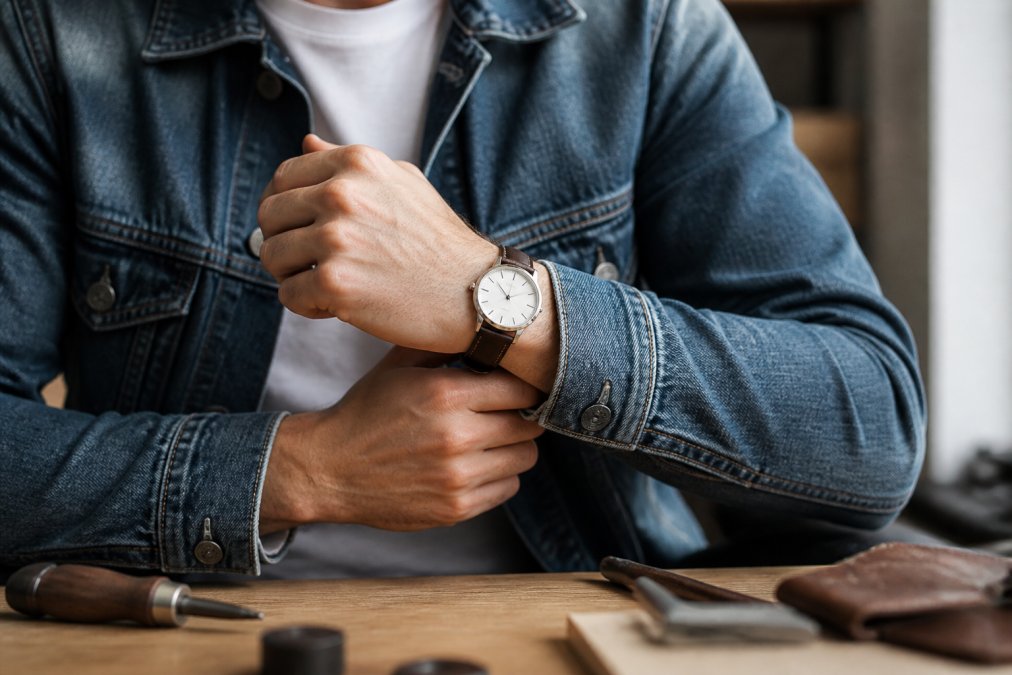
Practical moves that work:
- Pair a brown or tan leather strap with denim, chinos, or earth-toned knitwear
- Match the strap to your shoes or belt for a pulled-together look, not an identical one
- Choose a strap with visible texture or patina over a glossy, dressy finish
- Keep the buckle simple; an ornate buckle reads formal
- Swap to a Milanese mesh bracelet when you want a sportier, more contemporary feel
The strap is the easiest variable to change, and where most people get casual styling wrong: they keep the formal strap and wonder why the watch feels out of place.

Best Dress Watches for Everyday Wear: What to Look For
The best dress watches for everyday wear balance a slim profile with enough character to hold up against casual clothing. Durability matters more than most guides admit, because a daily-worn watch takes more abuse than one that lives in a drawer.
What to prioritize:
- Case material: Titanium is light and resists scratches better than polished steel, which keeps a daily-worn watch looking sharp
- Case size: 36-39mm suits most wrists and slips under a sleeve
- Water resistance: Enough for hand-washing and rain, even if you never swim in it
- Lug width: A common width like 20mm gives you the widest choice of aftermarket straps
- Movement: A reliable automatic caliber with a serviceable design
The Haim Watch Company Legacy Automatic is a good example of the category done right: a hand-finished titanium case, a custom-designed caliber, and 100% US assembly including the movement, built to order rather than pulled from a shelf. The Azure variant pairs a baby blue dial with applied Breguet numerals and a guilloché center, refined without reading stiff.

| Feature | Why It Matters for Casual Wear |
|---|---|
| Titanium case | Lighter on the wrist, resists daily scratches |
| 38mm diameter | Fits under a sleeve, suits most wrists |
| 20mm lug width | Unlocks the widest strap selection |
| Custom caliber | Thin profile, serviceable, distinctive |
| Textured dial | Adds interest without formality |
Strap Changes That Make Dress Watches Casual
Swapping the strap is the fastest way to make a dress watch casual, and the move most people skip. What separates a swap that works from one that looks like a mistake comes down to three variables: lug width, strap material, and how the strap's finish interacts with your outfit. Matching the texture of your leather or canvas to the rest of your comfortable casual clothes ensures the timepiece feels like a deliberate choice rather than an afterthought.
Measure Lug Width Before You Buy Anything
Lug width is the distance in millimeters between the two lugs on the watch head, measured where the spring bar sits, not the same as case diameter or the strap's width at the buckle. A 38mm case can take a 20mm strap; a 36mm case often takes an 18mm or 19mm strap. Get this number wrong and the strap will bow away from the case or leave a visible gap.
How to measure it without a caliper:
- Use a metric ruler or a printable lug-width gauge placed flat against the case
- Measure from the inside edge of one lug to the inside edge of the other, at the spring bar hole
- Round to the nearest whole millimeter; standard widths are 18mm, 19mm, 20mm, 21mm, and 22mm
- If you land between sizes, size down rather than up, a slightly narrow strap sits cleaner than one that bulges
A 20mm lug width is the sweet spot: it's the most common size, so aftermarket options are nearly endless.
Spring Bars: Quick-Release vs. Standard
Strap Material: What Each One Actually Does
| Material | Casual Read | Durability | Notes |
|---|---|---|---|
| Smooth alligator or glossy calf | Formal | Moderate | Fights denim and tees; save for suits |
| Textured calf or pebbled leather | Smart casual | Good | The default casual leather; ages into patina |
| Suede | Relaxed | Fair | Softens an outfit instantly; avoid heavy rain |
| Perlon (woven nylon) | Sporty, technical | High | Breathable, quick-drying, infinitely adjustable |
| NATO nylon | Utilitarian | High | Bulkier; can lift the watch head off the wrist |
| Milanese mesh | Contemporary | High | Adds a technical edge; fine weave reads dressier than a link bracelet |
| Rubber or FKM | Sport | High | Best for heat and water; can clash with a slim dress case |
Patina Is the Point
Match the Strap to the Outfit, Not the Other Way Around
Lug width, spring bar type, and strap material matter more than the strap brand. Get those three right and you can restyle a single watch for years without buying another one.
Tech-Wear and Smart Casual: The New Rules
What Counts as Tech-Wear Here
The Proportion Rule Still Governs Everything
Concrete Pairings That Work
A few combinations that hold up in practice:
What to Avoid
Durability Is the Real Question
The most common mistake is treating a dress watch as too precious to wear in technical settings. A watch rated for daily wear, on a strap that suits the weather, is more durable than most people assume. The real risk is a glossy leather strap in the rain, not the watch itself.
Building a Casual Rotation With Dress Watches
Frequently Asked Questions
Can dress watches be worn casually?
Yes. A dress watch works casually when you adjust the strap, dial color, and case size to match your outfit. Swapping a formal leather strap for a textured or Milanese bracelet, choosing a dial with subtle texture, and keeping the case under 40mm all help. The goal is proportion and subtlety, not formality. Dress watches casually styled often look more intentional than a sport watch with a suit.
How do you dress down a leather-strap timepiece?
Start with the strap. A handmade crocodile strap in a deep blue or brown patina can shift a dress watch toward business casual when paired with chinos or dark denim. For a more casual look, try a Milanese bracelet or a textured leather strap with quick release. Keep the rest of your outfit simple: a plain tee, a knit polo, or an unstructured blazer. The watch becomes the focal point without feeling out of place.
Does the size of a dress watch affect its casual versatility?
Yes. Case thickness and diameter matter. A 38mm dress watch with a slim profile sits closer to the wrist and reads as understated, which works with casual attire. Anything over 42mm or thicker than 12mm can feel formal or bulky. For everyday wear, aim for a case between 36mm and 40mm. The Haim Legacy Automatic at 38mm is a good example of a dress watch that transitions easily from office to weekend.
Are there specific dial colors that work better for casual wear?
Lighter and textured dials tend to be more versatile. Baby blue, silver, and slate gray work well with denim and earth tones. A guilloche or sunburst finish adds visual interest without formality. Avoid pure black or stark white if you want a casual look; those read more formal. The Legacy Automatic: Azure uses a baby blue dial with applied Breguet numerals, which pairs naturally with smart casual and tech-wear outfits.