

Last Updated: October 24, 2026
Quick Summary
Automatic watch servicing is due when timekeeping drifts beyond a minute or two a day, when the watch stops before reaching its stated power reserve, or when winding feels rough. Most automatic watch servicing should happen every five to seven years, or sooner if you notice these warning signs.
- Log daily deviations for 5 to 7 days before booking any service.
- A steady small daily loss is usually regulation, not wear.
- Wind the watch fully with 30 to 40 turns to test power reserve.
- Fog under the crystal is an emergency; do not wind the watch.
- Ask for timing-machine readings in writing before and after service.
Table of Contents
- How to Tell Your Automatic Watch Needs Servicing
- When to Service an Automatic Watch: Intervals and Service History
- Your Automatic Watch Running Slow: Regulation or Wear?
- Why Your Automatic Watch Keeps Stopping
- Diagnosing an Automatic Watch Power Reserve Problem
- Winding Feel, Rotor Behavior, and Movement Noise
- Water Resistance, Moisture, and Urgent Warning Signs
- Book a Service Inspection with Haim Watch Company
- Frequently Asked Questions
How to Tell Your Automatic Watch Needs Servicing
Automatic watch servicing is due when timekeeping drifts beyond a minute or two a day, when the watch stops before reaching its stated power reserve, or when winding feels rough.
Here's the core idea: a mechanical watch is a machine with oil in it. The American Watchmakers-Clockmakers Institute calls this the leading cause of premature movement wear.
So the question isn't really "is my watch broken?" It's "is my watch fighting itself?"
The Eight Signs, Ranked by Urgency
- Timekeeping drift beyond one minute a day
- Reduced power reserve or stopping overnight
- Rough or gritty winding feel
- Loud rotor noise or helicoptering
- Moisture or fog under the crystal
- Visible dirt or debris near the caseback
- Weak or inconsistent amplitude
- A long gap since the last service
Work down that list in order. The first four are early warnings. Signs five and six are emergencies.
Watch out: fog under the dial is not cosmetic. Moisture reaches the hairspring and wheel pivots fast, and rust there is permanent. Get the watch to a watchmaker immediately, and do not wind it.
The article ranks the warning signs an owner should check, from early warnings to emergencies.
| Sign | Urgency |
|---|---|
| Timekeeping drift beyond one minute a day | Early warning |
| Reduced power reserve or stopping overnight | Early warning |
| Rough or gritty winding feel | Early warning |
| Loud rotor noise or helicoptering | Early warning |
| Moisture or fog under the crystal | Emergency |
| Visible dirt or debris near the caseback | Emergency |
| Weak or inconsistent amplitude | Listed sign |
| A long gap since the last service | Listed sign |
When to Service an Automatic Watch: Intervals and Service History
Most automatic watch servicing should happen every five to seven years, or sooner if you notice the warning signs above. For practical guidance on servicing the kind of movements this brand uses, see Servicing Microbrand Watch Movements: A Practical Guide. That window is a guideline, not a rule, because wear depends on how often you wear the watch, the climate, and the movement design.
Service history matters more than the calendar. A watch serviced three years ago with a documented overhaul is in a very different place than one that has run untouched for a decade. Ask for the paperwork when you buy used.
A few factors that shorten the interval:
- Daily wear in hot, humid conditions
- Frequent exposure to dust or construction sites
- A watch that sits unworn for months at a time
Your Automatic Watch Running Slow: Regulation or Wear?
An automatic watch running slow is often a regulation issue, not a wear issue. Regulation is the watchmaker's adjustment of the rate, moving the regulator arm or adjusting the balance to speed up or slow down the movement.
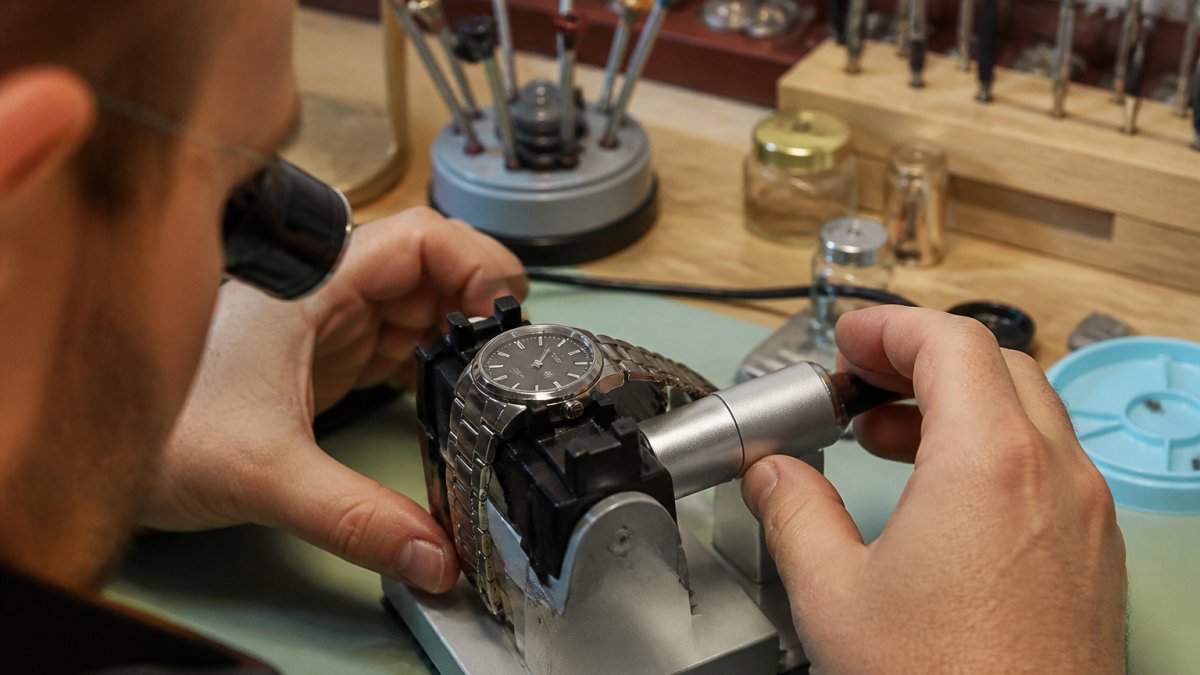
Run a repeatable accuracy check first
Before you decide anything, build a small dataset. This is the single most useful thing an owner can do, and most guides skip it.
- Pick a reference clock. Use a phone or computer synced to network time. Do not use another mechanical watch.
- Wind and set once. Wind the watch fully (30-40 turns by hand), set it to the second against your reference, and note the date and time.
- Wear it normally for 24 hours. Do not baby it, but do not subject it to shocks either.
- Record the deviation each morning at roughly the same time, to the nearest second. Note whether it is fast or slow.
- Repeat for 5-7 days. A single day tells you almost nothing; a week reveals the trend.
Read the trend, not the number
A single daily rate is not the diagnosis. The pattern is.
- Steady, small loss (for example, a consistent −8 to −12 seconds per day): this is the classic regulation signature. The movement is healthy but sitting slightly slow. A watchmaker can usually correct it with a regulator adjustment and a timing-machine check.
- Loss that grows week over week (for example, −5, then −15, then −30): this points to wear, a drying or thickening lubricant, a worn pivot, or a weakening mainspring. Regulation will not fix it, because the underlying friction is changing.
- Erratic day-to-day swings (fast one day, slow the next, tens of seconds apart): suspect a mechanical fault, a magnetized movement, or an impact. Magnetization in particular can cause large, sudden rate changes and is one of the few problems a watchmaker can often resolve quickly.
Test position sensitivity
A healthy movement keeps reasonably consistent time across positions. A worn one often does not.
- Leave the watch dial up overnight and record the deviation.
- The next night, leave it crown down (or dial down) and record again.
- Compare the two. A spread of many seconds between positions is a sign the movement's adjustment or condition has drifted, and it is exactly the kind of data a watchmaker wants before opening the case.
What regulation alone cannot fix
Regulation adjusts rate; it does not restore lubrication, replace worn parts, or correct a damaged hairspring. If your log shows a growing or erratic trend, or if the watch also shows a short power reserve or rough winding, regulation is a bandage. A full service is the correct call. Bring your written log to the watchmaker, a week of daily deviations and position notes turns a vague complaint into a diagnosis.
Why Your Automatic Watch Keeps Stopping
An automatic watch keeps stopping for three common reasons: insufficient winding from low activity, a power reserve problem, or a movement fault. Rule out the first one before you assume the worst.
The self-winding mechanism relies on your wrist movement. If you work at a desk and take the watch off at night, it may simply not be winding enough.
Watch out: if the watch stops and the rotor spins freely with no resistance when you shake it gently, stop shaking.
Diagnosing an Automatic Watch Power Reserve Problem
A power reserve problem shows up as a watch that runs fine on the wrist but dies within hours of coming off. The stated reserve is your benchmark.
Test it properly:
- Wind the watch fully by hand, about 30 to 40 turns
- Set it down, dial up, in a quiet spot
- Check it every few hours and log when it stops
If it falls well short, the likely culprits are a weak mainspring, a slipping ratchet, or thick oil in the barrel. Owners of our Legacy Automatic can check its movement specs against the symptoms before booking anything.
Winding Feel, Rotor Behavior, and Movement Noise
Winding feel and rotor noise tell you more about movement health than most owners realize.
Listen for these:
- Grinding or gritty resistance while winding by hand
- A helicoptering rotor that spins wildly with a buzzing sound
- A rattle when you tilt the watch
Grinding usually means worn wheel pivots or contaminated jewels. A helicoptering rotor points to a dry bearing. Both are service needs, not quirks.
A common mistake is assuming a noisy rotor is normal because the watch is "cheap." It isn't. Noise means friction, and friction means the lubrication has broken down.
Water Resistance, Moisture, and Urgent Warning Signs
Water resistance is not permanent. The gaskets that seal the case age and compress, so a watch rated for 100 meters may leak after a few years of use.
Act immediately if you see:
- Fog or droplets under the crystal
- A musty smell when you open the caseback
- Condensation that appears after a temperature change
Do not wind, shake, or run the watch. The NIOSH guidance on moisture and metal corrosion is written for industrial settings, but the principle holds: trapped moisture plus steel equals rust, and rust in a movement is not reversible.
Book a Service Inspection with Haim Watch Company
A service inspection is the cheapest step you can take, and it settles the question your home checks can't answer. But it helps to know what you are actually paying for and what happens after you hand the watch over. Here is the transparent version most guides leave out.
What a watchmaker does during an inspection
An inspection is a diagnostic, not an overhaul. Expect the watchmaker to:
- Open the caseback and examine the movement under a loupe for debris, corrosion, and oil condition
- Mount the watch on a timing machine to measure rate, amplitude, and beat error in multiple positions
- Check the crown, pushers, and gaskets for wear
The output is a recommendation: regulation only, a partial repair, or a full service. Ask for the timing-machine numbers in writing so you can compare them later.
What a complete service involves
A full service is a defined sequence, and knowing it helps you judge a quote:
- Disassembly. The movement is removed from the case, and the case and bracelet are set aside.
- Cleaning. Components are cleaned in a watch-cleaning machine to remove old oil, dirt, and metal debris.
- Inspection and replacement. The watchmaker inspects pivots, jewels, the mainspring, and the balance, and replaces worn parts, often gaskets and the mainspring as a matter of course.
- Reassembly and lubrication. The movement is reassembled and lubricated at specific points with specific oils; this step is where much of the skill lives.
- Regulation and testing. The watch is regulated on a timing machine and run for a period to confirm rate and power reserve.
- Case reseal and pressure test. Fresh gaskets are fitted and the case is pressure-tested to confirm water resistance.
Turnaround and what to ask before you commit
Turnaround varies with the watchmaker's backlog and parts availability, so ask up front rather than assuming. Before you commit, confirm:
- Whether the quote includes parts, or only labor
- Whether gaskets and the mainspring are replaced as standard
- Whether the watch is pressure-tested after resealing
A written quote that itemizes these points is a sign of a careful shop. A verbal estimate that covers none of them is a reason to keep looking.
Bring your notes
Your daily rate log and power-reserve test give the watchmaker a head start and help distinguish regulation from wear before the case is even opened. Read why Haim to see how we approach craftsmanship and after-sales care.
Your automatic watch is a small machine that deserves maintenance the way a good car does. Learn its signals, log its behavior, and act early on moisture.
Frequently Asked Questions
What are the most common signs an automatic watch needs servicing?
The clearest signs are accuracy drift outside a minute or two a day, a power reserve that no longer reaches its rated hours, a watch that stops overnight despite regular wear, rough or gritty winding, a rotor that spins noisily, and fogging under the crystal. Any one of these is worth a watchmaker's inspection. Two or more together usually point to dried lubricant or worn components rather than a simple regulation issue, and delaying service raises the eventual repair cost.
How often should I service my automatic watch if it still keeps good time?
Most watchmakers recommend a service interval of roughly five years, though modern synthetic oils and low-wear designs can stretch that to seven or more. Use is the deciding factor: a watch worn daily in heat, humidity, or dust ages faster than one worn on weekends. If you have no service history for a pre-owned watch, budget for an inspection rather than waiting for symptoms, because damage inside the movement is often invisible until accuracy collapses.
Why is my automatic watch running slow even after I wear it all day?
An automatic watch running slow usually means the mainspring is not fully wound, the movement needs regulation, or friction has increased as oil dries. Start with a practical check: wind it manually 30 to 40 turns, set it against a reference clock, and measure the gain or loss over 24 hours. If it is consistently more than 10 to 15 seconds slow per day, a watchmaker can regulate it. If the rate is erratic day to day, the movement likely needs servicing.
Can I fix an automatic watch power reserve problem myself?
You can test it, but not repair it. Fully wind the watch, leave it dial-up and unused, and note when it stops; compare that to the rated power reserve. If it falls well short, the cause is usually a worn mainspring, a slipping rotor, or thickened lubricant in the wheel train, all of which need a watchmaker. Avoid repeated manual winding to compensate, because a worn winding system can worsen with force. A proper overhaul restores both reserve and timekeeping accuracy.
If your watch has started drifting, stopping, or sounding different, don't wait for the problem to get worse. Get started with Haim Watch Company and book a service inspection, backed by our custom-designed calibers, hand-finished titanium cases, and 100% US-assembled Legacy Automatic.
