

Last Updated: October 23, 2026
Quick Summary
Servicing microbrand watch movements means disassembling, cleaning, lubricating, and reassembling the caliber so it keeps accurate time, and the brand on the dial rarely does the work itself. Identify the caliber number first, then check your warranty terms before choosing a service route.
- Most automatic watch service intervals land between four and seven years, but wearing habits matter more than any fixed number.
- The caliber number stamped on the movement bridge, not the brand name, determines who can service the watch.
- Most microbrand warranties cover manufacturing defects for one to two years and often exclude normal wear.
- Paying an independent watchmaker first can void warranty coverage you did not know you had.
- Insist on a pressure test after every service that opens the case and get the result in writing.
Table of Contents
- Servicing Microbrand Watch Movements: What Owners Need to Know
- What a Full Service Actually Covers
- The Automatic Watch Service Interval and How to Set Yours
- Microbrand Watch Repair: Warranty Pathways and Movement Serviceability
- Your Watch Movement Service Checklist
- The Watch Water Resistance Test After Service
- Costs, Turnaround Times, and How to Vet a Watchmaker
- Conclusion
- Frequently Asked Questions
Servicing Microbrand Watch Movements: What Owners Need to Know
Servicing microbrand watch movements is the process of disassembling, cleaning, lubricating, and reassembling a watch's mechanical caliber so it keeps accurate time.
Here is the part most owners miss: the brand on the dial rarely services the movement itself. A local watchmaker usually does the work.
Below, we walk through what a full service covers, when to book one, and how to vet a watchmaker.
What a Full Service Actually Covers
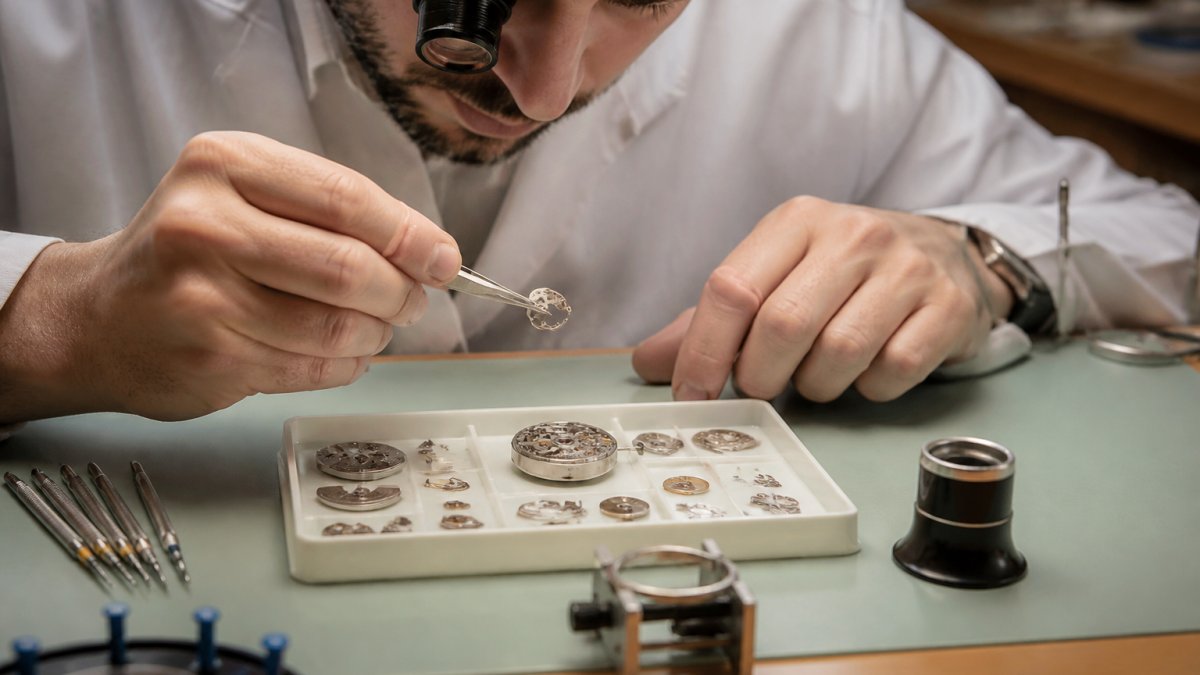
A full service is a complete teardown and rebuild of the movement, not a quick adjustment. The watchmaker opens the case, removes the movement, and takes it apart piece by piece.
Knowing whether your caliber is Swiss or Japanese helps you anticipate parts availability and service complexity, which is why our guide to Swiss vs Japanese watch movements is worth reading first.
Disassembly, Cleaning, and Lubrication
The movement comes apart into its smallest parts. Each piece is cleaned in a dedicated solution, then checked under magnification for wear.
A watchmaker applies tiny amounts of specific oils to specific points. This is slow, precise work. It is also where a rushed service shows up later as poor timekeeping.
The Automatic Watch Service Interval and How to Set Yours
Most automatic watch service intervals land somewhere between four and seven years, but your wearing habits matter more than any fixed number. A watch worn daily and exposed to sweat, dust, and temperature swings will need attention sooner than one worn occasionally.
Set your own interval using these signals:
- The watch runs fast or slow beyond a minute a day
- You notice a gritty or stiff winding feel
- The power reserve has dropped noticeably
If you want to check accuracy at home before booking, our guide on how to test mechanical watch accuracy walks you through it.
Microbrand Watch Repair: Warranty Pathways and Movement Serviceability
Microbrand watch repair starts with one question: who is responsible for the movement? The answer depends on three things you can determine before you pay anyone, the caliber inside the case, the warranty language that covers it, and whether parts are available outside the brand.
Step 1: Identify the movement before you call anyone
Open the caseback (or ask the brand) and record the caliber number stamped on the movement bridge, for example, a Sellita SW200-1, an ETA 2824-2, a Miyota 9015, a Seiko NH35, or a Soprod P024.
A common pattern among microbrands is to publish the caliber on the product page or spec sheet. If it is not listed, email the brand and ask for the caliber number and the movement manufacturer.
Step 2: Read the warranty terms for the service pathway
Most microbrand warranties cover manufacturing defects for a defined period, commonly one to two years from purchase, and many explicitly exclude normal wear, accidental damage, and water damage. The clause that matters for servicing is the one describing how claims are handled: whether the brand repairs in-house, directs you to an authorized service partner, or asks you to ship the watch back to the brand for assessment.
Look for three specific terms:
- Covered defects vs. excluded wear. A movement that stops within the warranty period may be covered; a movement that simply runs slow after three years of daily wear usually is not.
- Authorized service requirement. Some warranties require service by the brand or an approved partner to keep coverage intact. Paying an independent watchmaker first can void coverage you did not know you had.
- Shipping and insurance responsibility. Confirm who pays for insured shipping both ways and whether the brand requires a specific carrier or declared value.
Step 3: Choose the right service route for your caliber
Once you know the caliber and the warranty terms, the decision usually falls into one of three routes:
- Brand service route. Best when the watch is under warranty, when the caliber is custom or proprietary, or when the brand stocks parts. Trade-off: longer turnaround, often higher cost, and limited choice of watchmaker.
- Movement manufacturer route. For widely used third-party calibers, the movement maker's own service network or authorized parts distributors can supply components. This is often the fastest path for a Sellita, ETA, Miyota, or Seiko caliber that needs a replacement part.
- Independent watchmaker route. Best for out-of-warranty watches with commonly serviced calibers. Trade-off: you must verify caliber experience and parts sourcing yourself, and you lose any remaining brand warranty coverage.
Serviceability by caliber type
Serviceability is not a single yes-or-no question. It depends on parts availability, documentation, and how familiar watchmakers are with the movement.
- Widely used third-party calibers (for example, ETA 2824-2, Sellita SW200-1, Miyota 9015, Seiko NH35) tend to be the easiest to service. Parts are broadly available through watchmaking supply channels, technical documentation is common, and most independent watchmakers have worked on them.
- Less common or discontinued third-party calibers can still be serviceable, but parts may need to be sourced from a single distributor or salvaged from donor movements. Ask the watchmaker to confirm parts availability before you commit.
- Custom or in-house calibers often require parts from the brand itself. That can mean a longer turnaround and a service route that runs through the brand rather than an independent watchmaker.
If the movement is outsourced rather than in-house, that often means easier access to parts and more service options, as we explain in our breakdown of in-house vs outsourced watch movements. Owners of non-Swiss calibers should confirm parts access early; our article on alternatives to standard Swiss movements covers where service support tends to be strongest.
Once you know the caliber and the warranty terms, the decision usually falls into one of three service routes.
| Route | Best for | Trade-off |
|---|---|---|
| Brand service route | Watches under warranty, custom or proprietary calibers, brand-stocked parts | Longer turnaround, often higher cost, limited choice of watchmaker |
| Movement manufacturer route | Widely used third-party calibers needing a replacement part | Often the fastest path for Sellita, ETA, Miyota, or Seiko |
| Independent watchmaker route | Out-of-warranty watches with commonly serviced calibers | You verify caliber experience and parts sourcing; lose remaining brand warranty |
Your Watch Movement Service Checklist
Use this watch movement service checklist before you hand over your watch. It keeps the process clear and protects you from surprise charges.
- Confirm the warranty status and who honors it
- Ask whether the watchmaker has serviced your caliber before
- Request a written estimate before any work begins
The Watch Water Resistance Test After Service
A watch water resistance test after service confirms the case still seals properly. Every service that opens the case should end with one. New gaskets and a fresh caseback seal only work if they are tested, and a watch that passes a static seal check can still fail in real use if the test was done incorrectly or skipped.
Why new seals are not the same as water resistance
Replacing gaskets, the crown seal, and the caseback O-ring restores the parts that keep water out, but it does not prove the assembled case is watertight. Sealing depends on how those parts seat, the condition of the case threads, the crystal seal, and the pusher seals on chronographs. A watchmaker can install new seals and still leave a leak path at the caseback, crown, or crystal.
How pressure testing actually works
Watchmakers use two common methods, and the choice affects what the test can tell you:
- Dry pressure testing (air pressure). The watch is placed in a chamber, air pressure is applied, and the watchmaker measures whether the case deforms and recovers as expected. This method detects gross leaks without putting the watch in water and is common for watches that should not be exposed to moisture during testing.
- Wet pressure testing (water pressure). The watch is submerged in a pressure vessel and tested at a specified pressure, then inspected for moisture ingress. This is the more direct check for water resistance and is typically used for dive watches and other watches rated for water exposure.
Some watchmakers use a two-step approach: a dry test first to screen for leaks, then a wet test to confirm. Ask which method was used, because a dry-only test is weaker evidence for a watch you plan to swim with.
What the test result should tell you
A proper test reports the pressure the watch was tested to and whether it passed. The test pressure should match or exceed the rating on the caseback, a watch rated to 100 meters is typically tested to a pressure equivalent to that rating, and a dive watch rated to 300 meters is tested to a higher standard than a dress watch rated to 30 meters.
A watch that fails should be resealed and retested before it goes back on your wrist. Do not accept a verbal "it's fine" without a recorded result.
Precautions before wearing the watch in water
Even after a passing test, treat the first few weeks with care:
- Do not operate the crown or pushers underwater, even on a watch rated for swimming.
- Avoid hot showers, saunas, and hot tubs, heat can stress seals that passed a cold-water test.
- Have the watch retested if it is dropped, opened again, or exposed to salt water and not rinsed.
Costs, Turnaround Times, and How to Vet a Watchmaker
Service costs vary widely by caliber, parts availability, and the watchmaker's workload, so ask for a written estimate rather than a phone quote. Turnaround often runs several weeks, and longer if parts must be ordered from overseas.
Vet a watchmaker with these questions:
- Do you service this specific caliber regularly?
- Can you source replacement parts, and how long does that take?
- Is the pressure test done in-house?
Judging overall build quality helps you spot which watches are worth servicing and which are not, and our guide on how to evaluate microbrand watch quality covers exactly that.
Conclusion
The hardest part of servicing a microbrand watch is not the service itself. It is knowing who should do the work and what a fair job includes.
At Haim Watch Company, we build our timepieces around custom-designed calibers and hand-finished titanium cases, and we want every owner to understand what keeps them running. Explore our Swiss-made Viajero SE and our US-assembled Legacy Automatic to see the craftsmanship for yourself.
Frequently Asked Questions
How often should a microbrand watch movement be serviced?
Most mechanical movements benefit from a service every five to seven years of regular wear, though the automatic watch service interval depends on how the watch is used. If timekeeping drifts, the power reserve shortens, or the watch starts to feel stiff when winding, book an inspection sooner. A watch that sits unworn for long stretches may go longer between services, but seals still dry out, so have water resistance checked periodically.
Can any watchmaker service a microbrand watch?
Not every watchmaker will take on a microbrand watch repair. Some movements are easy to source parts for, while others use proprietary calibers where the brand controls the supply. Before handing over your watch, ask whether the watchmaker has worked on that specific caliber and can get replacement parts. A good watchmaker will tell you honestly if a movement is better replaced than serviced.
Does servicing a watch movement affect its water resistance?
Yes. Opening the case disturbs the gaskets and seals, so a watch water resistance test after service is essential. Ask for a pressure test before the watch is returned, and confirm the seals were replaced, not just inspected. A watch rated for daily wear should be tested to its stated rating, and you should request the result in writing so there is no ambiguity if moisture appears later.
Should I contact the microbrand before taking my watch in for repair?
Contact the brand first if the watch is still under warranty, since going to an independent watchmaker may void coverage. Even out of warranty, the brand can tell you which calibers are serviceable, whether parts are available, and which watchmakers they trust. That conversation often saves money and avoids a repair estimate you did not expect.
