

Table of Contents
- Classic Watch Design vs Modern Trends: What Actually Changed
- Defining Classic, Vintage, and Modern: A Clear Comparison
- Classic Watches vs Modern Watches: Case Size, Proportions, and Fit
- Timeless Watch Styles and the Dial Details That Age Well
- Movements, Materials, and Durability: Heritage vs Watch Technology
- How to Choose a Watch Style by Wearer and Use Case
- Long-Term Ownership: Service Intervals, Costs, and Resale Value
- Building a Three-Watch Collection That Balances Both Worlds
- Frequently Asked Questions
Last Updated: October 17, 2026
Classic Watch Design vs Modern Trends: What Actually Changed
Walk into any watch conversation in 2026 and someone will tell you modern trends have ruined the classic watch. That is only half true. What changed is not the rules of good design but the freedom watchmakers now have to break them. This guide from Haim Watch Company lays out the real differences, the trade-offs, and a framework for deciding which side you sit on.
The short answer: classic watch design is a set of proportion and legibility rules that have held for generations. Modern trends are engineering and styling choices layered on top of those rules, sometimes well, sometimes not. Knowing which is which saves you from a trend you will tire of or a classic that never fits your wrist.
Defining Classic, Vintage, and Modern: A Clear Comparison
The terms get used interchangeably, and that is the first mistake. Classic, vintage, and modern describe three different things: a design standard, an age, and an engineering era.
| Term | What It Describes | Key Marker | Example |
|---|---|---|---|
| Classic | A design standard | Balanced proportions, legible dial | Simple dial with applied markers |
| Vintage | An age bracket | Typically pre-1980s production | Aged lume, patina, small case |
| Modern | Engineering and styling era | New materials, larger cases, smart features | Ceramic bezel, 42mm+ case |
Classic Design Is a Set of Rules, Not an Age
Classic design is a standard, not a birth year. A watch made last month can be classic if it respects proportion, legibility, and restraint: a dial you can read at a glance, a case that fits the wrist, and details that do not compete for attention.
That is why a sector dial with thin hands and a clean layout still looks right decades later. It ignores watch trends rather than chasing them.
Vintage Means Age; Modern Means Engineering
Vintage is a factual label: the watch was made decades ago, with real trade-offs like acrylic crystals that scratch, movements that need servicing, and parts that may be hard to source.
Modern is an engineering label: current movement technology, materials, and manufacturing tolerances. A modern watch can still have a classic look, and the two categories overlap more than most buyers assume.
Classic Watches vs Modern Watches: Case Size, Proportions, and Fit
Case size is where classic and modern watches diverge most visibly. Classic proportions cluster in the 36mm to 39mm range, with slim profiles and short lugs that sit close to the wrist. Modern trends pushed cases past 42mm for years, and many modern designs still carry more bulk.
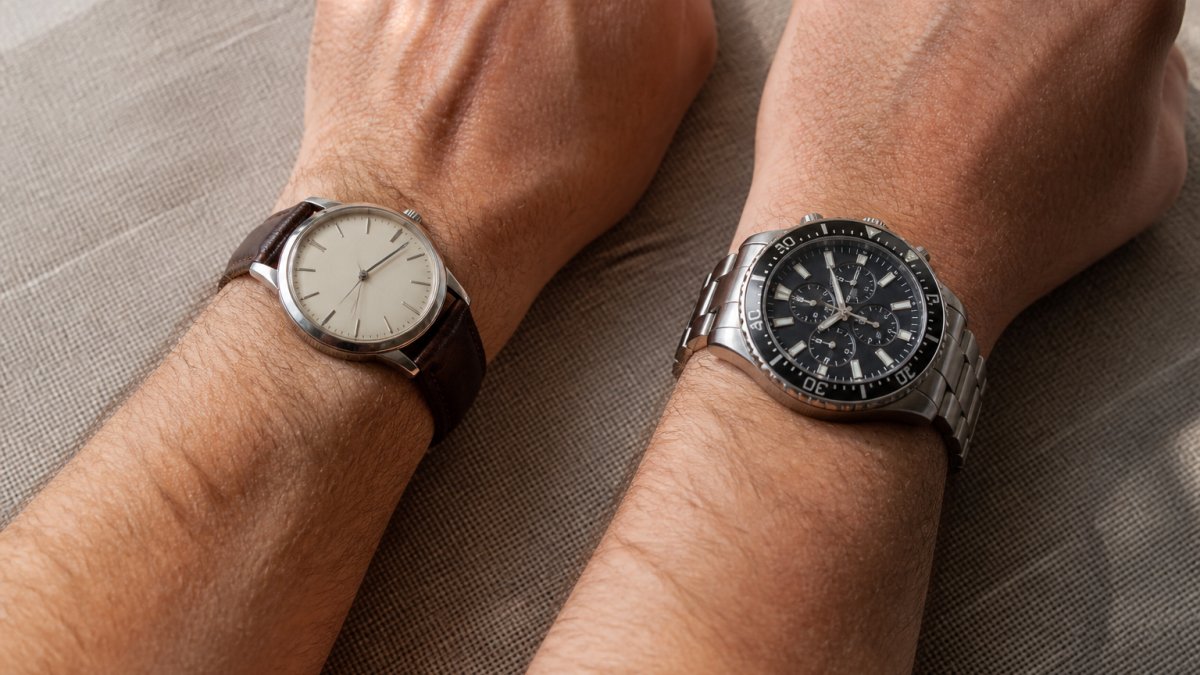
Case thickness matters as much as diameter: a slim profile slides under a cuff, while a thick case catches on fabric and feels heavy by evening. Lug-to-lug length decides whether a watch overhangs your wrist, and it is the number most buyers never check.
Fit Guidance Across Wrist Sizes
Measure your wrist circumference first, then match it to case size. These are starting points, not laws.
- Under 6 inches: 34mm to 37mm case, lug-to-lug under 44mm
- 6 to 6.5 inches: 36mm to 39mm case, lug-to-lug 44mm to 47mm
- 6.5 to 7.25 inches: 38mm to 41mm case, lug-to-lug 46mm to 49mm
- Over 7.25 inches: 40mm to 43mm case, lug-to-lug 48mm to 52mm
A cushion case or a watch with curved lugs wears smaller than its diameter suggests. Always check the lug-to-lug figure before you commit.
Timeless Watch Styles and the Dial Details That Age Well
Timeless watch styles share one trait: the dial does the work. A simple dial with applied hour markers, restrained hands, and clear contrast reads well at any age. The details that survive are the ones that serve legibility.
Here is what tends to age well:
- Simple dial layouts with no more than three hands and one date
- Sector dials that divide the face into clean zones
- Applied markers that catch light without shouting
- Earthy colors and muted tones over bright trend shades
- Balanced negative space rather than crowded subdials
A skeleton or ornate, hand-finished dial can be stunning and is where craftsmanship shows, but the risk is busyness. If you cannot read the time at a glance, the design will feel dated before the movement does.
Movements, Materials, and Durability: Heritage vs Watch Technology
Movement choice is the clearest split between heritage and watch technology. Mechanical movements fall into two families: hand-wound, where you turn the crown daily, and automatic, where a rotor wound by wrist motion keeps the mainspring tensioned. Both rely on a balance wheel and hairspring oscillating at 21,600 to 28,800 vibrations per hour (3 to 4 Hz). Higher frequencies improve rate stability but shorten the power reserve; a typical modern automatic runs 38 to 80 hours, while many vintage calibers managed 36 to 42.
Quartz movements replace the balance wheel with a crystal oscillating at 32,768 Hz, so they drift seconds per month rather than per day. The trade-off is craftsmanship: a quartz caliber is largely a circuit board and stepper motor, with little to hand-finish. That is not a knock on reliability, modern quartz is dependable, and solar-assisted quartz can run for months on ambient light.
Materials follow the same pattern, with practical differences you can feel:
- Stainless steel (316L or 904L): the workhorse. 316L is the common standard; 904L resists corrosion better and takes a higher polish but costs more and is harder to machine.
- Titanium (Grade 2 or Grade 5): roughly 40 to 45 percent lighter than steel, hypoallergenic, and corrosion-resistant. Grade 5 (Ti-6Al-4V) is stronger and is the grade most often used for cases and bracelets.
- Ceramic: scratch-resistant and colorfast, common on bezels. It is brittle, so a hard knock can chip rather than dent.
- Sapphire crystal: Mohs hardness of 9, second only to diamond, which is why it resists scratching far better than mineral glass (about Mohs 5) or acrylic (about Mohs 3).
- Recycled and sustainable steels: increasingly marketed, but for most buyers the practical difference is finish and weight, not measurable environmental performance.
Durability comes down to construction, not price. A screw-down caseback and crown, a sapphire crystal, and at least 100 meters (10 ATM) of water resistance do more for reliability than any movement badge. Shock resistance depends on the movement's anti-shock system, Incabloc and similar spring-loaded jewel settings protect the balance staff, and on case construction. Magnetic resistance is the other lever: a soft-iron inner cage or silicon hairspring keeps a watch accurate near phones and laptops, where an unprotected vintage caliber may lose minutes per day.
Watch technology has improved tolerances and shock resistance across the board, benefiting classic and modern designs alike. Judge a watch on its crystal, seals, water resistance, and anti-shock and anti-magnetic protection, not on whether the movement is mechanical or quartz.
How to Choose a Watch Style by Wearer and Use Case
How to choose a watch style comes down to three questions: what you wear daily, how often you will service it, and whether you want a conversation piece or a quiet tool. Answer those and the classic-versus-modern decision mostly makes itself.
- Office and daily wear: A slim classic in the 36mm to 39mm range with a simple dial. It disappears under a cuff and works with everything.
- Casual and weekend: A modern field or sport design with stronger water resistance and a more rugged case.
- Formal occasions: A thin dress watch with a leather strap and minimal complications.
- Travel: A worldtimer or GMT complication earns its place, and a modern movement keeps it accurate across time zones.
- Collecting: A limited edition or a piece with a distinctive dial rewards long-term interest.
For a watch that bridges both worlds, the Viajero pairs a 38.5mm hand-finished stainless steel case with a 3D-relief worldtimer dial, and the Annum brings a neo-vintage aesthetic with a complete calendar and moonphase in a 38mm case. Both respect classic proportions while using modern engineering.
Long-Term Ownership: Service Intervals, Costs, and Resale Value
Long-term ownership is where the classic-versus-modern choice gets expensive or cheap. The useful version is specific: what gets serviced, how often, what it costs, and whether the watch can be repaired in ten or twenty years.
A full mechanical service is not just an oil change: disassembly, cleaning, re-lubrication, new gaskets and possibly a mainspring, re-regulation, and pressure testing. Most practitioners recommend a full service every five to seven years for a daily-worn automatic, sooner if it gains or loses time or the power reserve shortens. Hand-wound movements often stretch toward seven years with no rotor bearing to wear. Quartz needs far less: a battery change every two to three years with a gasket check, and a full service only when it drifts or stops.
Cost scales with the caliber, not the brand name. A standard Swiss or Japanese automatic costs less to service than an in-house or custom caliber, because parts are catalogued and independent watchmakers can source them. A bespoke movement may require a return to the maker, adding shipping, wait time, and labor. Budget from day one: setting aside a modest amount each year turns a five-year service into a planned expense.
Parts availability is the hidden variable, and it is where classic and modern diverge most:
- Modern watches generally have catalogued parts and factory service networks for at least a decade, and often longer for core models.
- Vintage watches can be harder to repair. Obsolete gaskets, discontinued crystals, and out-of-production movements mean a watchmaker may need to fabricate or source donor parts, which raises cost and turnaround.
- Repairability favors designs with standard components: a sapphire crystal and a common movement are easier to service than a proprietary module or an integrated bracelet with unique end links.
Resale value favors recognizable classics and limited editions. A design with heritage and a documented production run tends to hold value better than a trend piece, and full sets, box, papers, service records, command more than a loose watch. Collectibility is never guaranteed, so buy what you will wear, not what you hope to flip. The most durable strategy is a watch you can service locally, with parts that will still exist when service is due.
Building a Three-Watch Collection That Balances Both Worlds
A three-watch collection should cover three jobs: daily wear, casual, and formal.
- The daily classic: a slim, simple-dial watch in the 36mm to 39mm range. This is the piece you wear most.
- The modern casual: a sport or field design with stronger water resistance and a more relaxed case.
- The statement or formal piece: a dress watch or a complication that marks an occasion.
For the third slot, a limited edition adds a sense of occasion. The L2 Chronograph (Anniversary Edition) is capped at 30 pieces per dial with individually numbered casebacks, and the standard L2 Chronograph offers the same eye-catching design at $489.00. For a Swiss-made centerpiece, the Viajero SE pairs Grand Feu enamel dials with hand-drawn 17th-century maps in a 39.5mm case.


The balance matters more than the brand names. One classic, one modern, one special piece covers nearly every occasion without overlap.
Choosing between classic watch design and modern trends is not a binary decision, and the buyers who struggle most treat it as one. Start with your wrist size, your daily wardrobe, and your tolerance for servicing, then let design follow. Haim Watch Company builds timepieces at that intersection, with hand-finished cases, custom-designed calibers, and ornate dial decoration that honors heritage while using modern engineering. Explore the collection and find the watch that fits the life you actually live.
Frequently Asked Questions
What is the difference between a classic watch and a modern watch?
A classic watch follows established design rules: restrained case sizes around 36mm to 39mm, balanced dial proportions, and details that have survived decades of watch trends. A modern watch prioritizes current preferences and technology, which can mean larger cases, bold colors, smart features, or quartz and hybrid movements. The useful distinction is design intent, not age. A newly made watch can be classic in style, and a 1970s piece can look dated rather than classic.
Are classic watches still in style in 2026?
Yes. Smaller case sizes and simple dials have led watch trends for several years, and brands continue to release neo-vintage models with sector dials and warm, earthy colors. Classic watch design stays in style because it is not tied to a single season. That said, style is personal: a 38mm dress watch suits a formal wardrobe, while a chronograph with more visual detail fits casual wear. Buy for how often you will wear it, not for a trend cycle.
How do I choose a watch style that fits my wrist?
Measure your wrist circumference and match it to case diameter. Wrists under 6.5 inches usually suit 34mm to 38mm cases; 6.5 to 7.25 inches handle 38mm to 40mm comfortably; larger wrists can carry 40mm and up. Also check lug-to-lug length and case thickness, since a long lug span overhangs narrow wrists. A slim profile under 11mm wears easily under a shirt cuff. Try the watch on a strap you already own before committing.
Can a modern watch have a classic design?
Yes, and this hybrid approach is one of the strongest options available now. A watch can use a classic dial layout, a restrained 38mm case, and vintage-inspired lugs while running a modern movement with better accuracy and easier servicing. Haim Watch Company's Annum is an example: a neo-vintage dial with CNC guilloché finishing paired with a custom mechanical calendar module. You get heritage looks with current engineering and parts support.
What is the three-watch collection rule?
The three-watch collection is a practical framework: one everyday watch, one dress or formal watch, and one sports or utility watch. The goal is coverage without redundancy, so each piece earns wrist time. A common build pairs a simple dial automatic for daily wear, a slim dress watch for occasions, and a chronograph or worldtimer for travel and weekends. Keep the case sizes varied so the collection feels intentional rather than repetitive.