

Table of Contents
- What Defines a Custom Engineered Caliber vs ETA Movement
- Accuracy and Performance: How They Compare
- Watch Movement Maintenance Costs and Serviceability
- In-House Movement vs Third-Party: Engineering and Exclusivity
- Long-Term Cost of Ownership and Resale Value
- Why Brands Choose Custom Calibers Over Standard Movements
- Making Your Choice: Custom or ETA
Last Updated: August 16, 2026
What Defines a Custom Engineered Caliber vs ETA Movement
A custom engineered caliber is a mechanical movement designed and manufactured specifically for a single brand, built to proprietary specifications that differentiate it from mass-produced alternatives. An ETA movement, by contrast, is a standardized mechanical caliber produced by ETA SA (part of the Swatch Group) and sold to multiple watchmakers, making it a third-party solution that countless brands rely on.
When a brand commissions a custom engineered caliber, they're investing in proprietary escapement geometry, unique balance wheel frequencies, hand-finished components, and movement architecture that competitors cannot replicate. ETA movements, while reliable, follow established blueprints refined over decades. They're modular, interchangeable, and cost-effective, but identical across dozens of brands.
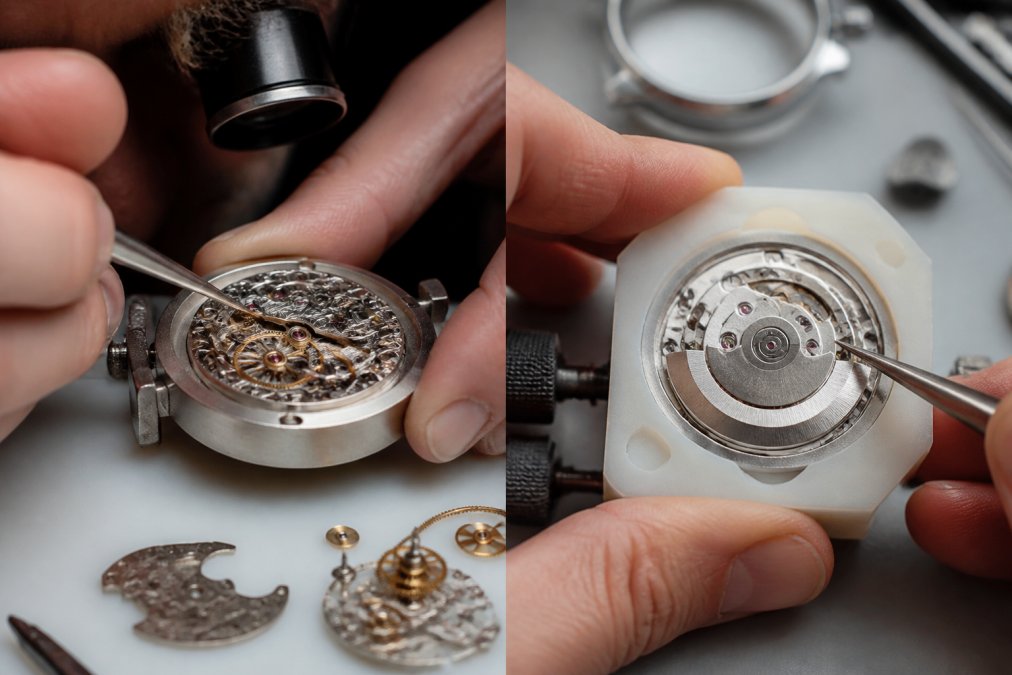
Haim Watch Company exemplifies this distinction with their Legacy Automatic, which features Caliber HWC-1, a fully custom-engineered movement assembled in the United States. This isn't a modified ETA base; it's a ground-up design reflecting the brand's horological philosophy, with hand-applied finishing techniques like perlage and côtes de genève.

Custom calibers allow brands to specify vibration frequency (measured in vibrations per hour, or vph), balance wheel design, hairspring geometry, and escapement characteristics. Third-party movements come with fixed specifications. A brand using an ETA movement accepts its 28,800 vph frequency, standard finishing, and modular architecture.
Accuracy and Performance: How They Compare
Custom engineered calibers and ETA movements both achieve chronometer-grade accuracy when properly regulated and maintained, but they arrive there through different engineering philosophies.
ETA movements are engineered for consistency across thousands of units. Their tolerance stack-ups, balance wheel oscillation characteristics, and escapement geometry are optimized for manufacturability and predictable performance. A well-regulated ETA movement will keep time within 10-15 seconds per day, meeting COSC chronometer standards.
Custom engineered calibers can achieve identical or superior accuracy, but only if engineering and manufacturing tolerances justify the investment. A bespoke caliber can optimize for tighter tolerances, lower friction in the escapement, and superior balance wheel symmetry. However, a poorly engineered custom movement can underperform an ETA.
Haim Watch Company's custom calibers undergo rigorous regulation and testing before shipping. The Annum, featuring Caliber HWC-2 with a complete calendar complication and moonphase module, demonstrates that custom engineering allows for complications that third-party movements cannot accommodate. An ETA movement cannot integrate a custom mechanical calendar module.

The practical performance difference in daily wear is often imperceptible. Both custom and third-party movements, when properly maintained, will keep time within acceptable tolerances. The real distinction emerges in edge cases: extreme temperature swings, sustained high G-force environments, or specific use cases where the movement's design philosophy directly impacts performance.
Watch Movement Maintenance Costs and Serviceability
Watch movement maintenance costs and long-term serviceability differ dramatically between custom and third-party movements, and these differences compound over a watch's lifetime.
ETA movements have a massive advantage in parts availability and service infrastructure. Any competent watchmaker worldwide can service an ETA movement because the parts ecosystem is mature, documented, and standardized. A service typically costs $150-400 depending on the movement's complexity and location. Replacement parts are inexpensive because they're mass-produced.
Custom engineered movements require parts sourced from the original manufacturer or authorized service centers. If a hairspring breaks or a jewel cracks, the watch owner cannot walk into a local watchmaker and get it fixed. They must contact the brand, which either repairs it in-house or coordinates with an authorized service center. This introduces delays, higher costs (often $300-600 for routine service), and potential parts scarcity if the brand discontinues a model.
The serviceability question becomes acute after 10-15 years of ownership. By then, an ETA movement has established service networks, documented repair procedures, and cheap replacement parts. A custom movement may face challenges: the brand might no longer exist, the service center might have closed, or the movement might have been superseded by newer designs with incompatible parts.
Haim Watch Company addresses this by committing to long-term support and parts availability for their custom movements.
| Movement Type | Service Cost | Parts Availability | Timeline | Long-Term Risk |
|---|---|---|---|---|
| ETA (Third-Party) | $150-400 | Widely available | 1-2 weeks | Low |
| Custom Engineered | $300-600 | Brand-dependent | 2-6 weeks | Medium to High |
| Custom with Brand Support | $300-600 | Guaranteed | 2-4 weeks | Low (if brand stable) |
If you buy a watch with a custom movement, you're making a commitment to that brand's long-term viability and support infrastructure. This isn't necessarily a dealbreaker; many collectors view this as part of the appeal. But it's a real consideration that ETA movements don't impose.
In-House Movement vs Third-Party: Engineering and Exclusivity
An in-house movement represents vertical integration: the brand designs, manufactures, and assembles the movement themselves or through a dedicated subsidiary. This allows complete control over every parameter, frequency, finishing, complications, and aesthetic choices. It's also extraordinarily expensive. Developing a chronometer-grade movement requires engineering talent, manufacturing infrastructure, regulatory certification, and years of refinement.
A third-party movement means the brand purchases a caliber from an external manufacturer (typically ETA) and integrates it into their case and dial. This approach is pragmatic: the brand focuses on case design and dial aesthetics while outsourcing the movement to a proven supplier.
Historically, owning an in-house movement was a marker of prestige and technical mastery. Rolex, Patek Philippe, and Omega all developed in-house movements as a symbol of their horological authority. But this association is outdated. A well-engineered ETA movement integrated into an exceptional case can outperform a mediocre custom movement.
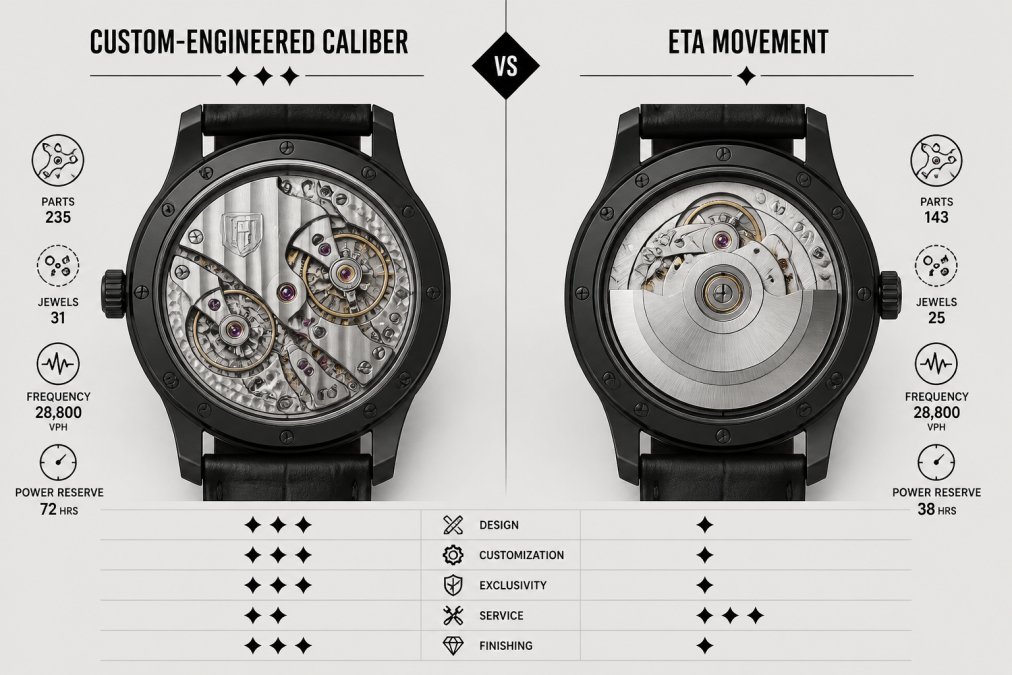
Haim Watch Company's positioning is instructive. Their Legacy Automatic features 100% US assembly and movement; the movement is custom-designed and assembled in the United States. The Annum takes this further with Caliber HWC-2, a custom movement featuring a complete calendar complication with moonphase. These choices reflect the brand's commitment to engineering differentiation.
The real advantage of in-house movements is technical flexibility. A brand cannot add a custom complication to an ETA base movement; the architecture doesn't accommodate it. Custom engineering allows for proprietary complications, unique aesthetic finishing, and movement characteristics optimized for specific use cases.
Long-Term Cost of Ownership and Resale Value
The true cost of watch ownership isn't the purchase price, it's the cumulative expense of maintenance, repairs, and eventual resale value. This is where custom engineered calibers and ETA movements diverge significantly.
An ETA movement watch typically costs less to maintain over its lifetime. Service intervals are predictable (every 5-10 years), parts are inexpensive, and the service network is global. A $500 ETA movement watch might cost $200-300 per service, totaling $600-900 in maintenance over 20 years. Resale value remains relatively stable because the movement is recognized and easy to service for the next owner.
A custom engineered movement introduces variable costs. If the brand supports it robustly, costs are manageable but often higher than ETA equivalents. If the brand discontinues support or fails, the watch becomes difficult to service, and resale value plummets.
The resale value question is critical for expensive purchases. A Haim Watch Company Legacy Automatic at $1,350 or Annum at $2,149.99 represents a significant investment. Resale value depends on brand reputation, movement serviceability, case materials (titanium holds value better than steel), and market demand.
Microbrands face an inherent disadvantage in resale markets because they lack the established collector base of heritage houses. However, Haim Watch Company has mitigated this risk through design excellence and collector engagement. Their watches have been featured in Worn & Wound, a respected publication in the watch enthusiast community. This third-party validation builds collector credibility and supports long-term resale value.
Why Brands Choose Custom Calibers Over Standard Movements
The decision to develop a custom engineered caliber is rarely financial. It's strategic.
Technical Differentiation. A custom caliber allows a brand to implement complications or movement characteristics impossible with third-party movements. Haim Watch Company's Annum demonstrates this: the custom Caliber HWC-2 integrates a complete calendar module with moonphase. An ETA movement cannot accommodate this.
Brand Identity. An in-house movement signals technical mastery, independence, and commitment to craft. This is particularly valuable for microbrands competing against established houses.
Exclusivity and Scarcity. A custom movement cannot be replicated by competitors or used by other brands. This creates genuine exclusivity.
Control Over Supply. Brands that develop in-house movements control their supply chain. They're not dependent on ETA's production capacity, pricing, or discontinuation decisions.
Aesthetic Finishing. Custom movements allow for proprietary finishing techniques, specific perlage patterns, unique jeweling layouts, and custom hand-engraving. These aesthetic choices become brand signatures.
Performance Optimization. A custom caliber can be optimized for specific use cases. A brand targeting diving watches can design a movement with superior shock resistance.
The downside is cost and complexity. Developing a chronometer-grade movement requires significant engineering investment, manufacturing infrastructure, and regulatory certification. Most brands cannot justify this expense.
Haim Watch Company's approach reflects this reality. The Legacy Automatic represents their third generation of designs, suggesting they reached a scale and vision where custom engineering became strategically justified. The Annum, with its more complex Caliber HWC-2, indicates continued investment in technical differentiation.
Making Your Choice: Custom or ETA
The decision between a custom engineered caliber and an ETA movement is not about which is objectively superior. It's about alignment between your priorities, budget, and expectations.
Choose a custom engineered caliber if: You value technical differentiation and exclusivity. You're willing to pay a premium for a movement optimized to specific characteristics. You want a deeper connection to the brand's engineering vision. You're comfortable with higher service costs and potential serviceability challenges. You trust the brand's long-term viability and support commitments. You appreciate complications or movement characteristics unavailable in third-party movements.
Choose an ETA movement if: You prioritize proven reliability and global serviceability. You want lower long-term maintenance costs. You prefer established brand heritage and collector recognition. You're budget-conscious and want maximum value per dollar. You're uncomfortable with brand-dependent service infrastructure. You want maximum resale flexibility.
For many collectors, the choice is practical rather than philosophical. An ETA movement watch from an established brand offers security and predictability. A custom movement watch from a respected microbrand like Haim Watch Company offers design excellence, technical engagement, and the satisfaction of supporting independent horological innovation.
Haim Watch Company's portfolio spans both philosophies. The L2 Chronograph at $489 uses a third-party VK64 movement, prioritizing value and proven performance. The Legacy Automatic at $1,350 and Annum at $2,149.99 feature custom-engineered movements, reflecting the brand's commitment to technical differentiation at higher price points.

The question isn't which movement is better. It's which movement aligns with your vision of what a watch should be.
The decision between custom engineered calibers and ETA movements reflects deeper choices about what you value in a timepiece. If you're drawn to technical mastery, exclusivity, and a brand's engineering vision, Haim Watch Company's custom-caliber offerings, particularly the Legacy Automatic and Annum, represent a compelling choice. Both watches combine bespoke movement engineering with ornate dial design and refined case finishing, delivering sophisticated style with reliable performance. Shop Now and discover how custom horological craftsmanship can become part of your personal journey.
Frequently Asked Questions
What's the real difference between a custom engineered caliber and a standard ETA movement?
A custom engineered caliber is designed and manufactured specifically for one brand, offering proprietary features, unique finishing, and optimized performance for that watch. An ETA movement is a mass-produced caliber sold to multiple brands. Custom calibers allow for exclusivity and brand differentiation, while ETA movements provide proven reliability at lower cost. The choice depends on whether you value uniqueness and proprietary innovation or affordability and proven standardization.
Are custom engineered movements more reliable than ETA movements?
Both can be reliable when properly engineered and maintained. ETA movements have decades of production history and widespread service availability. Custom engineered calibers offer the advantage of brand-specific optimization and often include hand-finishing that improves longevity. Reliability depends more on quality control and design execution than on whether the movement is custom or third-party. A well-designed custom caliber can match or exceed ETA reliability.
How much more expensive is watch movement maintenance costs for custom calibers versus ETA movements?
Custom caliber servicing typically costs 20-40% more than ETA movements because fewer independent watchmakers stock parts and fewer technicians are trained on proprietary designs. ETA movements benefit from widespread availability of replacement parts and competitive servicing rates across multiple repair centers. However, custom calibers often require less frequent servicing due to hand-finishing and optimized design. Over the lifetime of the watch, total maintenance costs depend on service intervals and part availability rather than caliber type alone.
Do custom engineered calibers hold their value better than watches with ETA movements?
Custom engineered movements can enhance resale value by signaling brand prestige and exclusivity, particularly for established brands with strong collector followings. However, value retention depends more on brand reputation, design appeal, and condition than movement type alone. Limited production runs and proprietary calibers appeal to collectors seeking uniqueness. ETA-equipped watches may have broader appeal to practical buyers. Ultimately, a well-designed custom caliber from a respected brand typically commands a premium over mass-market ETA alternatives.
This article was written using GrandRanker