

Table of Contents
- What Makes Hand Finished Titanium Watches Special
- Why Titanium Watches Are Better for Collectors
- Titanium vs Stainless Steel Watch Durability
- Hand-Finishing Techniques and Craftsmanship
- Titanium Watch Maintenance Tips for Long-Term Care
- Choosing Your Hand Finished Titanium Watch
- Conclusion
Last Updated: August 17, 2026
What Makes Hand Finished Titanium Watches Special
Hand finished titanium watches represent a distinct category within horology, where case finishing is applied by skilled craftspeople rather than mass production techniques. This transforms a titanium case from a functional container into a canvas for artisanal expression. The difference lies in how light plays across the surface, how the watch feels against your skin, and the narrative of human craftsmanship embedded in every detail.
What separates hand finished titanium watches from polished or standard-brushed counterparts is intentionality. A bead-blasted finish applied by hand creates subtle variations in depth and texture that catch light differently depending on wrist position. A brushed surface finished manually reveals micro-patterns suggesting movement and energy. These aren't flaws, they're signatures of the maker's touch.
Hand finished titanium watches appeal to collectors who understand that luxury is about authenticity, not industrial perfection. At Haim Watch Company, this philosophy drives every piece, from the Swiss-made Viajero SE to the 100% US-assembled Legacy Automatic. Each watch reflects a commitment to finishing techniques that honor both the material and the wearer's expectations for something genuinely distinctive.
Why Titanium Watches Are Better for Collectors
Titanium has earned its place as a preferred material for serious watch collectors for reasons that go beyond fashion or trend. This metal offers a combination of properties that stainless steel simply cannot match, making it the material of choice for those who understand what "built to last" actually means.
Lightweight and Durable Construction
Titanium weighs roughly 45% less than stainless steel while matching or exceeding its strength. A 42mm titanium sports watch feels proportional and balanced on the wrist in ways that an equivalent steel piece would struggle to achieve. The lightweight construction doesn't compromise durability; titanium's tensile strength keeps it resistant to denting and deformation even under demanding use.
For collectors who wear their watches daily across multiple activities, this matters significantly. A titanium case withstands impacts that would crease or dent steel, maintaining its structural integrity through years of wear. This durability translates directly into longevity; a hand finished titanium watch can be worn hard and still maintain its finishing character for decades.
Hypoallergenic Properties
Titanium is biocompatible by design. Unlike nickel-containing stainless steel alloys, pure titanium and grade 5 titanium don't trigger allergic reactions in the vast majority of wearers. This becomes particularly relevant for collectors with sensitive skin who have struggled with traditional watch materials.
The hypoallergenic quality means a titanium watch can be worn continuously without the irritation that sometimes develops from prolonged steel contact. For those building a collection intended for daily rotation, titanium eliminates one significant constraint.
Corrosion Resistance That Lasts
Titanium's oxide layer forms naturally and continuously, creating a self-healing protective barrier against corrosion. This is fundamentally different from stainless steel, which can still develop corrosion under certain conditions, particularly in saltwater or high-chloride environments.
A hand finished titanium watch exposed to seawater, sweat, or harsh environmental conditions will maintain its finish integrity far longer than a comparable steel piece. The material doesn't require special protective coatings to achieve this resistance; it's an inherent property.
Titanium vs Stainless Steel Watch Durability
The comparison between titanium and stainless steel reveals why experienced collectors often gravitate toward titanium for their most important pieces. Both materials are durable, but they behave differently under real-world conditions.
Stainless steel offers proven longevity and a familiar aesthetic. However, it's denser, making equivalent cases heavier on the wrist. It's also susceptible to corrosion in specific environments, and certain alloys contain nickel, which triggers reactions in sensitive individuals.
Titanium addresses these limitations directly. Its lower density means a titanium watch feels more comfortable during extended wear. Its corrosion resistance is superior, particularly in harsh environments. Grade 5 titanium offers strength comparable to many stainless steel alloys while being nearly 45% lighter.
The trade-off is cost and finishing complexity. Titanium is harder to machine and finish than steel, which is why hand finished titanium watches command higher prices. But for collectors prioritizing comfort, durability, and material purity, these considerations are secondary to what titanium delivers: a watch that feels lighter on the wrist, resists corrosion more effectively, and won't trigger allergic reactions.
Hand-Finishing Techniques and Craftsmanship
The distinction between mass-produced finishing and hand-finishing lies in control, intention, and the human element. Hand finishing a titanium case requires skill developed over years of practice.
Bead-Blasted and Brushed Finishes
Bead-blasting applies tiny glass or ceramic beads under pressure to create a matte, uniform surface texture. When done by hand, the craftsperson controls angle, pressure, and coverage, creating subtle variations that give the case character. A hand-applied bead-blasted finish reveals depth that machine finishing often misses.
Brushed finishes involve directional sanding or polishing that creates linear patterns across the surface. Hand-brushing allows the craftsperson to follow the contours of the case, adapting pressure and direction to emphasize the watch's design lines. On a hand finished titanium watch, brushed surfaces flow from one case element to another with intentional transitions that enhance the overall aesthetic.
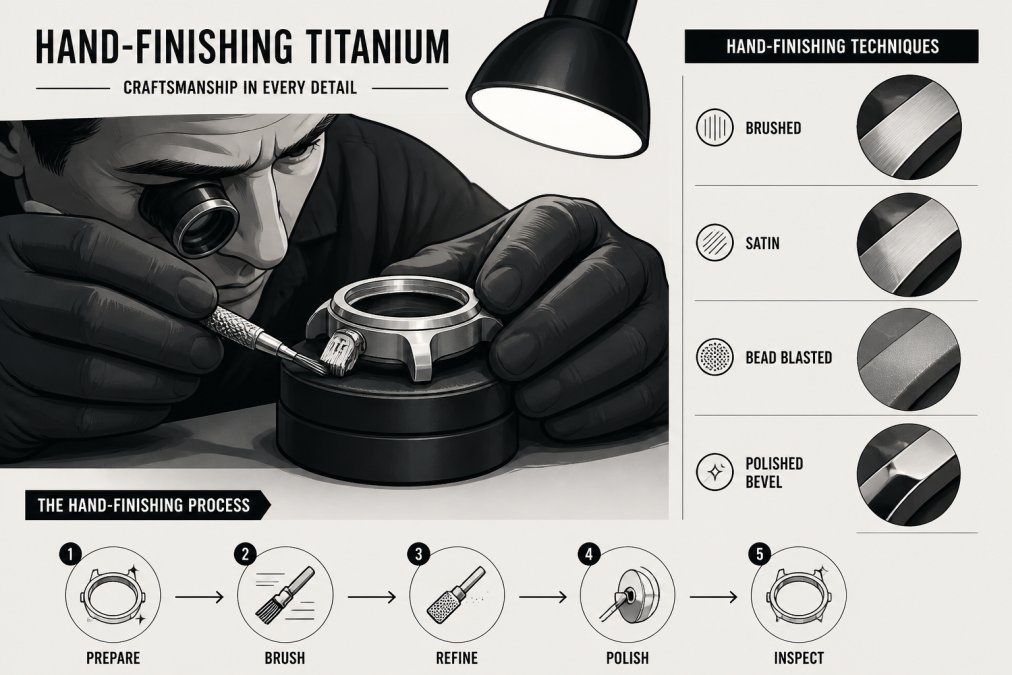
Scratch Resistance Myths and Reality
A common misconception about titanium is that it's scratch-resistant. The truth is more nuanced. Titanium is harder than stainless steel, but it's not scratch-proof. Hand-finished surfaces, particularly bead-blasted and brushed finishes, actually show scratches less obviously than polished surfaces because the existing texture masks minor marks.
This is where the practical advantage emerges. A hand-finished surface integrates minor scratches into the existing texture, allowing the watch to age gracefully rather than appearing damaged. Collectors who understand this prefer hand-finished titanium watches precisely because they're designed for real-world wear. A hand-finished titanium watch develops a patina over time, subtle changes that tell the story of its use.
Repairability of Hand-Finished Surfaces
When a hand-finished titanium watch requires refinishing, a qualified watchmaker can re-bead-blast or re-brush the case, restoring the original finish. The advantage over polished finishes is that hand-finishing techniques don't require matching a factory-perfect mirror polish.
A skilled craftsperson can re-finish a hand-finished titanium case and have it blend seamlessly with the original work. This repairability extends the life of the watch significantly. Rather than living with visible damage, collectors can have their hand finished titanium watches restored to like-new condition.
Titanium Watch Maintenance Tips for Long-Term Care
Maintaining a hand finished titanium watch is straightforward because titanium itself requires minimal intervention. The focus is on protecting the movement and keeping the case clean rather than preventing corrosion.
Rinse your hand finished titanium watch with fresh water after exposure to saltwater or chlorine. Use a soft brush and gentle soap if needed, nothing abrasive that would damage the hand-finished surface.
Store your watch in a dry environment. Although titanium doesn't corrode, the movement inside requires protection from moisture. A watch box or small safe is ideal.
Have the watch serviced by a qualified watchmaker every 5-7 years, depending on wear and environmental exposure. The movement needs periodic maintenance, cleaning, lubrication, and adjustment to maintain accuracy and longevity.
Avoid exposing your hand finished titanium watch to extreme temperature changes or significant impacts. Treat your watch with the care you'd give any precision instrument, and it will serve you for decades.
Choosing Your Hand Finished Titanium Watch
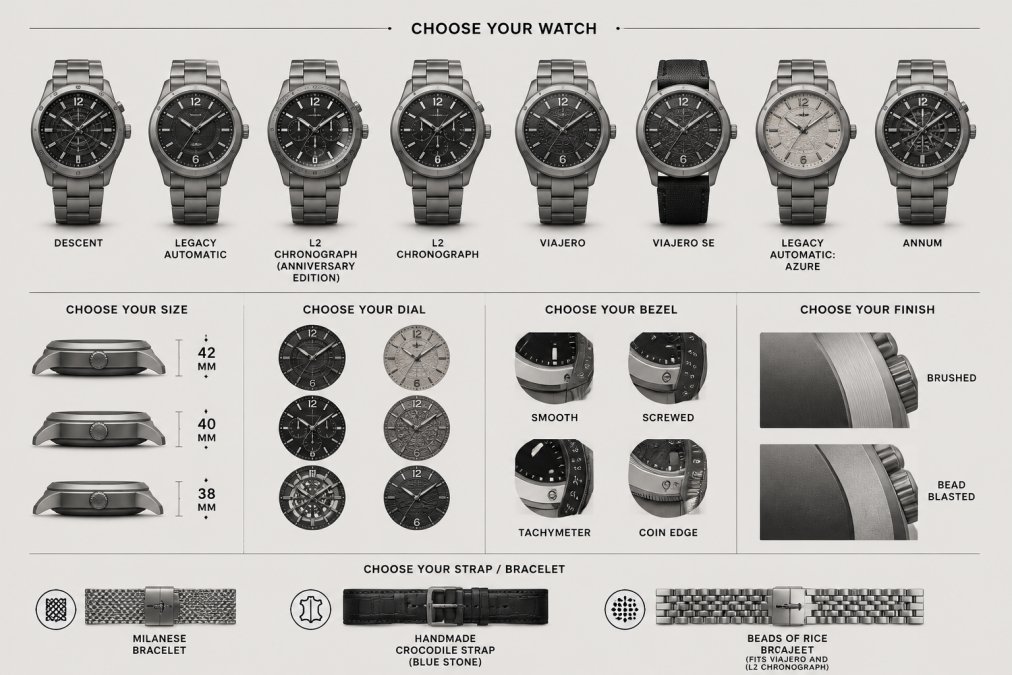
Selecting the right hand finished titanium watch requires understanding how several factors interact: case size, movement type, water resistance, and finishing style. Each decision shapes how the watch will feel, perform, and integrate into your collection.
Case Diameter and Wrist Presence
Case diameter fundamentally affects how a watch sits on your wrist and how it presents visually. Titanium's lightweight nature allows larger cases to feel proportional; a 44mm titanium watch often wears more comfortably than a 44mm steel equivalent. For most wrists, 38-42mm represents the sweet spot for daily wear.
Wrist presence depends on both case diameter and lug-to-lug distance. When shopping for hand finished titanium watches, consider how the specific model's proportions align with your wrist size and personal aesthetic preferences. Titanium's weight advantage means you can confidently choose a larger case than you might with steel without experiencing fatigue during extended wear.
Movement Type and Caliber
The movement determines accuracy, reliability, and maintenance requirements. Hand finished titanium watches are available with automatic calibers, manual-wind movements, and chronograph mechanisms.
Automatic movements wind themselves through wrist motion, making them convenient for daily wear. Manual-wind movements require periodic hand-winding but offer a more intimate connection to the watch's mechanical nature. Custom-engineered calibers, like those found in Haim Watch Company's Legacy Automatic, represent a step beyond standard movements, featuring unique finishing and improved performance characteristics.
Water Resistance and Practical Use
Water resistance is rated in meters and indicates depth capability, not duration. A watch rated 50m is splash-resistant, suitable for daily wear. A 100m rating handles swimming and snorkeling. A 300m rating is appropriate for diving with proper training.
For most collectors, 100m water resistance provides practical confidence for daily wear without overspecifying. Consider your actual water exposure when choosing; the specification should match your realistic use case rather than aspirational scenarios.
| Feature | Consideration | Impact |
|---|---|---|
| Case Diameter | 38-42mm typical; titanium allows larger sizes | Comfort and visual presence on wrist |
| Lug-to-Lug Distance | Measure from lug to lug for fit | Determines how watch sits on wrist |
| Movement Type | Automatic vs. manual-wind vs. chronograph | Convenience, engagement, complexity |
| Water Resistance | 50m, 100m, 300m+ depending on use | Confidence for daily wear and activities |
| Finishing Style | Bead-blasted, brushed, polished | Aesthetic preference and scratch visibility |
| Case Material Grade | Grade 5 titanium standard | Durability and hypoallergenic properties |
Hand finished titanium watches occupy a distinct space in horology. They're precision instruments built for daily wear, finished with artisanal care that respects both the material and the wearer. The combination of titanium's practical advantages with hand-finishing techniques that celebrate craftsmanship creates watches that improve with age rather than deteriorate.
When you're ready to invest in a hand finished titanium watch, prioritize brands that demonstrate genuine commitment to finishing quality and movement integrity. Haim Watch Company's approach, combining Swiss-made heritage with 100% US assembly and custom-engineered calibers, exemplifies how hand finished titanium watches can deliver sophisticated design, reliable performance, and the kind of craftsmanship that justifies their place in a serious collection.
Frequently Asked Questions
What makes a titanium watch hand-finished?
Hand finishing refers to the artisanal process where a watchmaker applies surface treatments to the titanium case by hand rather than through automated methods. Techniques include bead-blasting to create a matte texture, brushing to produce directional lines, and polishing for a mirror shine. Each hand-finished watch develops subtle variations in surface character, making every piece unique. This meticulous approach elevates the case from a functional component to a work of horological artistry.
Why titanium watches are better than other materials for collectors?
Titanium offers a superior weight-to-strength ratio, it's 45% lighter than stainless steel while maintaining equal durability. Grade 5 titanium resists corrosion in saltwater and humid environments without degradation, making it ideal for tool watches and daily wear. Titanium is biocompatible and hypoallergenic, eliminating skin sensitivity issues common with nickel-containing alloys. Its thermal conductivity means the watch feels cooler on the wrist, and the metal's natural luster accepts hand-finishing techniques that create distinctive aesthetic depth competitors cannot match.
Do hand-finished titanium watches scratch easily?
Titanium hand-finished surfaces do show micro-scratches with use, this is unavoidable with any soft metal finish. However, the narrative that titanium 'scratches easily' misses an important truth: hand-finished surfaces are designed to age gracefully. Minor scratches blend into the brushed or bead-blasted texture rather than creating obvious lines like polished steel. Many collectors view this patina as evidence of the watch's journey. Reputable makers use surface hardening techniques like PVD or DLC coatings on critical surfaces to increase resistance where it matters most.
How should I maintain a hand-finished titanium watch?
Clean your titanium watch regularly with a soft microfiber cloth and lukewarm soapy water to remove salt, sweat, and debris. Dry thoroughly to prevent water spots. Avoid abrasive cleaners and polishing compounds on hand-finished surfaces, as these can blur the intentional texture. Store the watch in a dry environment away from extreme temperature swings. If your watch has a leather strap, condition it periodically. Most titanium watches require standard service intervals (every 3-5 years) to maintain movement accuracy and water resistance, regardless of case material.
This article was written using GrandRanker