

Table of Contents
- What Sets Microbrand Watch Quality Apart
- The Microbrand Watch Movement Guide: Caliber, Regulation, and Sourcing
- Watch Case Finishing Techniques: Brushed vs Polished, Bead Blasting, and Bevels
- Dial Furniture, Alignment, and Lume Application
- RGM Watches vs Independent Microbrands: US Assembly and Movement Sourcing
- Best Microbrand Watches Under $1000: What to Expect and Where to Look
- Macro-Photography Inspection and Post-Purchase Longevity Testing
- Frequently Asked Questions
Last Updated: September 11, 2026
What Sets Microbrand Watch Quality Apart
Microbrand watch quality is the sum of measurable construction decisions, movement sourcing, case finishing, dial alignment, and after-sales support, that determine whether a small-brand timepiece performs like a serious instrument or just photographs like one. At Haim Watch Company, we've handled enough titanium cases and custom calibers to know the difference shows up in tolerances, not marketing copy.

The problem: most coverage of microbrand watch quality stops at brand rankings. That tells you what to buy, not how to judge it. This guide teaches the inspection method instead, the same checks a watchmaker runs before a piece ships.
What most guides miss is that microbrand watch quality is largely determined before the watch reaches you. Movement sourcing, case finishing, and dial assembly are locked in at the factory. Your job is verification, not correction.
The five-part framework below covers movement sourcing, case finishing, dial furniture, US assembly claims, and hands-on inspection. Run it before you buy, and again after.
The Microbrand Watch Movement Guide: Caliber, Regulation, and Sourcing
The microbrand watch movement guide starts with one question: is the caliber sourced off-the-shelf or specified by the brand? Both are legitimate. They signal different things about how the brand spends its money.
A caliber is the movement inside the watch, the engine that drives the hands, date, and any complications. In microbrands, calibers typically fall into three tiers:
- Off-the-shelf Swiss or Japanese: Reliable, widely serviced, but shared with dozens of other brands
- Modified stock: A base movement with upgraded finishing, regulation, or components
- Custom-designed: Brand-specified architecture, often with proprietary modules or decoration
Movement sourcing matters because it determines serviceability. A standard caliber can be serviced by any competent watchmaker. A proprietary one usually requires the brand to still exist.
Movement regulation is the adjustment of a movement's rate to keep it within a target accuracy window. Ask any brand for their regulation standard. A brand that can't answer hasn't tested it.
Watch Case Finishing Techniques: Brushed vs Polished, Bead Blasting, and Bevels
Watch case finishing techniques separate a $300 watch from a $1,300 one more reliably than any spec sheet. Finishing is labor, and labor is where microbrands either invest or cut.
Three finishes dominate:
- Brushed: Directional grain, hides scratches well, the default for tool watches
- Polished: Mirror surface, shows every mark, usually reserved for accents
- Bead blasting: Matte, uniform texture, common on titanium
The tell is the transition between finishes. On a well-finished case, the line where brushed meets polished is crisp and consistent around the entire case. On a rushed one, it wanders.
Bevels are the other giveaway. A bevel is the angled edge where two case surfaces meet. Hand-finished bevels catch light sharply and run evenly along the lugs. Machine-finished bevels look flat and inconsistent.
Check bezel action and crown operation next. A screw-down crown should thread smoothly without grit. A rotating bezel should click firmly with no back-play. Sloppy action here signals loose manufacturing tolerances elsewhere.
Dial Furniture, Alignment, and Lume Application
Dial furniture is everything applied to the dial: hour markers, hands, and the date window frame. Alignment and lume application are where microbrand quality lives or dies.
Hour marker alignment is checked by drawing an imaginary line from the 12 marker through the center to the 6. Every marker should sit on its own radial line from the center. A marker that leans even slightly is a QC failure.
Dial printing should be crisp under magnification. Look for bleeding edges, uneven ink density, or text that sits off-center in its track.
Lume application is the most visible QC tell. Applied lume should be level, evenly filled, and free of bubbles. Bubbles in lume are permanent. They don't settle.
The hand stack matters too. On a well-assembled watch, the hour, minute, and second hands sit parallel and evenly spaced. On a rushed one, the hands can touch or sit at an angle.
RGM Watches vs Independent Microbrands: US Assembly and Movement Sourcing
RGM watches vs independent microbrands is a useful comparison because it isolates one variable: how much of the watch is actually made where the brand says it is. Most guides skip this entirely, which is why supply chain transparency is the newest quality signal a buyer can use.
The core distinction is assembled in versus manufactured in. These are not interchangeable, and the gap between them explains most of the price spread across microbrands.
- Assembled in: The movement, case, dial, and hands arrive as finished components from other suppliers. The brand (or a contract facility) installs the movement, sets the hands, cases it up, and runs final QC. This is the most common microbrand model.
- Manufactured in: The brand controls some combination of case machining, dial printing, movement modification, or finishing in-house. True in-house manufacture at microbrand scale is rare; partial manufacture is more common.
- Finished in: A middle ground where components are produced overseas but final decoration, regulation, or assembly happens domestically.
A brand can be honest and still be "assembled in." The problem is when marketing language implies manufacture. Ask three questions of any brand claiming domestic assembly:
- Where is the movement assembled?
- Where is the case machined and finished?
- Where does final assembly and QC happen?
A brand that answers all three precisely is being transparent. A brand that answers only the first is usually hiding something. The same logic applies to movement sourcing: an off-the-shelf Swiss or Japanese caliber that is regulated and cased domestically is a legitimate value proposition, but it is not the same as a custom-designed caliber, and the price should reflect that difference.
For reference, RGM is a Pennsylvania-based watchmaker known for domestic assembly and in-house work, which places it at the manufactured end of the spectrum. Independent microbrands vary widely along the same axis. The distinction matters for service, warranty, and resale: a watch built around a widely serviced caliber is easier to maintain than one built around a proprietary movement tied to a single brand.
Haim Watch Company's Legacy Automatic is 100% US assembled, including the movement, with a custom-designed caliber and a hand-finished titanium case. That's a specific, checkable claim, the kind you should demand from every microbrand you consider.
FTC guidance on "Made in USA" claims
Best Microbrand Watches Under $1000: What to Expect and Where to Look
Best microbrand watches under $1000 is a crowded category, so set expectations first. Under $1,000, you're typically getting a reliable sourced movement, solid case finishing, and good dial work, but not a custom caliber or hand-finished bevels. The useful question is not "which brand wins" but "what should each dollar buy, and how do I score it."
Here's what to expect at each price band:
| Price Band | Movement | Case Finishing | Dial Furniture |
|---|---|---|---|
| Under $500 | Off-the-shelf quartz or automatic | Machine-finished | Applied markers, basic lume |
| $500-$1,000 | Regulated automatic | Brushed with polished accents | Applied markers, quality lume |
| $1,000-$2,000 | Modified or custom caliber | Hand-finished bevels | Complex furniture, guilloché |
Where to look: prioritize brands that publish movement specs, regulation standards, and assembly location. A brand that hides these isn't worth your time at any price.
To make the comparison repeatable, score each watch on a simple 1-5 rubric across six categories:
- Movement: Is it regulated, and can any competent watchmaker service it?
- Case finishing: Are the brushed-to-polished transitions crisp and consistent around the case?
- Dial alignment: Do the markers sit on true radial lines from the center?
- Lume: Is the application level, evenly filled, and free of bubbles?
- Transparency: Does the brand answer the three assembly questions precisely?
- After-sales: Is there a stated warranty term and a service path?
Total the score and compare across watches. A 24-30 is a strong buy at its price; 18-23 is average; below 18 means the brand is cutting somewhere you'll notice later.
Haim Watch Company's L2 Chronograph sits at $489, with a case that blends brushed and polished surfaces and chamfered edges. It's a good example of what the $500 band should deliver when the brand invests in case finishing.

Macro-Photography Inspection and Post-Purchase Longevity Testing
Macro-photography inspection is the single most useful skill for evaluating microbrand watch quality, and almost no guide teaches it. A smartphone macro lens and a loupe are enough to start.
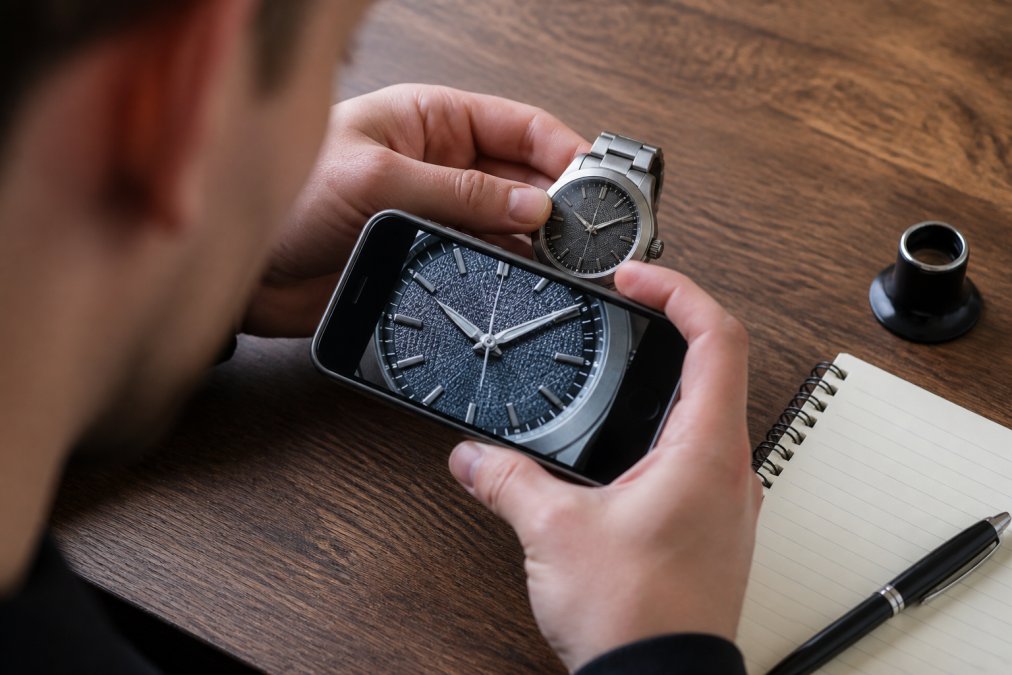
Shoot the dial at 12, 3, 6, and 9 under raking light. Then check:
- Marker alignment against radial lines
- Lume fill for bubbles or uneven application
- Printing edges for bleed
- Hand stack parallelism
Post-purchase longevity testing is the follow-up. Track rate deviation over the first 90 days. A well-regulated movement holds its rate. A poorly regulated one drifts.
Log these weekly:
- Rate deviation in seconds per day
- Crown and bezel action
- Caseback engraving wear
- Bracelet articulation and clasp security
A standardized grading rubric makes this repeatable. Score each category 1-5, total the score, and compare across watches. This turns subjective impressions into data you can act on.
ISO 3159 horological standards overview
NAWCC horological reference resources
Frequently Asked Questions
What specific components define high-quality microbrand watches?
High-quality microbrand watches typically feature a regulated automatic movement (like a Miyota 9039 or Sellita SW200), a sapphire crystal with inner anti-reflective coating, a screw-down crown, and a case made from 316L stainless steel or titanium. Finishing details such as brushed and polished surfaces, aligned bezels, and clean dial printing also matter. Brands that publish manufacturing tolerances and offer clear warranty coverage tend to have better quality control.
How can I verify the build quality of a watch before purchasing online?
Ask the brand for high-resolution macro photos of the dial, case flanks, and caseback. Look for alignment of hour markers, the date window, and the bezel insert. Check if the brand discloses movement regulation specs and water resistance rating. Read independent reviews that mention fit and finish, and confirm the return policy. A brand confident in its microbrand watch quality will provide these details without hesitation.
Are microbrand watches worth the investment compared to established luxury brands?
Microbrand watches often deliver comparable specifications, such as sapphire crystal, Swiss or Japanese movements, and hand-finished cases, at a fraction of luxury prices. For example, the Haim Legacy Automatic at $1,350 offers a custom caliber HWC-1 and 100% US assembly. However, resale value may not match established brands. If you value unique design and direct-to-consumer pricing over brand prestige, a microbrand can be a rewarding purchase.
What are the signs of poor finishing on a microbrand timepiece?
Poor finishing shows as uneven brushing, visible machining marks on polished surfaces, sharp edges on lugs, and misaligned bezel inserts or date wheels. Check for dust under the crystal, uneven lume application, and a crown that feels gritty when winding. A caseback with shallow or blurry engraving also indicates lower manufacturing tolerances. Inspect these areas under bright light or with a magnifying glass before buying.
The hardest part of evaluating microbrand watch quality isn't the inspection method. It's finding a brand transparent enough to make the inspection worthwhile. Haim Watch Company publishes its movement sourcing, offers 100% US assembly on the Legacy Automatic, and hand-finishes titanium cases with custom-designed calibers. If you want a timepiece where every quality claim is checkable, start there. Get started with Haim Watch Company and inspect your next watch with confidence.