

Table of Contents
- Why Movement Architecture Defines Your Watch
- 1. Manual Wind: The Purest Mechanical Watch Movement
- 2. Automatic: Self-Winding Efficiency and Daily Wear
- 3. Swiss-Made Wrist Watch Calibers: Precision and Heritage
- 4. High-Frequency Movements: The Role of Escapement Technology
- 5. Modular and Integrated Calibers: Movement Architecture Explained
- Automatic vs Manual Watch Movement: Which Suits You?
- Mechanical Watch Maintenance Tips for Long-Term Ownership
- Frequently Asked Questions
Last Updated: September 25, 2026
Why Movement Architecture Defines Your Watch
A mechanical watch movement is the engine inside the case: a mainspring stores energy, an escapement releases it in measured beats, and a gear train carries that energy to the hands. Movement architecture, meaning how those parts are laid out and assembled, shapes everything you feel on the wrist, from winding effort to long-term service costs. This guide from Haim Watch Company breaks down the five movement types enthusiasts should know, plus the maintenance realities most buying guides skip. As the National Institute of Standards and Technology explains timekeeping standards notes, precision is a measurable engineering outcome, not a marketing word.

Below, we'll show you exactly how to match a movement to how you actually wear a watch. The five types we cover span hand-wound purity, self-winding convenience, Swiss precision, high-frequency escapements, and modular versus integrated caliber design.
| Movement Type | Winding | Key Strength | Watch It Best |
|---|---|---|---|
| Manual wind | Hand-winding | Thin, pure, tactile | Collectors who enjoy ritual |
| Automatic | Self-winding rotor | Daily-wear convenience | One-watch owners |
| Swiss-made caliber | Automatic | Precision and heritage | Milestone purchases |
| High-frequency | Automatic | Stable rate, smooth seconds | Accuracy-focused buyers |
| Modular vs integrated | Varies | Serviceability and finish | Long-term owners |
1. Manual Wind: The Purest Mechanical Watch Movement
Manual wind is the oldest and simplest mechanical watch movement: you turn the crown to tension the mainspring, and the gear train does the rest. No rotor means a thinner case and an unobstructed view of the movement finishing through an exhibition caseback. The trade-off is real. Skip a day of winding and the watch stops, and you reset the time again.
What most guides miss is how winding feel varies by design. A well-built manual caliber offers gentle resistance near full power reserve. A poorly finished one feels gritty. If you rotate through several watches, hand-winding becomes a ritual rather than a chore. If you wear one watch daily, it becomes a nightly obligation.
2. Automatic: Self-Winding Efficiency and Daily Wear
An automatic movement adds a rotor that spins with wrist motion, converting kinetic energy into mainspring tension through self-winding. Wear it daily and it never needs hand-winding. Set it down for a weekend, and most automatics keep running until the power reserve drains, often somewhere between 38 and 70 hours depending on the caliber.
That convenience explains why automatics dominate modern collections. It also explains the most common mistake: buying an automatic as a "safe" first mechanical watch, then wearing it twice a month. A watch that sits in a drawer doesn't self-wind. It just stops.
3. Swiss-Made Wrist Watch Calibers: Precision and Heritage
A Swiss-made wrist watch caliber carries a legal definition, not just a label. Swiss law requires that a watch be cased in Switzerland, and that its movement be assembled, adjusted, and tested there, with a minimum percentage of Swiss-made components. That regulatory weight is why the term still means something to collectors.
Precision is the practical payoff. Swiss calibers are commonly regulated to tight daily rate tolerances, and higher tiers pursue chronometer certification through independent testing. The heritage argument matters less than the consistency: a well-regulated Swiss caliber holds its rate across positions and temperatures better than a loose one.
Haim Watch Company's Viajero SE is our first Swiss Made timepiece, pairing a hand-finished stainless steel case with Grand Feu enamel dials and an Atlas-shaped rotor visible through the exhibition caseback.

4. High-Frequency Movements: The Role of Escapement Technology
Escapement technology decides how a movement keeps time, and frequency is its most visible number. A balance wheel oscillating at 28,800 vibrations per hour beats eight times per second. Higher-frequency calibers push past that, and the payoff shows up as a smoother sweeping seconds hand and greater resistance to rate changes when you move your wrist.
But frequency is only one variable. The escapement itself, the mechanism that locks and releases the gear train on every beat, is where modern horology has done its most interesting engineering. Three designs matter to enthusiasts:
Lever escapement. The Swiss lever is the default in nearly every mechanical watch made today. It is robust, cheap to produce, and well understood by every watchmaker. Its weakness is sliding friction: the pallet stones drag across the escape wheel teeth on every beat, which is why lubrication quality and service intervals matter so much.
Co-axial escapement. George Daniels' co-axial design replaces the sliding friction of the lever with a combination of radial and tangential impulses, reducing the need for lubrication at the pallet stones. Omega adopted it across its movements, and the practical result is longer service intervals and more stable rate over time. The trade-off is that not every independent watchmaker is trained to service one, so parts and labor access vary by region.
Detent and constant-force escapements. These appear in high-end independent and marine chronometer work. A detent escapement gives a more direct impulse to the balance, which can improve rate stability, but it is sensitive to shock and rarely appears in wristwatches.
For enthusiasts comparing movements, the useful question is not "which escapement is best" but "which escapement can my watchmaker service, and how does it behave as the power reserve drains?" That second question is where constant-force and co-axial designs earn their reputation.
5. Modular and Integrated Calibers: Movement Architecture Explained
Movement architecture splits into two schools: modular and integrated. A modular caliber starts with a base movement, then adds complication modules on top. An integrated caliber builds the complication into the base plate from the start. This distinction rarely appears in buyer's guides, and it should, because it changes how a watch ages, how it services, and what it costs to keep running.
Automatic vs Manual Watch Movement: Which Suits You?
The automatic vs manual watch movement decision comes down to one question: do you want to interact with your watch every day, or only when you put it on? Automatics suit daily wear and one-watch owners. Manuals suit collectors who rotate, appreciate thin cases, and enjoy the winding ritual itself.
- Choose automatic if: you wear the same watch most days, want set-and-forget convenience, and value a rotor you can see through the caseback.
- Choose manual if: you own several watches, prefer a slimmer profile, or find winding part of the pleasure.
- Choose Swiss-made if: you want documented precision standards and long-term parts support.
- Choose high-frequency if: rate stability matters more to you than longer service intervals.
- Choose integrated architecture if: you care about movement finishing and case proportions.
Mechanical Watch Maintenance Tips for Long-Term Ownership
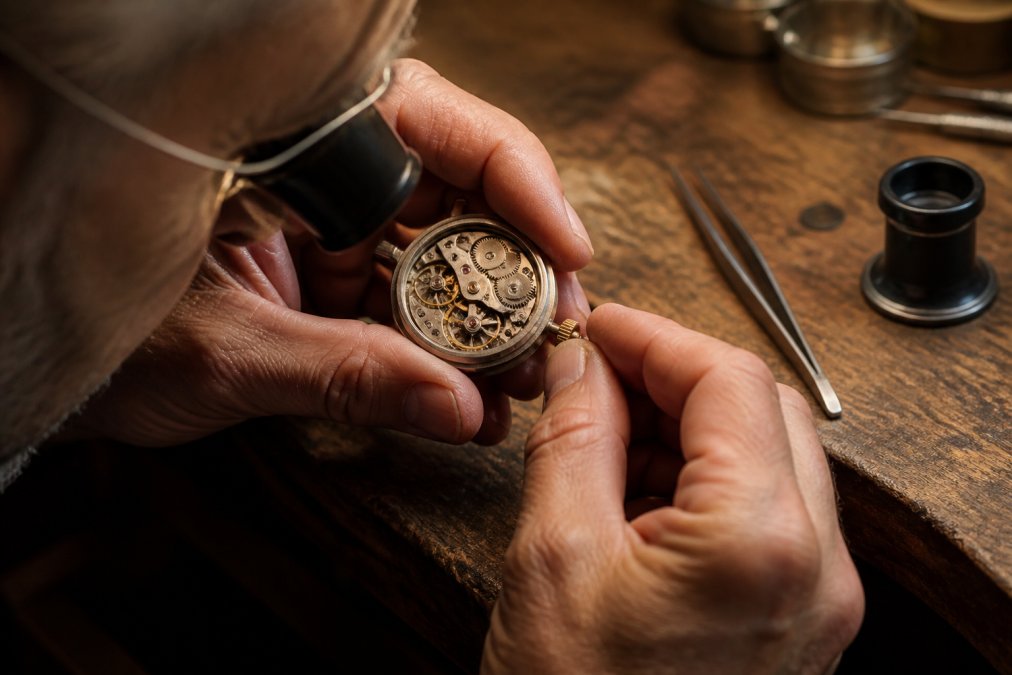
Mechanical watch maintenance tips start with one rule: service the movement before it tells you something is wrong. Lubricants degrade over time whether the watch runs or not, and a dry movement wears its pivots and jewels. Many watchmakers suggest a service interval of roughly five to seven years, though frequency of wear and the caliber itself shift that window.
- Wind or wear it consistently. A running movement distributes lubricant; a dormant one lets it pool and stiffen.
- Keep it away from magnets. Laptops, tablets, and speaker magnets can magnetize a hairspring and cause sudden rate changes.
- Avoid setting the date near midnight. The date-change mechanism is engaged then, and forcing it can damage teeth.
- Store on a soft surface. Titanium and polished steel scratch against hard trays.
- Track its rate. Note how many seconds it gains or loses per day. A sudden change is your earliest service signal.
Frequently Asked Questions
What is the best mechanical watch movement for enthusiasts?
There is no single best movement. Manual wind suits collectors who enjoy daily interaction and thin cases. Automatic movements fit daily wearers who want convenience. Swiss-made calibers offer proven precision, while high-frequency movements deliver better accuracy. Your choice depends on wear habits, budget, and whether you value service cost or finishing. For many enthusiasts, owning one of each type builds a well-rounded collection.
What is the difference between manual-wind and automatic movements?
A manual-wind movement requires you to turn the crown to tension the mainspring before the watch runs. An automatic movement contains a rotor that spins with wrist motion, winding the mainspring automatically. Manual movements are typically thinner and let you feel the winding mechanism directly. Automatic movements offer convenience but add case thickness. Both share the same core components: gear train, escapement, and balance wheel.
What makes a Swiss-made wrist watch movement stand out?
Swiss-made movements must meet strict criteria: assembly and final inspection completed in Switzerland, and Swiss parts throughout. Beyond the legal standard, Swiss calibers like those in the Viajero SE benefit from generations of watchmaking infrastructure and tighter manufacturing tolerances. This heritage translates to consistent accuracy and strong service networks worldwide.
How often does a mechanical watch movement need servicing?
Most mechanical movements need servicing every 5 to 7 years, though some run longer with careful use. Signs you need service include declining accuracy, a stiff crown, or reduced power reserve. Servicing involves full disassembly, cleaning, lubrication, and reassembly by a qualified watchmaker. Costs vary by movement complexity. A chronograph or calendar module costs more to service than a simple time-only caliber.
Are in-house movements better than off-the-shelf calibers?
Not automatically. In-house movements offer exclusivity, brand control over quality, and often superior finishing. Off-the-shelf calibers from established suppliers deliver proven reliability at lower cost and are easier to service. What matters most is execution: a well-finished off-the-shelf movement can outperform a poorly built in-house caliber. For enthusiasts, the deciding factor is often whether the movement tells a story worth the premium.