

Table of Contents
- RGM vs Vortic: Two Divergent Paths in American Watchmaking
- Side-by-Side Spec Sheet: Movements, Cases, and Finishing
- RGM's Approach: In-House Calibers and Original Manufacturing
- Vortic's Method: Vintage Pocket Watch Restoration at Scale
- Design Philosophy: Handcrafted Dials vs. Railroad-Era Heritage
- The Economics of American Made Watches: Serviceability and Resale
- How Luxury Watch Manufacturing Shapes the Collector Market
- Which Heritage Timepiece Belongs on Your Wrist?
- Frequently Asked Questions
Last Updated: September 8, 2026
RGM vs Vortic: Two Divergent Paths in American Watchmaking
Few debates capture the modern collector’s imagination quite like RGM versus Vortic watches comparison. These two Pennsylvania-based manufacturers represent opposite poles of the American watchmaking revival. RGM builds original, in-house calibers from the ground up, while Vortic transforms historic railroad-era pocket watches into wearable wrist timepieces.
American watchmaking today splits into two distinct philosophies: original manufacturing and heritage restoration. This guide breaks down the technical, economic, and philosophical differences so you can decide which approach aligns with your collecting goals.
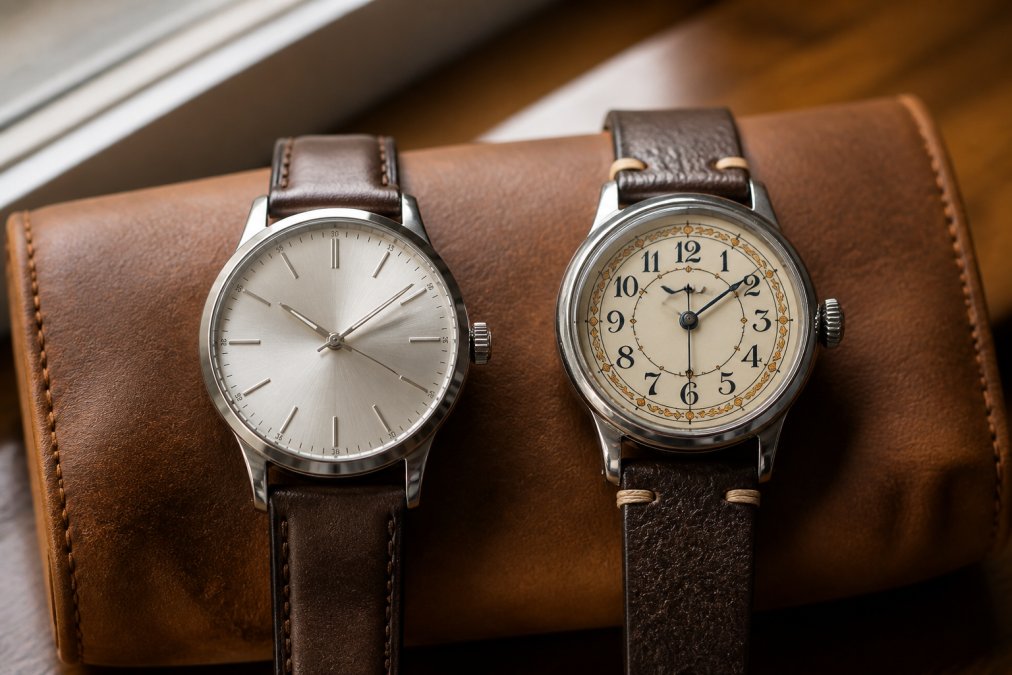
Side-by-Side Spec Sheet: Movements, Cases, and Finishing
The table below is a reference point for collectors who want to understand the concrete differences in manufacturing philosophy, materials, and engineering constraints.
| Specification | RGM | Vortic |
|---|---|---|
| Movement origin | In-house, newly manufactured calibers | Original vintage movements, typically Hamilton, Elgin, Waltham, or Illinois, from the railroad era (approx. 1890-1950) |
| Movement condition | New, with modern tolerances and materials | Restored to running condition; original gears, jewels, and mainsprings unless irreparable |
| Case material | Precious metals (gold, platinum) and high-grade stainless steel | CNC-machined Grade 5 titanium or naval brass, often with a PVD coating option |
| Case construction | Hand-finished, often with traditional techniques like Geneva stripes on visible bridges | CNC-machined, with a focus on structural integrity for the larger pocket watch movement |
| Dial type | Handcrafted, including grand feu enamel, engine-turned guilloché, or hand-painted | Original porcelain or enamel dials, restored where necessary; some models offer custom-printed dials |
| Movement mounting | Standard wristwatch architecture | Custom-designed movement mounting ring and shock absorption system to adapt a thin, large-diameter pocket watch movement |
| Crown position | Standard 3 o'clock | Typically 3 o'clock, but some models use a 6 o'clock crown to preserve the original pocket watch dial orientation |
| Water resistance | Varies by model; typically 30m to 50m for dress pieces | 30m for most models; not intended for swimming |
| Power reserve | Varies by caliber; typically 40-72 hours | Varies by original movement; typically 30-40 hours, reflecting the original design |
| Serviceability | Full in-house support; parts manufactured on demand | Dependent on vintage parts availability; custom fabrication may be required |
| Warranty | Typically 2-3 years, with service support from the factory | Typically 1-2 years, covering the restoration work but not the original movement's age-related wear |
| Production scale | Small batches, often bespoke commissions | Larger volume, catalog-driven, with limited-edition runs |
| Heritage focus | American watchmaking tradition, modern execution | Railroad-era chronometry, historical preservation |
The Engineering Constraint Nobody Discusses: Movement Geometry
The single most important technical difference between the two brands is the physical geometry of the movement. A pocket watch movement is typically 38mm to 42mm in diameter and only 3mm to 4mm thick, while a wristwatch movement is usually 25mm to 30mm in diameter and 4mm to 6mm thick.
Vortic's engineering challenge is to fit that large, thin movement into a case that is comfortable on the wrist. The solution is a custom-designed mounting ring that holds the movement securely while allowing for the crown and stem to be repositioned, which is why Vortic cases are often 42mm to 46mm in diameter, larger than the typical dress watch.
RGM does not face this constraint. Because the brand designs its calibers from scratch, it can optimize the movement size and thickness for a wristwatch case, allowing for a more traditional case profile, often 38mm to 42mm, which is more versatile for everyday wear.
Finishing: Handcrafted vs. Preserved
RGM's finishing is a deliberate act of creation. The brand applies Geneva stripes, perlage, and anglage to newly manufactured bridges and plates, aiming to meet or exceed Swiss haute horology standards.
Vortic's finishing is an act of preservation. The movement is cleaned and restored, but the original finishing, the damaskeening patterns, the engraved serial numbers, the manufacturer's marks, is left as-is to maintain historical integrity. A Vortic movement will show the wear of a century, including slight discoloration or minor pitting, which is part of its story.
RGM's Approach: In-House Calibers and Original Manufacturing
RGM, founded by Roland Murphy in 1992, represents the pinnacle of original American watchmaking. The brand manufactures movements, cases, and dials domestically, with an emphasis on traditional hand-finishing techniques. Every component is newly manufactured to modern tolerances.
This commitment means RGM owns the entire lifecycle of each timepiece. When a watch needs service, the brand can manufacture replacement parts rather than scavenging donor movements. The trade-off is price: original manufacturing at this scale carries significant costs that reflect in the final retail figure.
Each piece involves hundreds of hours of hand assembly, dial restoration, and case finishing, appealing to collectors who prioritize mechanical integrity and provenance over accessibility.
Vortic's Method: Vintage Pocket Watch Restoration at Scale
Vortic takes a fundamentally different approach to American watchmaking. The brand acquires antique pocket watches, primarily from the railroad era, and rehouses their original movements into modern wristwatch cases, preserving historical calibers that would otherwise sit dormant in collections.
The engineering challenge is considerable. Pocket watch movements are larger and thinner than typical wristwatch calibers, requiring custom case design and movement mounting systems. Vortic solves this with CNC-machined titanium cases that showcase the movement through exhibition casebacks.
Restoration at scale means Vortic can offer historically significant movements at more accessible price points than original manufacturing. However, the long-term serviceability question remains: when a vintage mainspring breaks, sourcing replacements depends on the availability of donor parts.
Design Philosophy: Handcrafted Dials vs. Railroad-Era Heritage
Design philosophy separates these two brands as clearly as their manufacturing methods. RGM produces handcrafted dials with modern interpretations of classic American aesthetics.
Vortic, by contrast, celebrates the untouched authenticity of railroad-era design. Their dials are often original porcelain or enamel pieces, complete with the patina and character that only a century of existence can provide, appealing to enthusiasts who want a genuine artifact rather than a recreation.
An RGM feels precise and deliberate; a Vortic feels alive with history. Neither approach is objectively superior; they address different emotional and aesthetic needs.
The Economics of American Made Watches: Serviceability and Resale
The real cost of ownership reveals itself over a decade, and that is where RGM and Vortic diverge sharply.
The Service Cycle: Planned vs. Contingent
An RGM in-house caliber operates on a predictable service interval. Most independent watchmakers recommend a full service every five to seven years for a modern mechanical movement. Because RGM manufactures its own parts, the service is straightforward: the watchmaker orders a mainspring or a jewel from the factory, and the watch returns to factory specification. The cost typically falls in the $600 to $1,200 range, depending on the complexity of the movement and the shop's rate.
A Vortic presents a different calculus. The movement inside is a century-old artifact. A service requires a watchmaker who is comfortable with antique calibers, often from defunct manufacturers like Hamilton, Elgin, or Waltham. The labor rate is similar, but the parts situation is not. A broken mainspring might be available from a specialist supplier like the National Association of Watch and Clock Collectors material section, but a damaged escape wheel or a cracked jewel may require custom fabrication. That work is slow and expensive. A realistic estimate for a full service on a Vortic movement, including any necessary parts work, is $800 to $1,500, and the turnaround time can stretch to several months while the watchmaker sources or makes the needed component.
The Parts Availability Spectrum
RGM's vertical integration means parts availability is a non-issue. The company maintains a stock of components for its current calibers and can manufacture replacements for older ones.
Vortic's model is inherently contingent. The brand does stock a supply of donor movements, but that inventory is finite. When a specific part is unavailable, the owner faces a choice: commission a custom part from a skilled machinist, or source a donor movement of the same caliber and hope its parts are in better condition. A common pattern is that a Vortic owner will buy a second, non-running pocket watch of the same make and model just to have a parts donor on hand, an additional cost that has no equivalent in the RGM ownership experience.
Resale Value: Predictability vs. Scarcity
Resale behavior follows the same logic. RGM watches, with their documented provenance and in-house calibers, tend to hold value steadily. The secondary market for RGM is thin but consistent, with prices for pre-owned pieces typically landing within 10-15% of retail, assuming the watch is in good condition with service history. The brand's limited production numbers support this stability.
Vortic watches are more volatile. A standard production model might depreciate initially, but a limited-edition piece with a historically significant movement, say, a rare railroad-grade chronometer from a specific year, can appreciate substantially. The auction market for American railroad-era pocket watches has shown that collectors will pay premiums for documented provenance and exceptional condition. Vortic taps into that scarcity, but it also inherits its unpredictability. A collector who buys a Vortic for its historical value is speculating on the continued demand for a specific era of American horology.
The Total Cost of Ownership Over Ten Years
A reasonable ten-year ownership model for an RGM looks like this: one or two full services at $800 to $1,200 each, plus a possible polishing or case refresh. Total maintenance cost: $1,600 to $2,400.
For a Vortic, the model is less certain. Assume two services at $1,000 each, plus a 30% probability of a parts fabrication or donor movement purchase at $500 to $1,500. Expected maintenance cost: $2,150 to $3,450. The higher end of that range reflects the reality that vintage movements are not as robust as modern calibers and may require more frequent attention.
This is not an argument against Vortic. It is an argument for informed budgeting. The historical authenticity of a railroad-era movement has a real cost, and that cost is not just the retail price. RGM offers the convenience of modern manufacturing; Vortic offers the romance of a living artifact. Both are legitimate, but they are not equivalent financial commitments.
How Luxury Watch Manufacturing Shapes the Collector Market
The resurgence of American watchmaking has shifted collector attention toward domestic production. Both RGM and Vortic benefit from a growing preference for transparent manufacturing and authentic provenance.
This movement toward transparency aligns with broader trends in the luxury sector. According to McKinsey's analysis of the global watch market, consumers are prioritizing craftsmanship narratives and supply chain visibility when making high-value purchases. American made watches occupy a unique position in this landscape because they offer a clear, verifiable story from raw material to finished product.
For brands like Haim Watch Company, this emphasis on authentic manufacturing informs our own approach. Our Legacy Automatic is 100% US-assembled with a custom-designed caliber, reflecting a commitment to domestic production, while our Swiss-made Viajero SE demonstrates that thoughtful sourcing sometimes crosses borders.
Which Heritage Timepiece Belongs on Your Wrist?
Choosing between RGM and Vortic ultimately depends on your collecting priorities. If you value original manufacturing, modern serviceability, and handcrafted dials, RGM represents the pinnacle of contemporary American watchmaking. If you seek historical authenticity, Vortic offers a tangible connection to horological history.
RGM commissions often involve waiting lists and significant financial commitment. Vortic's catalog provides more immediate access to American heritage, though the vintage restoration process carries its own uncertainties.
American watchmaking is experiencing a renaissance, and both RGM and Vortic deserve credit for advancing the craft. For collectors exploring this space, we recommend handling both approaches before committing. Visit the American Watchmakers-Clockmakers Institute to connect with professionals who can offer guidance on serviceability and care. Then consider what kind of story you want your timepiece to tell, because that answer will guide you toward the right choice.
The American watchmaking landscape offers more choice than ever, yet navigating between restoration and original manufacturing can feel overwhelming. Haim Watch Company bridges this divide with timepieces that honor both heritage and modern horological progress. Our Legacy Automatic delivers 100% US assembly with a custom-designed caliber and ornate dial decoration, while the Swiss-made Viajero SE showcases sophisticated hand-finished titanium cases. Explore our collection and discover a timepiece that reflects your own journey.
Frequently Asked Questions
What is the fundamental difference between RGM and Vortic watchmaking?
The core difference lies in manufacturing philosophy. RGM designs and builds original timepieces, including in-house calibers, from new components in its Pennsylvania workshop. Vortic restores original vintage pocket watch movements from the railroad era and adapts them into new wristwatch cases using modern 3D-printed materials. One is original manufacturing; the other is a meticulous restoration and adaptation process. This distinction affects everything from movement sourcing to long-term serviceability and the character of each timepiece.
Are RGM watches considered luxury watches?
Yes, RGM watches sit firmly in the luxury segment. Their positioning is built on handcrafted, small-batch production, in-house caliber development, and intricate hand-finishing. Collectors place them alongside other high-end independent American manufacturers. The price reflects the substantial hand labor involved in assembly, dial decoration, and case finishing. For buyers, the value proposition centers on owning a genuinely original piece of contemporary american watchmaking rather than a mass-produced luxury good.
How does Vortic repurpose vintage American pocket watch movements?
Vortic sources original, often antique, pocket watch movements from defunct American manufacturers like Hamilton, Elgin, and Waltham. Each movement undergoes a complete restoration process. This includes disassembly, cleaning, replacing worn parts, and recalibrating for accurate timekeeping. Vortic then installs the restored movement into a newly manufactured wristwatch case, often using 3D-printed materials to create a precise fit. This vintage pocket watch restoration process gives a century-old mechanical heart a new life on the wrist.
Which brand offers better long-term value, RGM or Vortic?
Long-term value depends on your priorities. RGM's new, in-house calibers offer easier serviceability through the manufacturer and a clearer path for future repairs, which supports sustained value. Vortic watches contain unique, historical movements, but parts for these calibers are scarce, making future servicing more complex and potentially costly. RGM may hold value better due to brand continuity and service support, while Vortic's appeal rests on the historical uniqueness of each piece rather than conventional investment metrics.