

Table of Contents
- The Rise of American Watchmaking (1850-1920)
- The Industrialization of American Watch Manufacturing
- What Defines American Made Watches Today
- US Assembled Automatic Watches and Modern Revival
- The Decline and Collapse of the Industry (1960s-1980s)
- Investment Potential and Heirloom Quality
- Conclusion
- Featured External Sources
- Frequently Asked Questions
Last Updated: September 3, 2026
The Rise of American Watchmaking (1850-1920)
American watchmaking emerged when manufacturers realized that interchangeable parts could transform horology from artisanal craft into industrial manufacturing. Before the mid-19th century, precision timepieces were handcrafted luxuries dominated by Swiss and European makers. By manufacturing components to exact tolerances that could be swapped between movements without modification, American makers could produce reliable watches affordably and at scale.
Aaron Luntz Dennison, often called the father of American watchmaking, established the Waltham Watch Company in 1854 with a radical vision: create a factory system producing watches with precision equal to Swiss hand-crafted pieces, but at a fraction of the cost. Within decades, American watches flooded the market. By the 1880s, the United States had become the world's largest watch manufacturer.
Interchangeable Parts and the Industrial Revolution
The principle of interchangeable parts revolutionized assembly. Rather than master craftsmen spending weeks fitting each component, semi-skilled workers could follow standardized processes. Screw-cutting lathes, milling machines, and specialized jigs allowed manufacturers to produce components to tolerances measured in thousandths of an inch, unprecedented precision in horology. European makers, still reliant on hand-finishing and individual craftsmen, struggled to compete on price and volume.
American manufacturers understood that standardization wasn't the enemy of quality; it was the path to it. By documenting every step, training workers in repeatable processes, and investing in precision machinery, companies like Waltham, Elgin, and Hamilton created watches that were mechanically superior to many hand-assembled European pieces.
Mass Production Transforms Precision
By the 1890s, large American factories employed hundreds of workers, each responsible for a specific stage of movement assembly. This division of labor was ruthlessly efficient: a single factory could produce thousands of movements per month, output that would have taken European workshops years to achieve. Damaged components could be replaced without rebuilding the entire movement.
American manufacturers invested heavily in testing equipment, quality control, and technical development. Movements were chronometer-tested, escapements refined, and mainsprings improved. Companies weren't simply copying European designs; they were advancing horological innovation.
The Industrialization of American Watch Manufacturing
By 1900, American factories had developed specialized processes, trained workforces, and supply chains dedicated to component sourcing. Entire towns like Waltham, Massachusetts and Elgin, Illinois became centers of horological manufacturing.
Assembly Line Innovation and Caliber Development
Mass production demanded consistency across thousands of movements. American manufacturers responded by developing proprietary calibers, standardized movement designs that became the foundation of their product lines. Waltham's 1883 caliber, Elgin's B.W. Raymond movement, and Hamilton's 992 became legendary for precision and reliability. These were engineered specifically for mass production while maintaining horological performance.
Each component was designed for efficient manufacturing without sacrificing accuracy. Bridges were shaped for strength and ease of assembly. Jewel settings were positioned for optimal friction reduction. The movement assembly itself was optimized so workers could assemble a complete caliber in minutes rather than hours.
Domestic Labor and Component Sourcing
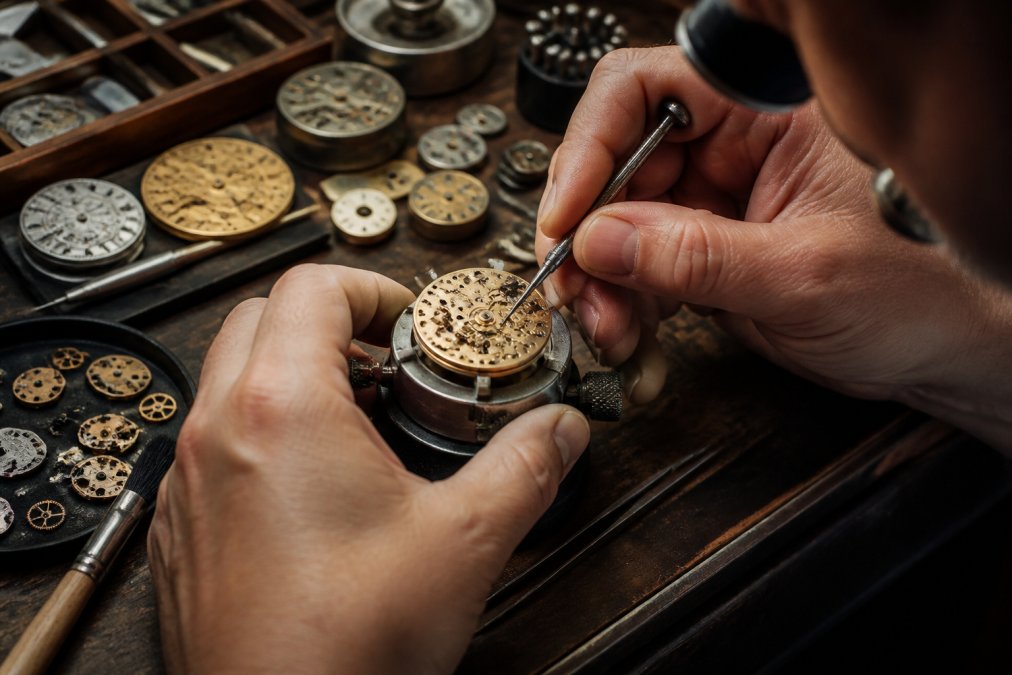
American watchmaking required an extensive supply chain. Dial manufacturers created decorated faces with hand-painted designs and intricate patterns. Case makers produced protective housings. Spring manufacturers supplied mainsprings and hairsprings. This vertical integration meant a single factory sourced parts from dozens of specialized suppliers.
The domestic labor force was diverse: skilled craftspeople hand-finished movements, semi-skilled workers operated machinery, and apprentices learned through hands-on work. The watchmaking industry became a pathway to middle-class stability for thousands of American families. Supply chain transparency was built into this system by necessity, factories couldn't produce watches without knowing exactly where every component came from and when it would arrive.
What Defines American Made Watches Today
The definition of "American made" has become complicated. A watch assembled in the United States might contain movements manufactured overseas. Consumer expectations about what "American made" means have shifted, and so have the standards that govern it.
Watchmaking Standards and Certification
The Federal Trade Commission provides guidance on what constitutes "made in the USA," but standards are less stringent than many consumers assume. A product can be labeled "made in the USA" if final assembly occurs domestically, even if most components are imported. There's no official certification body for American watchmaking specifically.
Some American watchmakers have adopted stricter standards voluntarily. Brands claiming "100% US assembled" typically mean movement assembly, case finishing, and dial installation all occur domestically. But definitions vary: does "US assembled" include where the hairspring comes from, or only final assembly?
This ambiguity creates a persistent disconnect between consumer expectations and actual production practices. A consumer interested in supporting American watchmaking heritage might purchase what they believe is domestically-made, only to discover the movement was manufactured overseas.
Supply Chain Transparency in Modern Production
Transparency has become a selling point precisely because it's rare. When a watchmaker documents every production stage, where the movement was manufactured, which supplier provided case material, how the dial was decorated, it stands out. Modern consumers, particularly younger buyers, increasingly demand this information. verifying American gear.
Brands embracing supply chain transparency often do so because their model depends on it. A company producing watches with custom-engineered calibers or hand-finished cases has invested in the story of how those watches are made. Documenting that process, sharing images of the workbench, naming craftspeople, explaining sourcing decisions, becomes part of the product's value proposition.
US Assembled Automatic Watches and Modern Revival
American watchmaking heritage seemed extinct in the 1980s but has experienced genuine revival. A new generation of independent watchmakers and small manufacturers has emerged, committed to producing watches with American assembly and increasingly American-designed movements. These brands operate differently than their predecessors, smaller, more specialized, and deeply engaged with customers.
Technical Evolution of Mechanical Movements
Modern American watchmakers face a different technical landscape. Computer numerical control (CNC) machinery can produce components with tolerances that hand-crafted movements could never achieve. Contemporary American watchmakers use these tools to create movements technically superior to historical pieces.
The automatic movement has seen significant innovation. Rotor design, winding mechanisms, and jewel placement have been refined through modern engineering. An American-made automatic watch today represents a synthesis of traditional horological knowledge and contemporary manufacturing capability, genuine evolution rather than nostalgic recreation.
Hand-Finished Craftsmanship Meets Contemporary Design
Modern American watchmaking blends historical inspiration with contemporary sensibility. Sunburst finishes, guilloche patterns, and applied numerals draw from vintage American watches, but execution is modern: precise, consistent, and refined.
Hand-finishing, once a necessity, has become a luxury. When a watchmaker chooses to hand-finish bridges, chamfer edges, or polish the balance wheel, these deliberate choices add cost and time because they enhance the product's value and owner's experience.
Design philosophy emphasizes wearability and contemporary aesthetics. A modern American-made watch might feature a 38mm case reflecting current preferences, minimalist dial layout with applied indices, and titanium or steel finishing. These choices reflect what contemporary watch enthusiasts actually want.
Haim Watch Company exemplifies this approach. The Legacy Automatic represents commitment to American watchmaking heritage through 100% US assembly and movement production. The custom-designed Caliber HWC-1 powers the watch with hand-finished components and ornate dial decoration reflecting both horological tradition and contemporary design. At $1,350.00, it positions itself as accessible luxury.

The Decline and Collapse of the Industry (1960s-1980s)
The collapse of American watchmaking was neither sudden nor inevitable, it was a cascade of decisions, technological disruptions, and market shifts accumulated over two decades. By 1980, the industry that once employed tens of thousands had essentially ceased to exist.
The quartz revolution of the 1970s was the obvious culprit, but not the only one. Swiss manufacturers adapted and survived. Japanese companies thrived. American manufacturers failed to respond effectively: some were slow to embrace quartz, others invested heavily but couldn't compete on price with Japanese manufacturers, and some were acquired by conglomerates that dismantled watchmaking operations.
The decline was also psychological. Mechanical watches became associated with obsolescence. Why buy an American-made mechanical watch when a Japanese quartz watch kept better time and cost half as much? Manufacturing capacity disappeared. Factories closed. Skilled workers retired or retrained. Supply chains dissolved. By the time anyone realized mechanical watches might have a future, the infrastructure to produce them domestically had largely vanished.
Investment Potential and Heirloom Quality
Mechanical watches are no longer evaluated primarily as functional timekeeping devices. Instead, they're increasingly viewed as investment pieces, heirlooms, and expressions of personal aesthetic. This reframing creates genuine value for American-made watches, particularly those produced with custom-engineered movements and hand-finished components.
A watch built to last decades, with parts that can be serviced and maintained, becomes something worth passing down. Vintage American watches have appreciated significantly in recent years, with collectors viewing contemporary American-made watches as continuation of tradition rather than nostalgic recreation.
The investment thesis rests on limited production (scarcity), documented craftsmanship (provenance), technical innovation (custom movements), and cultural significance. However, the market for high-end mechanical watches is relatively small, and liquidity can be an issue.
What's more reliable is heirloom quality, the durability and repairability that make a watch worth maintaining across generations. A well-made mechanical watch, properly serviced, can function for decades. The movement can be cleaned and restored by skilled watchmakers. Unlike electronic watches that become obsolete, a mechanical watch remains functional and relevant across time.
Conclusion
American watchmaking heritage represents a unique chapter in manufacturing history, where American innovation and industrial capacity created products rivaling and often exceeding European craftsmanship. That era ended, but it's not forgotten. Contemporary American watchmakers have revived the tradition by synthesizing historical knowledge with modern engineering and design sensibility.
When you choose an American-made watch today, you're engaging with this heritage directly. You're supporting precision manufacturing, custom-engineered movements, and hand-finished craftsmanship. Haim Watch Company's Legacy Automatic exemplifies this commitment: 100% US assembled with a custom-designed Caliber HWC-1, hand-finished titanium case, and ornate dial decoration reflecting both horological tradition and contemporary aesthetic. It's a watch built to last, to be maintained, and to be worn with the knowledge that it represents genuine American watchmaking innovation.
Featured External Sources
According to the Smithsonian Institution's documentation on American industrial manufacturing, the principle of interchangeable parts fundamentally transformed how precision goods were produced in the 19th century. The American Watchmakers-Clockmakers Institute maintains historical records and technical standards for contemporary American watchmaking. For information on Federal Trade Commission guidelines regarding "Made in USA" labeling, the FTC's regulations on product origin claims provides the official standards that govern how manufacturers can describe their products.
| Era | Key Development | Impact on Watchmaking |
|---|---|---|
| 1850-1880 | Interchangeable parts adoption | Enabled mass production at scale |
| 1880-1920 | Assembly line refinement | Thousands of watches produced monthly |
| 1920-1960 | Caliber standardization | Consistent quality across production |
| 1960-1980 | Quartz revolution | Mechanical watchmaking collapse |
| 1980-2026 | Independent revival | Small-batch, custom movements |
Frequently Asked Questions
What defines a watch as being part of American watchmaking heritage?
A watch qualifies as part of American watchmaking heritage when it embodies the technical standards and manufacturing principles established during the industrial revolution, precision through interchangeable parts, mechanical movement assembly, and domestic production. Modern American made watches like Haim Watch Company's Legacy Automatic (100% US-assembled with a custom-designed caliber) honor this legacy by maintaining hand-finished craftsmanship and transparent domestic sourcing, distinguishing them from mass-market alternatives.
How did the industrial revolution shape American watch manufacturing?
The industrial revolution introduced interchangeable parts manufacturing to American horology, enabling mass production of precise movements without sacrificing caliber quality. This shift from hand-crafted pocket watches to assembly-line production made mechanical timekeeping accessible beyond the wealthy. The innovation established standards for movement assembly and component sourcing that define American watchmaking authenticity today, influencing how modern brands approach custom-engineered calibers and domestic labor practices.
What is the difference between vintage American watches and modern US-assembled timepieces?
Vintage American watches (1850-1960s) were produced domestically at industrial scale, with names like Hamilton and Bulova dominating global markets. Modern US-assembled watches like those from Haim Watch Company combine historical precision standards with contemporary design and custom mechanical innovation. Today's offerings emphasize transparency in supply chain and hand-finished aesthetics, whereas vintage pieces were primarily functional instruments. Both honor horological heritage, but modern brands add artisanal dial decoration and custom caliber development.
Why did American watch manufacturing decline, and how is it reviving?
American watchmaking collapsed in the 1960s-1980s due to quartz technology competition and offshore manufacturing cost advantages. The industry lost its position as global leader. Revival began in the 2000s through microbrands and independent horologists who prioritized craftsmanship, custom-designed movements, and domestic assembly over volume. Modern brands restore credibility through transparent US production, hand-finished titanium cases, and ornate dial designs, proving that American watchmaking heritage remains viable when paired with contemporary horological innovation and direct consumer relationships.
What are the hallmarks of quality in American-made watches?
Quality American-made watches feature custom-engineered calibers, hand-finished cases (often titanium), precise movement assembly using interchangeable components, and transparent domestic sourcing. Haim Watch Company exemplifies these standards with the Legacy Automatic: a 100% US-assembled timepiece with a proprietary caliber, hand-finished titanium case, and ornate Guilloche dial work. Authentic pieces also demonstrate heirloom quality through technical specifications, limited production runs, and investment potential, markers that distinguish heritage craftsmanship from marketing claims.
How does modern assembly compare to historical American watch production methods?
Historical American production (1890-1950s) prioritized speed and volume through assembly lines, producing thousands of identical calibers for pocket watches and wristwatches. Modern US-assembled watches balance precision manufacturing with artisanal finishing, each piece is built individually with hand-decorated dials and custom components. Contemporary brands use CNC machining alongside traditional horological techniques, allowing smaller production runs without sacrificing accuracy. This hybrid approach honors the industrial standards that defined American watchmaking while incorporating individual craftsmanship that vintage mass production could not achieve.
Is investing in an American-made watch a good financial decision?
American-made watches from established microbrands with transparent production and custom calibers show stronger resale potential than mass-market alternatives. Limited production runs, hand-finished cases, and proprietary movements create scarcity and desirability. Watches like Haim's Legacy Automatic ($1,350.00) and Annum ($2,149.99) combine technical innovation, supply chain transparency, and artisanal design, factors that support long-term value. However, investment potential depends on brand stability, production consistency, and collector demand; buying from established horological craftspeople with proven track records reduces risk.
This article was written using GrandRanker