

Table of Contents
- Automatic vs Quartz Watches: The Difference That Changes Everything
- Watch Movement Accuracy: What You Can Realistically Expect
- Mechanical Watch Maintenance: What Ownership Actually Requires
- Power Source, Batteries, and Daily Wear Habits
- Cost, Resale Value, and Long-Term Ownership
- Which Movement Fits Your Wrist: A Buyer's Decision Framework
- Frequently Asked Questions
Last Updated: October 6, 2026
Automatic vs Quartz Watches: The Difference That Changes Everything
The automatic vs quartz debate comes down to one question: do you want a watch that runs on a battery and stays accurate to within seconds a month, or one that winds itself from your wrist movement and carries a mechanical soul? At Haim Watch Company, we build both, from our Swiss-made Viajero SE to the 100% US-assembled Legacy Automatic, so we have no stake in pretending one answer fits every wrist. This guide breaks down how each movement actually works, what watch movement accuracy looks like in daily wear, what mechanical watch maintenance really demands, and how to pick the one you will still enjoy wearing in five years. Below, we walk through the five factors that decide it.
How a Quartz Movement Keeps Time
A quartz movement is a battery-powered electronic caliber that uses a vibrating quartz crystal to regulate time. The battery sends current through the crystal, which oscillates at a steady, high frequency. A small integrated circuit counts those vibrations and converts them into one-second pulses that drive the hands.
That electronic heartbeat is why quartz watches are so consistent. There is no mainspring to wind down, no gear train losing energy as it turns, and no rate drift from the position of your wrist. You set it, wear it, and replace the battery every couple of years.
How an Automatic Movement Keeps Time
An automatic movement is a mechanical caliber wound by the motion of your wrist rather than by a battery. A weighted rotor spins as you move, transferring energy into a mainspring. That spring releases power through a gear train and an escapement, which ticks the hands forward.
No electronics are involved. The trade-off is that an automatic only runs while it has stored power, usually somewhere in the range of a day or two depending on the caliber, and it needs to be worn or wound to keep going. That mechanical character is the entire appeal, and it is also the source of every difference that follows.
Watch Movement Accuracy: What You Can Realistically Expect
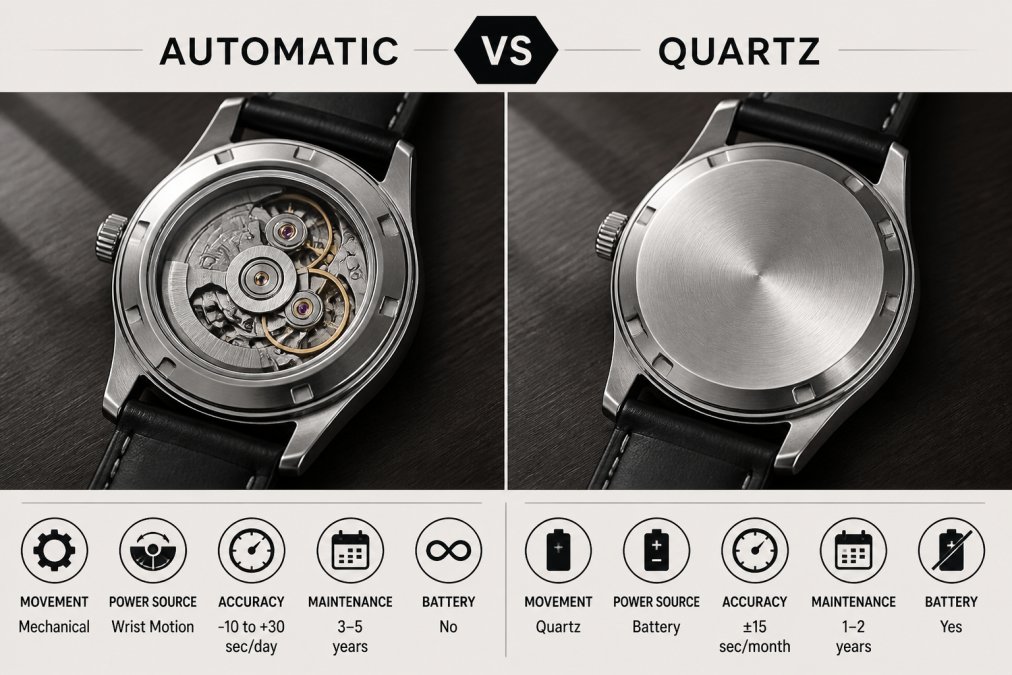
Quartz wins the accuracy contest outright, and it is not close. A quartz caliber typically holds time to within a few seconds per month. A mechanical automatic, even a well-regulated one, drifts by seconds per day. Neither number is a defect; they are simply two different engineering philosophies.
Quartz Accuracy in Real Conditions
Quartz accuracy barely changes with how you live. Temperature swings and battery age affect it slightly, but a quartz watch worn daily, stored in a drawer, or knocked against a doorframe keeps essentially the same rate. That predictability is why quartz became the default for tool watches and everyday wear.
Automatic Accuracy and Rate Variation
Automatic accuracy moves with you. Position matters, so a watch resting crown-up overnight can run at a different rate than one lying flat. Temperature, state of wind, and how much you move all nudge the rate. A common mistake is judging a new automatic after one day. Give any mechanical watch a week of normal wear before you decide how it behaves.
Mechanical Watch Maintenance: What Ownership Actually Requires
Mechanical watch maintenance is the real cost of admission for an automatic, and most buyers underestimate it. A quartz watch needs a battery swap every couple of years and almost nothing else. An automatic needs periodic servicing, and that service is skilled labor.
Here is what ownership actually involves:
- Servicing every several years. Lubricants dry out and parts wear. A watchmaker disassembles, cleans, re-lubricates, and reassembles the caliber.
- Gasket and seal checks. Water resistance depends on rubber seals that harden over time.
- Careful handling. Avoid setting the date during the hours when the mechanism is engaged, and keep magnets away from the case.
- Winding discipline. If you rotate watches, wind a stopped automatic gently before wearing it.
Quartz ownership is simpler, but not free. Batteries leak if left too long, and a dead battery in a drawer can damage the movement.
Power Source, Batteries, and Daily Wear Habits
Your daily routine quietly decides which movement suits you. An automatic rewards movement; a quartz does not care whether you wear it.
If you wear one watch every day, an automatic stays wound and running. If you rotate several watches or only wear one on weekends, an automatic will stop between wears, and you will reset it each time. That is not a flaw, but it is friction, and it is the single most common reason people drift back toward quartz.
Quartz handles irregular wear effortlessly. It runs whether it is on your wrist or in a case, and it only asks for a battery every few years. For anyone with an active, varied schedule, that reliability is worth more than mechanical romance.
Cost, Resale Value, and Long-Term Ownership
Two costs matter here: what you pay up front and what you spend over the life of the watch. Quartz calibers are cheaper to produce, so quartz watches generally cost less to buy and less to keep running. Automatic calibers involve more parts and more hand assembly, which pushes both the purchase price and the service cost higher.
Resale value is where the picture gets murky. Mechanical watches from respected makers can hold value, and some appreciate, because collectors prize mechanical craftsmanship. Quartz watches rarely do, with a few notable exceptions. But resale should never be the reason you buy. Buy the movement you enjoy wearing, and treat any retained value as a bonus rather than a plan.
| Factor | Quartz | Automatic |
|---|---|---|
| Power source | Battery | Wrist motion, mainspring |
| Accuracy | Seconds per month | Seconds per day |
| Maintenance | Battery swap | Periodic servicing |
| Upfront cost | Lower | Higher |
| Resale value | Rarely holds | Can hold or appreciate |
| Best for | Low-effort daily wear | Enthusiasts who wear daily |
Which Movement Fits Your Wrist: A Buyer's Decision Framework
Choose quartz if you want accuracy, low maintenance, and a watch that is ready whenever you are. Choose automatic if you value mechanical craft, enjoy the ritual of winding, and wear one watch most days. There is no wrong answer, only a wrong match for your habits.
Run your own decision this way:
- Do you wear the same watch most days? If no, lean quartz.
- Do you enjoy winding and setting a watch? If no, lean quartz.
- Do you care about mechanical finishing and movement design? If yes, lean automatic.
- Can you budget for periodic servicing? If no, lean quartz.
- Will you still enjoy it in five years? Let this one decide.
At Haim Watch Company, our collection spans both worlds: the Swiss-made Viajero SE and the 100% US-assembled Legacy Automatic, each with hand-finished titanium cases and ornate dial decoration. Whichever movement you choose, buy the one that matches how you actually live, not how you imagine you might.
The hardest part of buying a watch is not choosing between automatic and quartz; it is finding a piece that feels like yours the moment you put it on. Haim Watch Company builds timepieces for exactly that moment, with custom-designed calibers, hand-finished titanium cases, and ornate dial decoration that stands apart from mass-produced designs. Whether you want the Swiss-made Viajero SE or the 100% US-assembled Legacy Automatic, you get sophisticated craftsmanship and reliable timekeeping in one piece. Shop now and start your collection with a watch made to be part of your journey.
Frequently Asked Questions
What is the main difference between an automatic and a quartz watch?
An automatic watch runs on a mainspring wound by the motion of your wrist, while a quartz watch runs on a battery that sends current through a quartz crystal. That single difference drives everything else: quartz movements tick once per second and stay accurate to within seconds per month, while automatics sweep smoothly, need regular wear to keep running, and typically run within a handful of seconds per day.
Which is more accurate, an automatic or a quartz movement?
Quartz wins on raw timekeeping. A standard quartz caliber drifts only a few seconds per month, while a well-regulated automatic movement is usually rated within a few seconds per day, which adds up to a minute or more monthly. Watch movement accuracy in automatics improves with better regulation and higher-grade components, but quartz remains the more precise option for everyday timekeeping.
Do automatic watches require batteries or regular servicing?
No battery is involved, but mechanical watch maintenance matters. Manufacturers generally recommend a full service every five to seven years to clean, lubricate, and re-regulate the movement. Between services, keep the watch wound, avoid magnets and hard knocks, and have the gaskets checked if you swim with it. Quartz watches skip the mechanical service but need a battery change every two to three years.
Are automatic watches worth the higher price point?
It depends on what you value. Automatics cost more because the movement contains hundreds of finished parts assembled and regulated by hand, and that craftsmanship is what you see through an exhibition caseback. If you want set-and-forget accuracy at the lowest cost, quartz is the smarter buy. If you want a mechanical object that ages with you and holds collector interest, an automatic earns its premium.