

Table of Contents
- What Are Watch Movement Complications?
- Types of Watch Complications: A Ranked Guide
- Watch Complications Explained: How They Affect Accuracy and Reliability
- Chronograph Watch Function: Mastering the Stopwatch Complication
- GMT Watch Function and Dual-Time Tracking
- Mechanical, Quartz, and Smartwatch Complications: What's Available Where
- Common Misconceptions About Watch Complications
- Choosing the Right Complications for Your Lifestyle
- Frequently Asked Questions
Last Updated: October 4, 2026
What Are Watch Movement Complications?
A watch movement complication is any function beyond basic timekeeping that a mechanical watch performs, with watch movement complications ranging from simple date displays to intricate mechanisms like tourbillons. While a simple movement measures hours, minutes, and seconds, complications add layers of functionality: a calendar display, a stopwatch, a second time zone, or something far more intricate.
The term "complication" comes from the added complexity required to engineer these functions. A basic automatic movement has fewer than 100 parts; a watch with multiple complications can have 200 or more, each demanding precision in wheels, springs, cams, and escapements that must work in perfect synchronization.
Complications serve practical purposes: a calendar shows the date, a chronograph measures intervals, a GMT function tracks multiple time zones. They also showcase the watchmaker's skill and engineering elegance.
Types of Watch Complications: A Ranked Guide
Complications vary in prevalence and utility. Here's what you'll encounter most often, ranked by prevalence.
Date and Calendar Functions
The date complication is the most widespread function on modern watches, displaying the current day of the month and rotating every 24 hours.
A day-date complication adds the day of the week alongside the date, answering "What day is it?" without checking your phone.
More elaborate calendar complications exist but are far rarer. An annual calendar accounts for months with fewer than 31 days, requiring adjustment only once per year. A perpetual calendar handles leap years automatically and won't need adjustment until the year 2100. Haim Watch Company's Annum features a complete calendar with moonphase, combining a custom mechanical module with our Caliber HWC-2 movement.
Choose based on your tolerance for adjustment: simple date (monthly), annual calendar (yearly), or perpetual calendar (virtually none during your lifetime).
Chronograph and Stopwatch Functions
A chronograph is a stopwatch integrated into your watch movement, using subdials to track elapsed time in hours, minutes, and seconds. Two pushers at the 2 and 4 o'clock positions start, stop, and reset the chronograph independently of the main timekeeping function.
The chronograph wheels must engage and disengage without disrupting the main movement's accuracy, remaining precise to within a second over several minutes of use.
A tachymeter scale often surrounds the dial's outer edge, converting elapsed time into speed. If you time one mile, the tachymeter shows your average speed instantly, an elegant piece of mechanical problem-solving.
The Haim Watch Company L2 Chronograph uses the VK64 caliber, delivering chronograph precision with a design that catches your eye immediately.

Moon Phase Displays
A moon phase complication shows the lunar cycle through a rotating disk visible in a window on the dial, rotating to display the correct phase as the moon waxes and wanes through its 29.5-day cycle.
This function has no practical purpose for most modern wearers, yet it remains popular because it connects the wearer to the actual moon in the sky, a tradition inherited from pocket watches used as navigational aids.
The mechanism requires a 59-tooth wheel that advances slightly each day, with accuracy depending entirely on the underlying movement's precision.
Haim Watch Company's Annum pairs a complete calendar with moonphase display, representing a significant mechanical achievement in custom movement design.
GMT and Dual-Time Functions
A GMT function (Greenwich Mean Time) displays a second time zone on a 24-hour hand, allowing you to track both local time and a reference time zone simultaneously.
The mechanism adds a second hour hand that completes one rotation every 24 hours, operating independently of the main hour hand.
A dual-time complication achieves similar functionality through different means: separate hour and minute hands or a rotating bezel with a second hour hand.
A GMT hand is subtle and doesn't clutter the dial; a full dual-time display is more obvious but takes up more space. Choose based on how often you need a second time zone and your dial space preference.
Power Reserve and Alarm Complications
A power reserve indicator shows how much energy remains in your watch's mainspring, typically 40 to 70 hours for automatic movements.
This complication has practical value: an empty indicator tells you the watch needs winding, and faster-than-expected depletion signals the need for servicing.
An alarm complication adds an audible alert function using a hammer striking a gong or bell inside the case. Mechanical alarm watches are rare because the function adds significant complexity; most modern alarm watches use quartz movements.
Tourbillons and Escapements
A tourbillon is one of watchmaking's most celebrated complications, yet it's fundamentally a solution to a problem that no longer exists. Abraham-Louis Breguet invented it in 1795 to compensate for gravity's effects on accuracy.
The mechanism places the entire escapement and balance wheel inside a rotating cage that completes one rotation per minute. In theory, gravity's effects average out; in practice, modern materials and manufacturing have made tourbillons largely unnecessary for accuracy.
Yet tourbillons remain prized for their visual appeal; many feature a transparent caseback so you can see the cage rotating, justifying the premium price for many collectors.
An escapement is the mechanism that regulates how energy from the mainspring transfers to the timekeeping function. While not technically a complication, understanding escapement types (lever, chronometer, co-axial) helps you appreciate how they affect accuracy, efficiency, and sound.
Watch Complications Explained: How They Affect Accuracy and Reliability
Adding complications changes how a watch behaves: more parts mean more potential points of failure and greater service demands.
Accuracy suffers slightly with each complication added, as extra wheels and springs introduce friction and create more places where wear can accumulate.
A well-serviced complicated movement performs beautifully; a neglected one deteriorates faster than a simple movement.
Servicing costs increase with complication count: simple movements ($200-300), chronographs ($500+), perpetual calendars or tourbillons ($1,000+). Factor this into your decision.
Choose complications that serve your actual lifestyle. A chronograph is worthless if you never time anything; a GMT function adds no value if you never travel; a perpetual calendar is overkill if you adjust a date once yearly.
Chronograph Watch Function: Mastering the Stopwatch Complication
The chronograph is the most popular complication after date functions: it's visually striking and mechanically elegant.
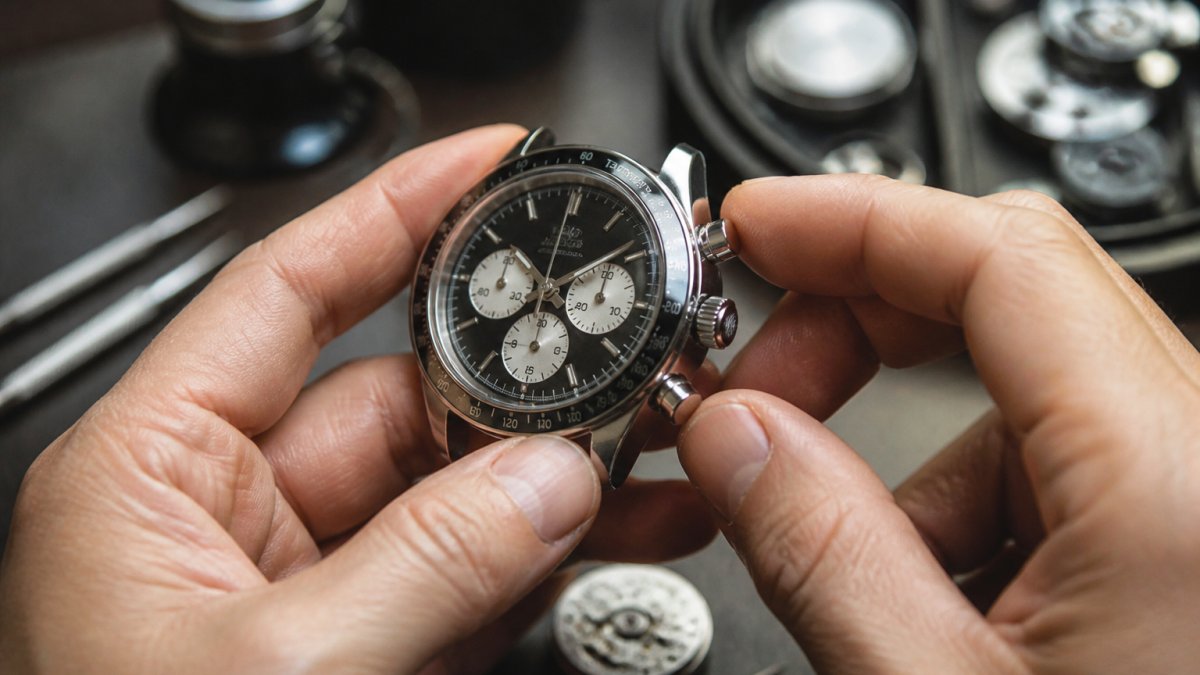
A chronograph has three subdials for elapsed seconds, minutes, and hours. The top pusher at 2 o'clock starts and stops timing; the bottom pusher at 4 o'clock resets to zero.
The tachymeter scale printed around the dial's edge converts elapsed time into speed. If you time one mile and the chronograph reads 45 seconds, the tachymeter shows your speed: 80 mph.
Common mistakes: forgetting that the chronograph operates independently of basic timekeeping, and leaving it running after use, which eventually stops it from advancing.
The L2 Chronograph from Haim Watch Company delivers this function with precision and visual clarity, with the VK64 caliber powering reliable operation.

GMT Watch Function and Dual-Time Tracking
A GMT function solves a specific problem: tracking two time zones simultaneously without mental math.
The GMT hand completes one rotation every 24 hours, twice as slow as the main hour hand. Set it to your reference time zone, then set the main hour hand to local time.
The practical advantage: the GMT hand doesn't interfere with telling local time, sitting underneath visible but not distracting.
To set a GMT function: adjust the hour hand to local time, then use the crown to adjust the GMT hand independently to your reference time zone (consult your manual for exact instructions).
GMT functions benefit anyone coordinating across time zones: remote teams, customer service operations, and finance professionals all find them valuable.
Mechanical, Quartz, and Smartwatch Complications: What's Available Where
Mechanical movements can feature virtually any complication, but the most elaborate ones (perpetual calendars, minute repeaters, tourbillons) appear almost exclusively in mechanical watches because they require physical mechanisms that electronics can replicate without the mechanical elegance.
Quartz watches can display calendars, chronographs, and dual-time functions electronically. A quartz chronograph is often more accurate than a mechanical one because quartz timekeeping is more precise. However, quartz chronographs lack the mechanical satisfaction, the feeling of pushing buttons that engage physical mechanisms inside the watch.
Smartwatches offer unlimited complications through software. They can track heart rate, display notifications, run apps, and record data. But they lack something mechanical watches possess: the independence from battery charging and the mechanical connection between function and physical mechanism.
The trade-off is philosophical. Mechanical complications represent engineering achievement. Quartz and smartwatch complications represent technological convenience. Choose based on what appeals to you: the mechanical satisfaction of a chronograph's pushers engaging internal mechanisms, or the practical precision of quartz timekeeping.
Common Misconceptions About Watch Complications
Misconception 1: More complications mean better accuracy. False. Accuracy depends on the movement's design, materials, and regulation, not on how many functions it has.
Misconception 2: Complications always add value. Not necessarily. A perpetual calendar adds value only if you wear the watch long enough to benefit from its accuracy. A chronograph adds value only if you actually time things.
Misconception 3: Rare complications are always desirable. Rarity doesn't equal utility. A minute repeater (a complication that chimes the time) is rare and mechanically impressive, but most modern wearers find it impractical.
Misconception 4: Complications require constant adjustment. Some do, some don't. A simple date requires monthly adjustment. An annual calendar requires yearly adjustment. A perpetual calendar requires virtually none. Understand what you're committing to before buying.
Misconception 5: Quartz complications are inferior to mechanical ones. They're different. A quartz chronograph is often more accurate than a mechanical one. A quartz perpetual calendar is less mechanically satisfying but equally functional. Choose based on what matters to you.
Choosing the Right Complications for Your Lifestyle
The best complication is the one you'll actually use. Start by asking yourself: What information do I need on my wrist? What functions would improve my daily routine?
If you're a professional who needs to track time zones, a GMT function answers a real need. If you travel rarely, it's unnecessary complexity.
Consider maintenance requirements. Simple complications (date, day-date) require minimal service beyond normal movement maintenance. Complex complications (perpetual calendar, minute repeater) demand specialized expertise and higher costs.
Think about visual clarity. A watch with too many subdials becomes difficult to read at a glance.
Consider your lifestyle aesthetics. A chronograph suits someone who values precision and timing. A moonphase appeals to someone who appreciates horological tradition.
The final consideration: authenticity. Choose complications because they serve you, not because they impress others. The most satisfying watch is one whose functions align with how you actually live.
Choosing a watch with the right complications means understanding what each function does, how often you'll use it, and whether it fits your lifestyle.
Frequently Asked Questions
What is the difference between a chronograph and a chronometer?
A chronograph is a watch complication that functions as a stopwatch, with pushers that start, stop, and reset timing functions. A chronometer is a watch certified to meet strict accuracy standards set by official testing organizations. A watch can be both: a chronograph chronometer combines the stopwatch function with certified precision. Many people confuse these terms, but they describe entirely different features.
Are watch movement complications available in both quartz and automatic movements?
Most complications exist in both quartz and automatic movements, though implementation differs. Automatic movements use mechanical gears and escapements for complications like chronographs and GMT functions. Quartz movements rely on electronics and motors. Mechanical complications like tourbillons are exclusive to automatic movements because they regulate the escapement itself. For everyday wear, quartz chronographs and GMT functions offer reliable performance with less maintenance than their mechanical counterparts.
Which watch complications are most useful for everyday wear?
Date displays and GMT functions rank highest for daily utility. A date complication keeps you oriented without checking your phone, while GMT functions help travelers and remote workers track multiple time zones. Chronographs appeal to professionals who time tasks frequently. Alarm complications are practical for morning routines. Power reserve indicators matter if you wear your automatic watch inconsistently. Choose based on your actual habits, not what sounds impressive on paper.
Do watch complications affect how often I need to service my watch?
Yes. More complications mean more moving parts, gears, and mechanical interactions. A simple three-hand automatic watch typically needs servicing every 5-7 years. A watch with multiple complications, especially a tourbillon or minute repeater, may require servicing every 3-5 years. The escapement and balance wheel, which regulate timekeeping, wear faster under the stress of additional functions. Quality finishing and regular maintenance extend intervals, but expect more frequent professional attention as complexity increases.