

Table of Contents
- Why Guy Watch Brands in 2026 Reward Buyers Who Know Movements
- Watch Movement Types Explained: Automatic, Mechanical, and Quartz
- Entry-Level vs. High-End: Where Guy Watch Brands Actually Differ
- Best Mechanical Watches for Men: Matching the Watch to the Wrist
- How to Start a Watch Collection Without Overpaying
- Sizing, Wrist-to-Case Ratio, and the Cost of Ownership
- Buying Pre-Owned: Secondary Market Tips for Guy Watch Brands
- Conclusion: Building a Collection That Holds Its Value
- Frequently Asked Questions
Last Updated: October 2, 2026
Why Guy Watch Brands in 2026 Reward Buyers Who Know Movements
The market for guy watch brands has split into two camps: those who understand what is inside the case, and those who pay for a logo. Understanding movement types, case sizing, and long-term ownership costs separates a smart purchase from an expensive mistake.
A mechanical watch is a timepiece powered by a mainspring and gear train rather than a battery, wound either by hand or by the motion of the wrist. That single distinction drives everything else: service intervals, accuracy tolerances, and resale performance. According to the American Watchmakers-Clockmakers Institute guide to watch servicing, mechanical movements require periodic maintenance that quartz watches do not, which is the hidden cost most buyers ignore.
Below, we break down movement types, price tiers, sizing math, and pre-owned strategy so you can buy once and buy well.
Watch Movement Types Explained: Automatic, Mechanical, and Quartz
Automatic movements wind themselves through wrist motion; manual mechanical movements require hand-winding; quartz movements run on a battery and a vibrating crystal.
Automatic and manual watches share the same core architecture: a mainspring, escapement, and balance wheel. The difference is the rotor.
Quartz is the practical choice: more accurate, cheaper to service, and needing only a battery change every few years instead of a full movement service.
Entry-Level vs. High-End: Where Guy Watch Brands Actually Differ
The gap between a $500 watch and a $2,500 watch is rarely about telling time. The difference is finishing, complication count, and assembly origin.
Entry level buys a reliable movement, a stainless-steel case, and a clear dial. The high end buys hand-finishing, custom calibers, and complications that require real engineering.
The $400 to $900 Tier: Chronographs and Worldtimers
This tier is where guy watch brands compete hardest. A chronograph adds a stopwatch; a worldtimer displays multiple time zones. Both are genuinely useful complications rather than decoration.
The Haim Watch Company L2 Chronograph sits at $489 and runs the VK64 caliber, chosen for ease of use and accurate timekeeping. Its case blends brushed and polished surfaces with chamfered edges and comes in four dial themes. The L2 Chronograph (Anniversary Edition) at $515 is limited to 30 pieces per dial, individually numbered on the caseback, and revives the Pulsometer scale from earlier Legacy models.

The Viajero, at $899.99, introduces a worldtimer complication at a price most brands reserve for simple three-handers. Its 38.5mm case and 20mm lug width keep it wearable, and the exhibition caseback shows an Atlas-shaped rotor.
| Model | Price | Complication | Case Size | Best For |
|---|---|---|---|---|
| L2 Chronograph | $489.00 | Chronograph | Brushed/polished case | First mechanical purchase |
| L2 Anniversary Edition | $515.00 | Chronograph, Pulsometer | Limited 30 per dial | Collectors wanting rarity |
| Viajero | $899.99 | Worldtimer | 38.5mm | Frequent travelers |
The $2,000 to $2,500 Tier: Calendar Complications and Swiss Assembly
Spending above $2,000 buys complications that take real watchmaking skill to build. A complete calendar tracks date, day, and month; a moonphase adds a lunar display accurate for years.
The Annum, at $2,149.99, debuts Haim Watch Company's Caliber HWC-2 and a custom mechanical calendar module with a Complete Calendar and Moonphase. Its 38mm case carries a neo-vintage dial in three colorways, two with intricate CNC guilloché patterns.
Best Mechanical Watches for Men: Matching the Watch to the Wrist
The best mechanical watch for men is the one whose case diameter, thickness, and lug width fit the wearer's wrist, not the one with the biggest spec sheet. Fit beats prestige.
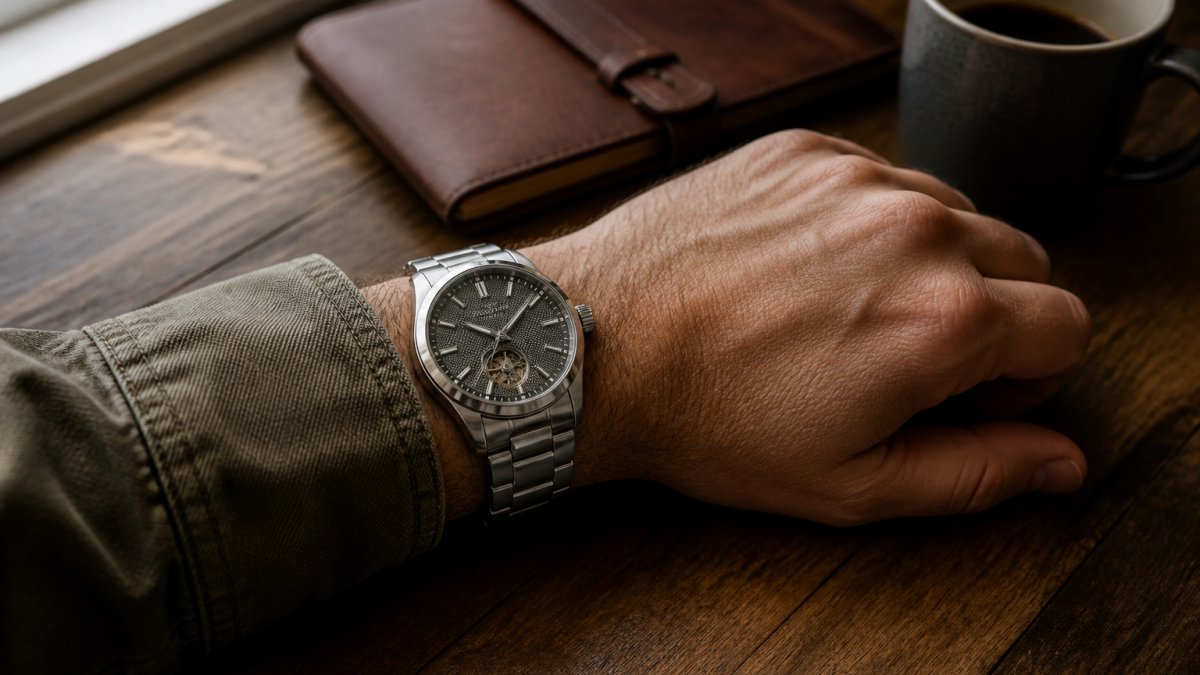
Start with case diameter. A 38mm case suits wrists roughly 6.5 to 7.25 inches around, covering most men; a 39.5mm case reads slightly larger without becoming bulky.
Lug width determines how the watch wears on a strap. A 20mm lug width is the sweet spot, offering the widest aftermarket strap selection. Both the Annum and the Viajero use 20mm lugs, so swapping between leather and steel is straightforward.

How to Start a Watch Collection Without Overpaying
Start a watch collection by buying one versatile piece first, then adding a second that fills a genuine gap. Most new collectors buy three similar watches and end up with redundancy. The fix is a buying framework, not a shopping list.
The 50/30/20 Budget Rule for a First Collection
A practical pattern is to split a first-year watch budget roughly 50/30/20:
- 50% on the daily wearer. One stainless-steel three-hander or chronograph on a swappable 20mm strap, the watch you wear four or five days a week.
- 30% on the second piece. A complication you will actually use, a worldtimer if you travel, a calendar if you reference the date constantly. Do not buy a second three-hander.
- 20% held in reserve. The fund for the first service, a strap upgrade, or a pre-owned piece at a good price. Collectors who skip this reserve end up selling the first watch to pay for the second.
The Three-Question Test Before Any Purchase
Before you buy, answer three questions in writing:
- What does this watch do that my current watch cannot? If the answer is "nothing," you are buying a duplicate.
- What is the total five-year cost? Purchase price plus one service plus strap or bracelet changes. A $489 watch with a $200 service is a $689 watch.
- Who is the buyer if I resell? A 38mm stainless steel piece with a named caliber has a broad buyer pool; a 44mm fashion watch with an unnamed movement does not.
What to Avoid in Year One
- Buying two watches in the same category. Two chronographs, two divers, or two dress watches is redundancy, not a collection.
- Chasing limited editions before you know your size. Scarcity does not fix a bad fit.
- Paying full retail on a model that trades below retail pre-owned. Check the secondary market before you buy new.
- Ignoring the strap ecosystem. A watch with a 20mm lug width gives you dozens of aftermarket options; an odd lug width gives you almost none.
When to Add the Third Watch
Buy the third watch only after wearing the first for several months and the second for a few weeks. By then you will know whether you prefer a smaller case, a lighter titanium build, or a bolder dial. The third piece should have a story behind it, a limited edition, a hand-finished dial, or a complication that took real engineering.
Sizing, Wrist-to-Case Ratio, and the Cost of Ownership
Wrist-to-case ratio is the relationship between your wrist circumference and the watch's lug-to-lug measurement. A watch should leave a small gap between the lugs and the edge of your wrist. It is the single most useful fit metric, and most buying guides skip it.
How to Measure Your Wrist and Match It to a Case
Measure your wrist with a soft tape at the narrowest point, just behind the wrist bone. Then use this starting framework:
| Wrist Circumference | Case Diameter Range | Lug-to-Lug Ceiling |
|---|---|---|
| 6.0 to 6.5 in | 34mm to 37mm | 44mm |
| 6.5 to 7.0 in | 36mm to 39mm | 47mm |
| 7.0 to 7.5 in | 38mm to 41mm | 50mm |
| 7.5 in and up | 40mm to 44mm | 52mm |
Case diameter is the number brands advertise, but lug-to-lug determines fit. A 38mm case with long lugs can wear larger than a 40mm case with short ones. Always ask for the lug-to-lug figure before buying online.
Thickness and Lug Width Matter Too
- Thickness: A 10mm case slides under a shirt cuff. A 12mm case sits higher and reads more casual. A 14mm case is a tool watch and will catch on sleeves.
- Lug width: 20mm is the sweet spot, offering the widest aftermarket strap selection. 18mm and 22mm are also well supported. Odd widths like 19mm or 21mm limit your options.
The Real Cost of Ownership: Service Intervals and Repair
Cost of ownership goes beyond the purchase price. Mechanical watches need servicing every several years, and the bill scales with complication count. A simple three-hander costs far less to maintain than a complete calendar with a moonphase module.
Generally, for mechanical watches:
- Simple three-hander or chronograph: service every 5 to 7 years. The work is a clean, oil, and regulate.
- Calendar or moonphase complication: service every 4 to 6 years. The module adds parts and labor.
- Worldtimer or GMT: service every 5 to 7 years. The additional time-zone mechanism adds complexity but not as much as a calendar module.
Quartz watches skip the movement service entirely: a battery change every 2 to 3 years plus a gasket check to maintain water resistance.
What Drives the Service Bill
| Ownership Factor | Entry-Level | High-End |
|---|---|---|
| Purchase price | $489 to $900 | $2,100 to $2,500 |
| Service interval | 5 to 7 years | 4 to 6 years |
| Service cost driver | Simple movement | Complication count |
| Parts availability | Widely available calibers | Brand-specific modules |
| Resale liquidity | Broad buyer pool | Narrower, collector-driven |
Pre-Owned Sizing and Service Checks
When buying pre-owned, verify the case has not been over-polished, original case lines matter for appearance and value. Ask for the service history and caliber name. A watch with a documented recent service is worth more than one with unknown history, because you are buying the next several years of trouble-free ownership. If a seller cannot show the movement or name the caliber, walk away.
Buying Pre-Owned: Secondary Market Tips for Guy Watch Brands
The secondary market rewards buyers who verify condition and provenance before paying. Ask for service history, original box and papers, and clear photos of the caseback and movement.
Limited editions hold interest better than open-production models because supply is fixed. The L2 Anniversary Edition, capped at 30 pieces per dial, is the kind of release that stays scarce. For everyday models, buy the version you will actually wear.
Conclusion: Building a Collection That Holds Its Value
The hardest part of collecting is resisting the urge to buy everything at once. Collectors who do well buy deliberately: one versatile piece, one complication they use, and one watch with genuine scarcity behind it.
Haim Watch Company builds timepieces for exactly that approach. The L2 Chronograph brings a VK64 caliber and a chamfered case at $489. The Annum pairs a custom Caliber HWC-2 with a Complete Calendar and Moonphase at $2,149.99. The Viajero SE delivers Swiss Made assembly and Grand Feu enamel dials at $2,495.99.

Shop now at Haim Watch Company and start a collection built on movements you understand, not logos you rent.
Frequently Asked Questions
What are good watch brands for guys who want something beyond the usual names?
Look at what a brand builds rather than how long it has existed. A small maker that designs its own calibers, finishes cases by hand, and assembles in the United States or Switzerland gives you more watch per dollar than a mass-market logo. Haim Watch Company is one example: the 100% US-assembled Legacy Automatic and the Swiss-made Viajero SE both use custom-designed calibers and ornate dials, so the craftsmanship is visible on the wrist instead of buried in marketing copy.
What is the difference between mechanical and quartz watch movements?
A quartz movement runs on a battery and a vibrating crystal, which makes it accurate to within a few seconds a month and cheap to service. A mechanical movement, whether automatic or hand-wound, runs on gears and a mainspring with no battery at all. Mechanical watches lose a few seconds a day but carry the finishing, power reserve, and exhibition casebacks that collectors value. Quartz suits a grab-and-go daily watch; mechanical suits someone building a collection.
How do I choose the right watch brand for my lifestyle?
Start with case diameter and water resistance, then work backward to the brand. A 38mm to 39.5mm case with a 20mm lug width sits well on most wrists and slides under a shirt cuff. If you work in tech or dress casually, a stainless steel case with a brushed finish reads less formal than a polished dress watch. If you travel, a worldtimer complication earns its place; if you dress up twice a year, a chronograph is the more useful buy.
Are US-assembled watches a good investment?
Assembly location alone does not create value, but limited production does. A run capped at 30 pieces per dial, individually numbered on the caseback, gives a watch scarcity that mass-produced models cannot match. Buy for the movement, the finishing, and the production numbers, not the flag on the box. Watches held for years tend to fare better than those flipped in months, and servicing costs should be part of your math from day one.