

Last Updated: November 7, 2026
Quick Summary
To choose a chronograph watch for beginners, start with how you will actually use it, then check fit, legibility, and what you can comfortably maintain. A standard two-pusher setup is plenty for a first watch, and quartz is the simpler, cheaper-to-own choice if mechanical service costs would make you wince.
- A chronograph watch is a timepiece with a built-in stopwatch, run by two pushers beside the crown.
- Stop the chronograph before you reset it, or you risk damaging the mechanism.
- Quartz needs no winding and is generally the cheapest to own; mechanical costs more to buy and service.
- Most automatic chronographs reserve 38 to 48 hours of running time when off the wrist.
- A mechanical chronograph needs servicing every five to seven years; quartz batteries last two to three years.
Table of Contents
- Start With How You'll Actually Use the Watch
- How to Use a Chronograph Watch: Pushers, Crown, and Reset
- The Types of Chronograph Movements and What They Cost You
- What Are the 3 Dials on a Chronograph Watch?
- Fit, Legibility, and the Checks You Can Do Before Buying
- Choosing a Chronograph Watch for Everyday Wear
- Total Cost of Ownership and the Beginner Budget Framework
- Pick Your First Chronograph at Haim Watch Company
- Frequently Asked Questions
Start With How You'll Actually Use the Watch
Learning how to choose a chronograph watch for beginners starts with one question: what will you actually time? A chronograph watch is a timepiece with a built-in stopwatch, run by two pushers beside the crown. Pick the use case before the look. That single decision shapes everything after it.
Most beginners buy the dial first and regret it later. The watch looks stunning in photos, then sits in a drawer because the pushers are stiff or the subdials are unreadable.
Start here instead:
- Office and daily wear: a clean dial, moderate case size, and a strap that slides under a cuff.
- Weekend and outdoors: stronger water resistance, a legible minute counter, and a durable bracelet or strap.
- Collecting and rotation: a mechanical movement you enjoy winding, even if it needs more care.
- Timing real events: cooking, laps, presentations. A quartz chronograph is simpler and more accurate.
Write down your top two uses. If they conflict, favor the one the watch will see most often.
How to Use a Chronograph Watch: Pushers, Crown, and Reset
A chronograph watch runs on three controls. The top pusher starts and stops the central seconds hand. The bottom pusher resets it to zero. The crown sets the time and date. That is the whole system.
Here is the sequence to practice:
- Press the top pusher once to start timing.
- Press it again to stop. The elapsed time freezes on the subdials.
- Press the bottom pusher to reset everything to zero.
One rule matters more than the rest. Stop the chronograph before you reset it.
The Types of Chronograph Movements and What They Cost You
The movement is the engine, and it decides the price, the feel, and the upkeep. A movement is the internal mechanism that powers the watch and drives the chronograph function. For a beginner, the useful split is not brand or country of origin, it is quartz versus mechanical, and within mechanical, hand-wound versus automatic.
Quartz chronographs run on a battery and a quartz crystal oscillator. The chronograph function is usually driven by a dedicated stepper motor, which is why the central seconds hand on many quartz chronographs ticks once per second rather than sweeping. Quartz needs no winding and is generally the cheapest to own. The trade-off is that the second hand lacks the smooth sweep many enthusiasts associate with a mechanical chronograph, and the watch will eventually need a battery change. The Haim L2 Chronograph is powered by the VK64 caliber, chosen for ease of use and more accurate timekeeping.
Mechanical chronographs are powered by a wound mainspring and regulated by a balance wheel. They come in two winding styles:
- Hand-wound (manual): you wind the crown every day or two. Fewer parts, often a thinner case, and a ritual many beginners come to enjoy.
- Automatic: a rotor spins with wrist motion and winds the mainspring. Convenient if you wear the watch daily; it will stop if it sits in a drawer for a couple of days, and most automatic chronographs reserve 38 to 48 hours of running time.
Mechanical chronographs cost more to buy and more to service. Mechanical chronographs cost more to buy and more to service than simpler watches, because the chronograph module adds parts. Budget for servicing as a real ownership cost.
Within mechanical chronographs you will meet two engagement mechanisms. A cam-actuated chronograph uses shaped cams and levers to start, stop, and reset; it is robust, cheaper to produce, and perfectly adequate for daily use. A column wheel chronograph uses a rotating column wheel to coordinate the same actions; the pusher feel is usually crisper and the mechanism is more expensive to make. Neither is more accurate at timing, the difference is feel, cost, and the romance of the mechanism.
You will also see these chronograph types:
- Standard two-pusher chronograph: start/stop on the top pusher, reset on the bottom. This is what almost every beginner should buy.
- Flyback chronograph: one press of the reset pusher restarts timing from zero without a stop-reset-start sequence. Useful for timing consecutive laps.
- Split-seconds (rattrapante) chronograph: two central seconds hands let you time two events that start together but finish apart. Rare, complex, and expensive.
For a first watch, a standard two-pusher setup is plenty. If you want the deeper mechanics, our guide to common watch movement complications explains what each one adds.
What Are the 3 Dials on a Chronograph Watch?
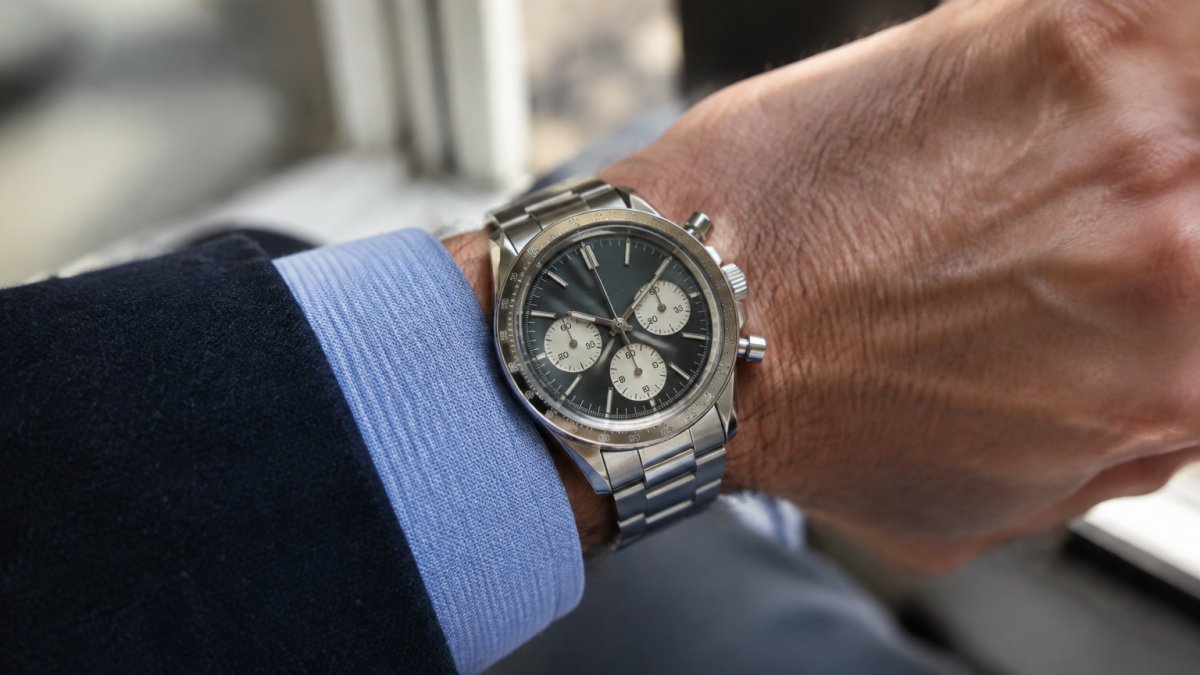
The three dials, called subdials or registers, usually show elapsed seconds, elapsed minutes, and elapsed hours. Together they let you read a timed event at a glance.
Layout varies by watch. A common arrangement puts the running seconds on one subdial, the minute counter on another, and a 24-hour indicator on the third. Not every third subdial counts hours, so read the spec sheet.
Why does this matter for a beginner? Legibility. Small subdials with thin hands are hard to read at a glance. Look for clear contrast between the hands and the subdial face.
Fit, Legibility, and the Checks You Can Do Before Buying
Fit decides whether you wear the watch or leave it in the box. Pay attention to case diameter, case thickness, and lug-to-lug length, the distance from one lug tip to the other. That last number tells you more about wrist fit than diameter alone.
The man is American.
Run these checks before you commit:
- Measure your wrist with a soft tape, then compare it to the lug-to-lug length.
- Check cuff clearance. A thick case catches on shirt sleeves.
- Read the dial in a photo at arm's length. If you cannot tell the time quickly, it will annoy you daily.
- Confirm water resistance matches how you live.
- Look at the bracelet or strap. Quick-release pins make swapping easy; our Signature Beads of Rice Bracelet fits the Viajero and L2 Chronograph for exactly that reason.
Choosing a Chronograph Watch for Everyday Wear
Everyday wear rewards restraint. The best daily chronograph is comfortable, legible, and versatile enough to pair with most of your wardrobe.

A few practical filters:
- Case material: stainless steel resists scratches well. Titanium is lighter on the wrist.
- Crystal: sapphire resists scratches better than mineral glass.
- Dial legibility: high contrast and clear hands beat busy decoration for daily use.
- Strap options: a bracelet suits the office; a strap suits weekends.
- Power source: quartz means set-and-go. Mechanical means winding or wearing it regularly.
A chronograph watch for everyday wear should disappear on your wrist by lunchtime. If you notice it constantly, the fit is wrong.
Total Cost of Ownership and the Beginner Budget Framework
The purchase price is only part of the cost. A mechanical chronograph needs servicing every five to seven years, and that service can cost a meaningful share of the watch's price. Quartz watches need battery changes instead, typically every two to three years, and far cheaper per visit. Neither is a reason to avoid a category; both are reasons to buy with the full number in view.
Use this framework to set a realistic budget. The bands below describe what you get at each level, not specific products:
| Budget band | What it typically buys | Main trade-offs |
|---|---|---|
| Entry | Quartz chronograph, mineral or entry sapphire crystal, steel case, basic water resistance | Accurate and low-maintenance; less refined finishing, ticking seconds hand, limited water resistance |
| Mid | Better quartz or entry mechanical, sapphire crystal, stronger water resistance, solid bracelet | Servicing enters the picture on mechanical; case may be thicker |
| Upper-mid | Mechanical chronograph with a recognized movement, good finishing, 100 m or better water resistance | Higher purchase price and real service costs; heavier on the wrist |
| Enthusiast | Column-wheel or specialty chronograph, premium finishing, collector demand | Service can approach a large fraction of purchase price; diminishing daily-wear returns |
Then layer the ownership costs on top:
- Battery replacement (quartz): a routine jeweler visit every few years. Cheap, quick, and the main reason quartz suits a first watch.
- Servicing (mechanical): every five to seven years, priced well above a three-hand service because the chronograph module adds parts and labor. Ask the seller for the recommended interval before you buy.
- Repair complexity: chronograph parts are more numerous and more specialized than three-hand parts, so repairs cost more and take longer. A watchmaker who services chronographs is not the same as one who only changes batteries.
- Strap and bracelet wear: leather straps wear out in a year or two of daily wear; steel bracelets last far longer but may need sizing and occasional refinishing.
A practical rule for a first chronograph: spend on fit, legibility, and a movement you can actually maintain, not on prestige. If a mechanical chronograph's service cost would make you wince, a quartz chronograph is the honest choice, it will keep better time and cost less to own.
Our advice for a first purchase: spend on fit and legibility, not on prestige. If you are weighing brand trust, our microbrand watch reviews guide for beginners walks through how to judge a smaller brand before you buy.
Pick Your First Chronograph at Haim Watch Company
Your first chronograph comes down to three things: how you will use it, how it fits, and what you can comfortably maintain. Get those right and the watch earns its place on your wrist.
The L2 Chronograph is powered by the VK64 caliber and features a case that blends brushed and polished surfaces with chamfered edges, across four dial themes. The L2 Chronograph (Anniversary Edition) is limited to 30 pieces per dial, individually numbered on the caseback, and brings back the Pulsometer scale.
Browse the full chronograph collection, or start with the L2 Chronograph itself. Either way, you get ornate dial design and reliable timekeeping without a collector's learning curve.

Ready to time something worth remembering? Haim Watch Company pairs custom-designed calibers with hand-finished cases and dials that reward a closer look. Start with the L2 Chronograph and see how a well-made chronograph fits a beginner's wrist.
Frequently Asked Questions
What should a beginner look for in a chronograph watch?
Start with the movement, then work outward. A quartz caliber like the VK64 in the Haim L2 Chronograph keeps time accurately and needs little upkeep, while a mechanical movement costs more to service but appeals to collectors. After that, check case diameter and lug-to-lug length against your wrist, confirm the subdials are readable at a glance, and set a budget that includes future servicing. Fit and legibility matter more than the badge on the dial.
Is a chronograph watch the same as an automatic watch?
No. Chronograph describes the stopwatch function, while automatic describes how the watch is powered by a rotor that winds the mainspring as you move. A chronograph watch can run on quartz, manual-wind, or automatic movements. The Haim L2 Chronograph, for example, is powered by the VK64 caliber, so it is a chronograph; check its listing for movement details. Decide which feature you want first, then shop within that category.
Are chronograph watches good for everyday wear?
They can be, provided the case is not too thick and the dial stays readable. When choosing a chronograph for everyday wear, check case diameter and lug-to-lug length against your wrist width, and confirm water resistance before wearing it near water.
What is a tachymeter used for on a chronograph?
A tachymeter scale converts elapsed time into speed. Start the chronograph, stop it after one unit of distance or a known interval, and the central seconds hand points to a number on the bezel or dial flange. It was designed for timing speed over a measured mile. The Haim L2 Chronograph (Anniversary Edition) brings back the Pulsometer scale.
