

Last Updated: November 1, 2026
Quick Summary
Choose water-resistant watches rated 100m or higher, since that covers swimming and showering while staying slim enough for daily office wear. Confirm the case is under 12mm thick, the lug-to-lug length fits your wrist, and the strap is quick-release so you can swap leather for mesh or resin on weekends.
- A 30m rating is splash-resistant only and can fail in a pool from dive-entry pressure.
- A 200m diver adds gaskets and a thicker caseback that pushes it out of a shirt cuff.
- Keep lug-to-lug length within about 2mm of your wrist's flat top width.
- Rinse with fresh water after saltwater or chlorine exposure and keep the crown screwed down.
- Have seals checked every few years or after any hard knock to the case.
Table of Contents
- What Water-Resistance Ratings Actually Mean in Real Use
- Best Everyday Watches for Office-to-Weekend Wear
- Why 100m Water-Resistant Watches Hit the Sweet Spot
- Dress Watches With Water Resistance: Style Without Compromise
- Does Water Resistance Decrease Over Time? Care and Maintenance
- Fit and Comfort for All-Day Wear
- Choosing Your Office-to-Weekend Watch
- Frequently Asked Questions
What Water-Resistance Ratings Actually Mean in Real Use
A water-resistance rating is a laboratory depth figure, not a promise that you can dive to that depth. The number tells you how much static pressure a watch survived during testing, which is why a 100m water-resistant watch is fine for swimming but not for deep diving.
Here is what the numbers mean in practice:
- 30m (3 ATM): Splash-resistant only. Handwashing is fine; swimming is not.
- 50m (5 ATM): Light swimming in calm water. Skip the diving board.
- 100m (10 ATM): Swimming, snorkeling, and showering without worry.
- 200m (20 ATM): Serious water sports, recreational diving, and rough surf.
The gap between the label and real life matters most at the low end. A watch rated 30m can fail in a pool because the pressure of a dive entry far exceeds the static rating.
Here is what the common water-resistance ratings mean in everyday use.
| Rating | Real-world use | Note |
|---|---|---|
| 30m (3 ATM) | Splash-resistant only; handwashing fine, swimming not | Can fail in a pool due to dive-entry pressure |
| 50m (5 ATM) | Light swimming in calm water | Skip the diving board |
| 100m (10 ATM) | Swimming, snorkeling, and showering without worry | Sweet spot for daily wear |
| 200m (20 ATM) | Serious water sports, recreational diving, rough surf | Usually thicker, heavier case |
Best Everyday Watches for Office-to-Weekend Wear
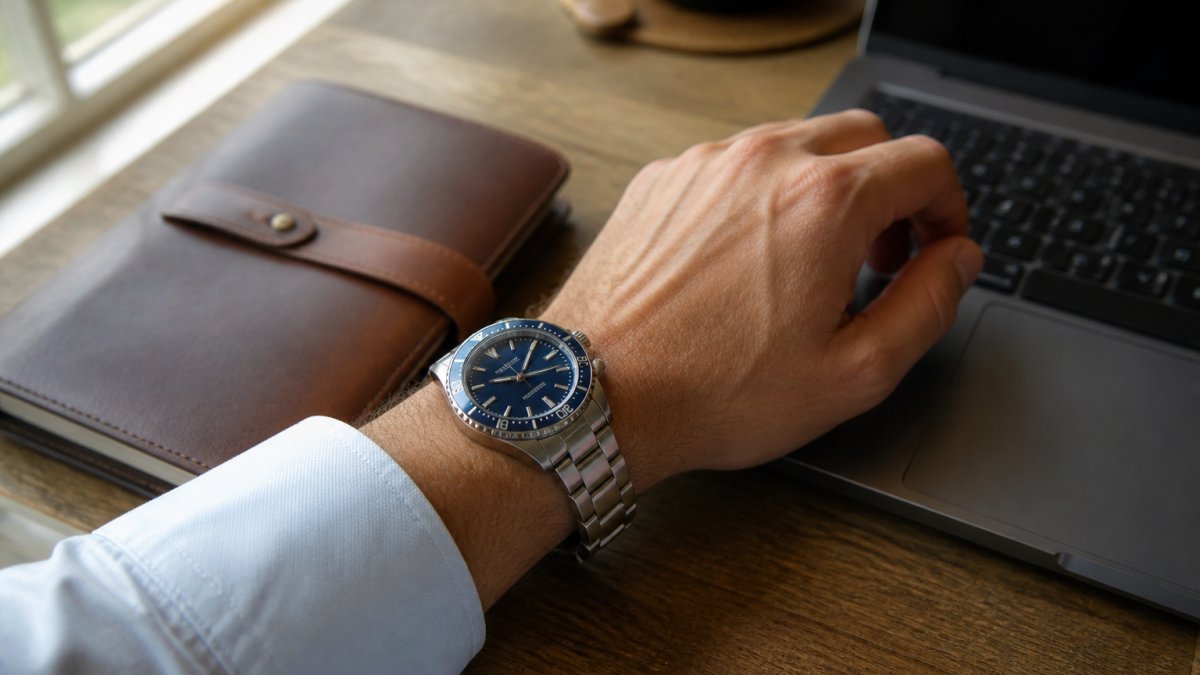
The best everyday watch for office-to-weekend wear is one that reads formal enough for a meeting and tough enough for a Saturday hike. The Descent is built for exactly that blend of dress style and rugged readiness. That means a clean dial, a case that slips under a cuff, and a rating of at least 100m. The hard part is that most watches optimize for one setting or the other: a slim dress watch looks right at a desk but feels fragile at a trailhead, while a chunky diver survives the weekend but bulges under a shirt cuff.
Three specs decide whether a watch pulls this off:
- Case thickness: Under 12mm sits flat under a shirt cuff; under 11mm is the safer target if you wear slim-fit or French-cuff shirts.
- Dial legibility: Applied indices and a simple handset read well in low office light, while a busy chronograph or oversized numerals tilt the watch toward weekend-only.
- Strap versatility: A quick-release leather band for the week and a mesh or resin band for the weekend covers both modes without tools.
Case diameter is the second lever. A 38-40mm case reads dressier on most wrists and disappears under a cuff; a 42-44mm case reads sportier and works better on a 7-inch-plus wrist. Lug-to-lug length matters more than diameter for cuff clearance, if the lugs overhang your wrist, the watch will catch on fabric no matter how thin the case is.
Dial design is where office-to-weekend styling is won or lost. A sunburst or matte dial in black, blue, or silver pairs with a suit and a flannel; a bright orange or lime dial is a weekend statement. A date window at 3 o'clock is the most office-friendly complication; a rotating bezel or chronograph pushers push the watch toward casual. None of these are dealbreakers, they are dials you turn toward one setting or the other.
Strap material carries the same signal. Leather reads professional but dislikes chlorine and saltwater; silicone and resin shrug off water but look casual in a meeting; stainless steel and mesh sit in the middle and work in both settings. A watch with quick-release lugs lets you swap a leather band for a mesh or rubber band in seconds, which is the single easiest way to stretch one watch across the whole week.
As Dappered's affordable-watch roundup notes, a stainless-steel diver with a 200-meter rating can be had without a luxury price, which shows how far practical water resistance has come at the accessible end.
Why 100m Water-Resistant Watches Hit the Sweet Spot
100m water-resistant watches are the sweet spot because they cover swimming and showering while staying slim enough for daily wear. Push to 200m and the case usually grows thicker and heavier. Drop to 50m and you lose the freedom to swim without thinking.
Case size is the trade-off. A 200m diver adds gaskets, a screw-down crown, and a thicker caseback, all of which push the watch off the wrist and out of a dress shirt cuff. A 100m watch keeps a slimmer profile while still handling a pool session.
GearJunkie's field-watch coverage lists field watches with 100-meter resistance, which reflects how common that rating has become for outdoor-focused pieces. For most people, 100m is the rating that stops the second-guessing. Browse the Sports & Adventure collection to see the watches that carry this rating.
Dress Watches With Water Resistance: Style Without Compromise
What to look for in a dressy water-resistant piece:
- A slim case that clears a cuff, ideally under 11mm
- A push-pull or screw-down crown with a proper seal
- A leather or mesh band that can be swapped for weekend wear
The styling question trips people up more than the spec sheet. A dress watch with a sporty case can look off at a formal dinner if the dial is too busy. Our guide to wearing dress watches casually shows how to style one for everyday outfits.
Does Water Resistance Decrease Over Time? Care and Maintenance
Water resistance can decrease over time as gaskets dry out and seals wear.
The maintenance basics:
- Have seals checked every few years, or after any hard knock to the case.
- Rinse with fresh water after saltwater or chlorine exposure, then dry with a soft cloth.
- Keep the crown screwed down unless you are setting the time.
- Avoid hot showers and saunas, which stress gaskets through repeated expansion.
Watch out: a watch that fogs on the inside after a swim has already lost its seal. Stop wearing it near water and get it serviced before the movement corrodes. For titanium pieces, our titanium care guide covers cleaning and scratch protection in more detail.
Fit and Comfort for All-Day Wear
Fit decides whether a watch stays on your wrist past lunch. A watch that slides, pinches, or catches on a cuff gets taken off, and a watch in a drawer tells no time at all. Most buying guides treat fit as an afterthought, but for a watch you wear from a desk to a trailhead, it is the difference between a daily driver and a weekend-only piece.
Comfort comes down to five measurable things:
- Case diameter matched to wrist size, roughly 38-42mm for most wrists; under 38mm reads dressy, over 42mm reads sporty and can overwhelm a smaller wrist.
- Lug-to-lug length under your wrist width so the case does not overhang, a common rule of thumb is to keep lug-to-lug within about 2mm of your wrist's flat top width.
- Case thickness under 12mm so the watch clears a shirt cuff and does not catch on a keyboard or desk edge.
- Weight, a stainless-steel case in the 80-120g range feels substantial without dragging; titanium and resin cases run noticeably lighter, which matters on long desk days.
- Band breathability and micro-adjustment so the fit holds through heat and cold and the strap does not trap sweat against the skin.
Strap material drives comfort as much as case size. Leather molds to the wrist but dislikes sweat and water; silicone and rubber breathe well and rinse clean; stainless-steel bracelets and mesh distribute weight evenly but can pinch hair and feel cold in winter. A bracelet with a micro-adjust clasp or a strap with several holes lets you tighten or loosen the fit as your wrist swells through the day, a small feature that makes a big difference over eight hours at a desk.
Caseback shape is the hidden variable. A flat caseback sits flush; a domed or protruding caseback can dig into the top of the wrist when you rest your hand on a desk. Curved lugs and a contoured caseback are the two design details that most reliably separate an all-day watch from a two-hour watch.
If your wrist runs small, sizing gets harder and the margin for error shrinks. Our guide to microbrand watches for small wrists covers fit and comfort in more detail.
Choosing Your Office-to-Weekend Watch
Choosing your office-to-weekend watch comes down to matching the rating to your actual week, not to the most impressive number on a spec sheet. Start with 100m, confirm the case sits under a cuff, and pick a strap you can swap.
Use this checklist before you buy:
- Rating is 100m or higher
- Case thickness clears your shirt cuffs
- Lug-to-lug length fits your wrist width
- Crown is sealed and screws down
- Strap is quick-release or easily swapped
- Seal and service questions answered by the brand
- Dial reads clearly in low light
A watch that passes all seven earns its place on your wrist seven days a week. One that fails on fit or rating becomes a weekend-only piece, which defeats the point of a single do-everything watch.
The hardest part of buying an office-to-weekend watch is finding one that pairs real water resistance with finishing you want to look at every day. Haim Watch Company builds exactly that: hand-finished titanium cases, ornate dial decoration that Worn & Wound called a trove of design, and custom-designed calibers for reliable timekeeping. Our Swiss-made Viajero SE and 100% US-assembled Legacy Automatic each blend heritage style with modern performance. Get started with Haim Watch Company and find a timepiece that moves from the meeting room to the weekend without missing a beat.
Frequently Asked Questions
What water resistance rating is best for an everyday watch?
For daily wear that includes handwashing, rain, and occasional splashes, a rating of 50 meters (5 ATM) is the minimum. If you want to swim or shower with your watch, look for 100 meters (10 ATM) or higher. Match the rating to your actual activities rather than paying for depth you will never use.
Can you wear a water-resistant watch in the shower?
It depends on the rating. A watch rated 50 meters can handle splashes but not direct streams of hot water. For showering, choose at least 100 meters. Heat and soap can degrade gaskets over time, so even a higher-rated watch should be rinsed and dried after exposure to soap. Always check that the crown is pushed in fully before getting it wet.
Does water resistance decrease over time?
Yes, water resistance can decrease as gaskets age, dry out, or become compressed. Exposure to heat, chemicals, and repeated pressure changes speeds this up. A watch that passed a pressure test when new may not hold the same rating after several years of daily wear.
What is the difference between water-resistant and waterproof watches?
There is no such thing as a truly waterproof watch. The term waterproof is no longer allowed in watch marketing in many markets because no watch is completely impervious to water under all conditions. Water-resistant means the watch is designed to resist penetration to a specified depth rating. Always trust the ATM or meter rating on the dial or caseback rather than vague claims.
