

Last Updated: October 31, 2026
Quick Summary
To protect watch crystals from daily wear damage, build habits first: remove the watch face-up onto something soft in the same spot every time, and never let it share a pocket or bag with keys and coins. Add a crystal protector film matched to your crystal type, and rinse off grit before wiping with a clean microfiber cloth.
- Sapphire resists scratches but can chip on hard knocks, while mineral glass scratches more easily but tolerates knocks better.
- A flat die-cut film lifts at the edge on domed glass, so choose a flexible film for domed sapphire.
- Clean by rinsing first with fresh water, then wiping with a clean microfiber cloth, not a tissue.
- Warm a film slightly with a hair dryer on low and peel slowly to remove it safely.
- Store each watch separately in a case or pouch and handle it by the case, never by the crystal.
Table of Contents
- Step 1: Know What Your Watch Crystal Is Up Against
- Sapphire vs Mineral Crystal Scratch Resistance: What Each Material Tolerates
- Step 2: Build Daily Habits That Keep the Crystal Clear
- Step 3: Add a Watch Crystal Protector Film
- Step 4: Learn How to Clean a Watch Crystal Without Adding Scratches
- Step 5: Set Realistic Limits on Watch Crystal Scratch Repair
- Step 6: Match Your Storage and Handling to the Crystal on Your Wrist
- Choosing a Haim Timepiece You'll Want to Protect
- Frequently Asked Questions
Step 1: Know What Your Watch Crystal Is Up Against
Most crystal damage doesn't come from dramatic accidents. It comes from doorframes, desk edges, and the bottom of a bag. If you want to know how to protect watch crystals from daily wear damage, start by understanding that the enemy is repetition, not catastrophe.
A watch crystal is the transparent cover over the dial, made from sapphire, mineral glass, or acrylic. Each material handles impact and abrasion differently, so the right protection plan depends on the crystal you have.
The everyday risks that cause most crystal damage are predictable:
- Doorframes and walls you brush past without thinking
- Desk edges and table corners during typing or reaching
- Loose keys and coins sharing a pocket or bag
None of these feel dangerous in the moment.
Sapphire vs Mineral Crystal Scratch Resistance: What Each Material Tolerates
Sapphire generally sits at the top for scratch resistance, while mineral glass scratches more easily and acrylic scratches fastest but polishes out with ease.
Here's how the three compare in practice:
| Material | Scratch Resistance | Impact Behavior | Repair Path |
|---|---|---|---|
| Sapphire | Very high | Can chip on hard knocks | Replacement |
| Mineral glass | Moderate | Cracks under sharp impact | Replacement |
| Acrylic | Low | Dents rather than shatters | Polishing compound |
| Hardlex | Moderate-high | Resists cracks well | Replacement |
The trade-off surprises people. Sapphire resists scratches but is brittle, so a hard hit on a doorframe can chip an edge.
Check your watch's specification before buying any protector or cleaner. A product made for acrylic can cloud a coated sapphire surface.
Step 2: Build Daily Habits That Keep the Crystal Clear
Habits beat products. A few small routines will prevent more damage than any accessory you can buy.
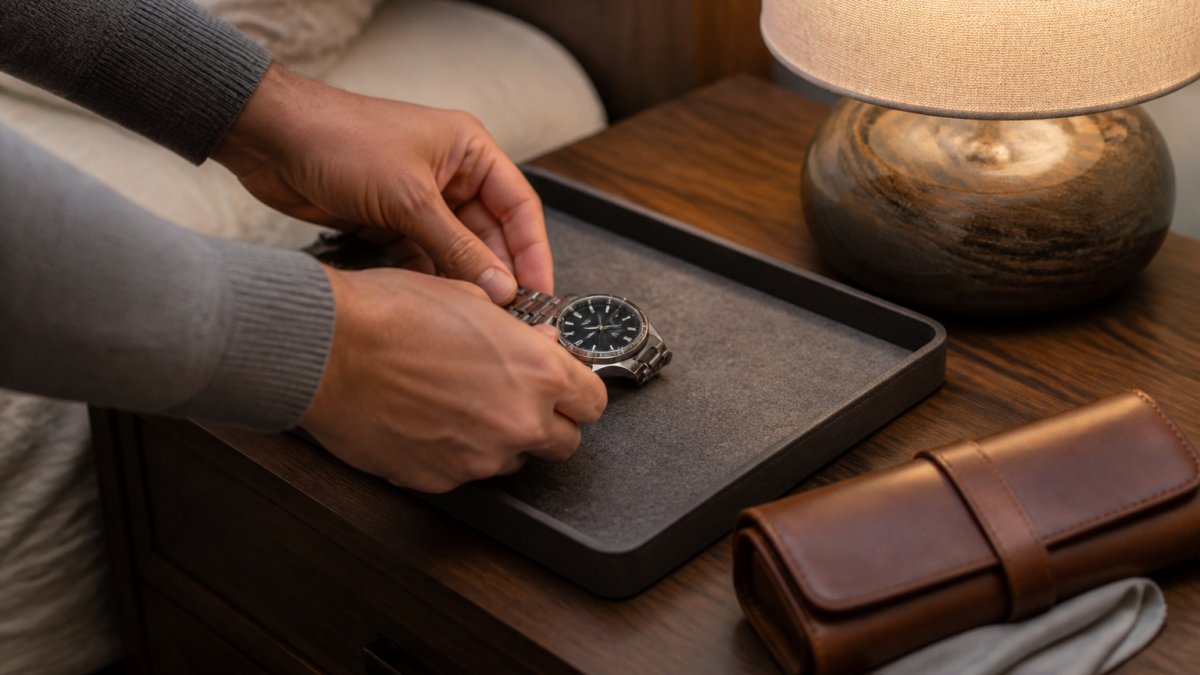
Where to Put Your Watch When You Take It Off
The single riskiest moment for a crystal is the second you remove the watch.
Instead, follow one rule: the watch comes off face-up, on something soft, in the same spot every time. A felt tray, a folded cloth, or a watch roll by the bed removes the decision and the risk.
Setting a watch face-down on a hard surface is a common cause of hairline scratches on the crystal, and it happens in seconds.
Bags, Pockets, and Loose Objects
A pocket shared with keys is a polishing wheel running in reverse. Keep the watch in a dedicated pouch or on your wrist, never loose beside metal.
- Use a soft pouch if the watch goes in a bag
- Empty pockets of coins before dropping a watch in
- Keep the watch away from zippers and buckles
- Never stack two watches together in transit
Step 3: Add a Watch Crystal Protector Film
A watch crystal protector film is a thin, clear adhesive layer that sits over the crystal and absorbs light abrasion before it reaches the surface. The results depend on how well the film matches the crystal and case.
Know the Protector Types Before You Buy
Most protectors fall into three groups:
- Flat die-cut films sized to a specific case diameter. Best for flat crystals; they lift at the edge on domed glass.
- Flexible TPU or hydrogel films that conform to slight curvature. Better for domed sapphire and mineral glass, but they show more edge wear.
- Tempered-glass screen protectors with an adhesive perimeter. The most impact protection, but they add visible thickness and can trap grit at the edge.
A product made for acrylic can cloud a coated sapphire surface, so check the crystal material and any anti-reflective coating before ordering.
Match the Film to Your Crystal
- Flat sapphire: a flat die-cut film is enough; the goal is guarding against scuffs and coating wear, not scratches.
- Domed sapphire: choose a flexible film or a curved tempered protector; a flat film will peel at the edge within days.
- Mineral glass: any of the three types works, and a tempered protector does more of the heavy lifting against abrasion.
- Acrylic: skip rigid protectors; a flexible film avoids the adhesive pulling on a soft surface.
Size and Install It Cleanly
- Measure the case diameter across the crystal, not the bezel, and order to that size.
- Clean the crystal with a lint-free cloth and let it dry fully.
- Work in a low-dust room; a bathroom after a shower settles airborne particles.
- Peel the film from its backing with tweezers and align one edge first.
- Lay it down slowly and press from the center outward to push out air bubbles.
- Wipe the edges down firmly and let the adhesive settle for the time the maker specifies.
Check Visibility and Remove It Safely
To remove a film, warm it slightly with a hair dryer on low, lift one corner with a plastic card, and peel slowly. Adhesive residue comes off with isopropyl alcohol on a microfiber cloth, never a razor blade, which will scratch the crystal you are trying to protect.
Step 4: Learn How to Clean a Watch Crystal Without Adding Scratches
Cleaning is where good intentions backfire. Grit trapped on a cloth acts like sandpaper, so the first move is always to rinse, not rub.
Here's how to clean a watch crystal safely:
- Rinse first with fresh water to float off grit
- Wipe with a clean microfiber cloth, not a tissue or shirt sleeve
- Use mild soap for fingerprints, then rinse again
- Dry fully before storing
After swimming, always rinse in fresh water. Saltwater and chlorinated water leave residue that can dull the surface and attack seals over time. Never use a paper towel; wood fibers scratch.
Step 5: Set Realistic Limits on Watch Crystal Scratch Repair
Not every mark is a scratch, and the wrong response turns a cosmetic issue into a replacement. Before you reach for a polish, work out what you're actually looking at.
Inspect Before You Treat
Run through this sequence in good light:
- Wipe first. A damp microfiber cloth removes smudges, dust, and dried residue. Many "scratches" disappear at this step.
- Look at an angle. A faint haze that won't clean off and sits in a uniform patch is usually coating wear, not a scratch.
- Drag a fingernail lightly across the mark. A line you can feel is a true scratch in the surface. A mark you can see but not feel is often in the coating or on the surface film.
- Check for depth and edges. A crack or chip has a visible edge or a change in reflection; that is a structural failure, not a cosmetic one.
Match the Response to the Material
- Acrylic: the most forgiving. Fine scratches polish out with a plastic polish and a soft cloth; deep gouges need replacement.
- Mineral glass: light scuffs may improve with a cerium-oxide polish, but polishing removes material and can leave a wavy surface. Deep scratches mean replacement.
- Sapphire: polishing at home rarely works and often makes the surface worse. A coating-safe cleaner is the limit; chips and deep scratches go to a watchmaker.
- Coated crystals: any abrasive polish can strip the anti-reflective layer entirely, leaving a patchy haze that looks worse than the original mark.
Clean Without Adding Damage
- Rinse first with fresh water to float off grit.
- Wipe with a clean microfiber cloth, not a tissue or shirt sleeve.
- Use mild soap for fingerprints, then rinse again.
- Dry fully before storing.
After swimming, always rinse in fresh water. Saltwater and chlorinated water leave residue that can dull the surface and attack seals over time. Never use a paper towel; wood fibers scratch.
Know When to Stop
Deep scratches and chips mean replacement, not repair. If a scratch sits over the dial and bothers you daily, weigh the repair against the watch's value. Before you send a watch anywhere, it's worth learning what servicing involves and whether your watch needs it.
Step 6: Match Your Storage and Handling to the Crystal on Your Wrist
Storage is the long game. A watch left loose in a drawer collects scratches from everything around it, and a crystal that sits against metal for months shows it.
- Store each watch separately in a case or pouch
- Keep watches away from magnetic fields, heat, and direct sun
- Wind automatic watches on schedule so they stay running
- Handle by the case, never by the crystal
Match the approach to the material. How to Tell How Long Microbrand Watches Last helps you gauge how long a microbrand timepiece will realistically hold up. Acrylic needs gentler handling and more frequent polishing, while sapphire needs protection from hard knocks more than from abrasion.
Choosing a Haim Timepiece You'll Want to Protect
Protection starts with a watch worth protecting. Our Legacy Automatic is 100% US-assembled with a custom-designed caliber, and our Swiss-made Viajero SE brings hand-finished detail to a titanium case. Each dial features ornate decoration.
When you're ready, explore the collection and find the piece that fits your daily life.
Frequently Asked Questions
How can I avoid scratches on a watch crystal during normal daily wear?
Most scratches come from a handful of repeat situations: brushing a doorframe, setting your wrist down on a desk edge, and tossing the watch into a bag with keys. Take the watch off before you reach into a pocket or bag, place it face-up on a soft surface rather than face-down, and keep it in a lined case or roll when it is not on your wrist. On acrylic and mineral glass, a thin protector film adds a sacrificial layer that takes the scuffs instead of the crystal.
Is sapphire crystal scratch-proof, and how does it compare to mineral glass?
Sapphire is not scratch-proof, but it is the most scratch-resistant crystal commonly used on watches. Its hardness sits near 9 on the Mohs scale, so everyday contact with keys, desk edges, and zippers rarely marks it. Mineral glass sits closer to 5, which means it shows fine hairline scratches sooner, while acrylic is softest and can usually be polished back to clarity. The trade-off is toughness: sapphire resists abrasion but can chip or crack under a sharp impact, while mineral and acrylic flex and absorb more.
Does a watch crystal protector film affect visibility or appearance?
A well-fitted protector film is thin enough that most people stop noticing it after a day or two. Poorly fitted films can leave visible edges and trap dust underneath.
Can household cleaners or alcohol wipes damage a watch crystal?
Alcohol wipes and ammonia-based glass cleaners can degrade anti-reflective coatings and attack the gaskets that keep water out, so keep them off the crystal and case. Rinse with lukewarm fresh water after contact with seawater, chlorinated pool water, or sweat, then dry with a soft microfiber cloth. For fingerprints and smudges, a barely damp cloth is enough. If the watch is rated for swimming, check that the crown is fully screwed down before any rinse.
The best crystal care is the kind you stop noticing: a tray by the bed, a pouch in the bag, a rinse after the pool. Haim Watch Company builds timepieces with hand-finished titanium cases, custom-designed calibers, and dials detailed enough to make clear glass matter. Get started with Haim Watch Company and wear your watch with confidence, not caution.
