

Last Updated: October 25, 2026
Quick Summary
The average cost to service automatic watches typically runs from about $200 to $700 for a full service on a standard movement, according to Yelp's watch repair cost guide. An automatic watch service climbs higher for chronographs, vintage pieces, and complicated calibers, since quotes reflect labor hours, parts, movement complexity, and who does the work.
- Most watchmakers suggest a service every 3 to 5 years for a watch worn daily.
- A simple three-hand automatic typically runs $200 to $350 to service.
- Chronograph service usually falls in the $450 to $800 range.
- Vintage or discontinued calibers can cost $500 to $1,200 or more.
- Many shops charge a $25 to $75 diagnosis fee, sometimes credited toward the service.
Table of Contents
- Average Cost to Service Automatic Watches: The Real Price Range
- How Often to Service an Automatic Watch
- What Is Included in a Watch Service?
- Automatic vs Quartz Watch Service Cost
- How Movement Complexity Affects the Price
- Automatic Watch Service Time: What to Expect
- How to Read a Service Estimate and Avoid Surprise Charges
- Is Servicing Your Automatic Watch Worth It?
- Frequently Asked Questions
Average Cost to Service Automatic Watches: The Real Price Range
The average cost to service automatic watches typically runs from about $200 to $700, according to Yelp's watch repair cost guide. That range covers a full service on a standard movement. Chronographs, vintage pieces, and complicated calibers climb higher. At Haim Watch Company, we field this question often, and the honest answer is that no single number fits every watch.
Why the spread? Because a service quote reflects labor hours, parts, movement complexity, and who does the work. A local independent watchmaker and a manufacturer service center price the same job very differently.
Why Quotes Vary So Widely
Three things drive the gap between quotes. First, labor rates differ by provider and region. Second, parts availability changes the math, especially for older or discontinued calibers. Third, the condition of the watch matters. A running watch needs cleaning and lubrication. A damaged one needs repair work on top.
A common mistake is comparing quotes without comparing scope. A low quote may exclude parts, polishing, or a new gasket set. Ask what the price covers before you judge it.
How Often to Service an Automatic Watch
Most watchmakers suggest a service every 3 to 5 years for a watch worn daily. That is a guideline, not a rule. Many automatic watches run well for 5 to 10 years before they need attention. A self-winding watch that keeps steady time and holds a full power reserve usually does not need immediate work.
The maintenance interval depends on use. A watch worn every day and exposed to sweat, dust, and temperature swings ages faster than a weekend piece kept in a case.
Signs Your Watch Is Due for Service
Watch for these warning signs:
- The watch loses or gains time beyond a minute or two a day
- The power reserve drops, so it stops overnight
- The rotor feels rough or you hear grinding
- Moisture or fog appears under the crystal
- The crown feels stiff or gritty when winding
If any of these show up, get a movement inspection. Our guide on whether your automatic watch needs servicing walks through the signs in more detail.
What Is Included in a Watch Service?
A standard service, sometimes called a complete service, follows a set process. The watchmaker disassembles the movement, cleans every part, inspects for wear, replaces worn components, lubricates, reassembles, and regulates the timing. The case and crystal usually get cleaned too.
Here is what a full service typically covers:
- Full disassembly of the movement
- Ultrasonic cleaning of all parts
- Lubrication at the correct points
- Replacement of gaskets and seals
- Timing regulation and accuracy testing
- Case cleaning and light refinishing
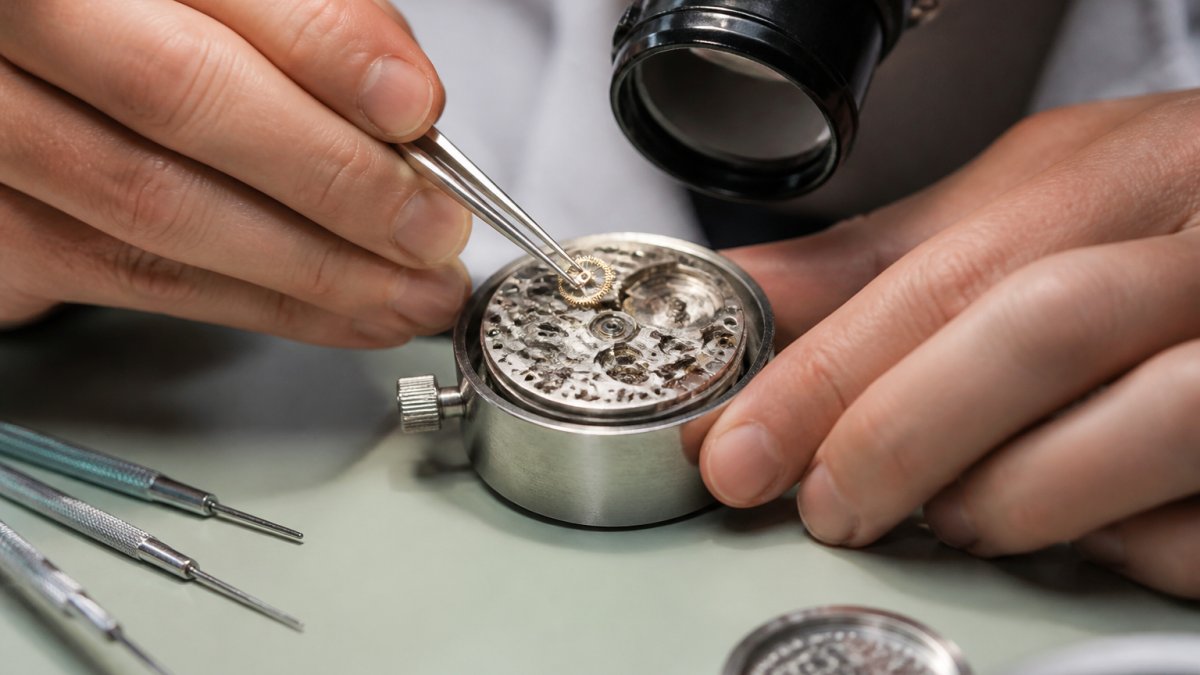
Complications add work. A GMT or chronograph has more parts to strip, clean, and time. Our explainer on common watch movement complications shows why those movements cost more to service.
Automatic vs Quartz Watch Service Cost
Quartz watches cost far less to service than automatics. A quartz movement has fewer parts and often gets replaced outright rather than rebuilt. An automatic watch has hundreds of moving components that a watchmaker must disassemble, clean, and lubricate by hand.
That labor is the difference. A mechanical watch service is skilled, time-intensive work. A quartz service is often a battery change plus a quick check. If you are weighing the two, our comparison of automatic vs quartz watches explains the trade-offs beyond cost.
How Movement Complexity Affects the Price
The more complex the caliber, the higher the bill, but the jump is not linear. It tracks the number of parts, the number of timing points, and how hard it is to source replacements. Here is a practical way to tier a quote before you accept it.
| Movement / Watch Type | Typical Service Range (USD) | What Drives the Price |
|---|---|---|
| Simple three-hand automatic | $200-$350 | Low part count, one timing point, common gaskets |
| Three-hand with date | $250-$400 | Added date mechanism, calendar disc alignment |
| GMT or dual-time | $350-$550 | Extra hour hand, additional setting mechanism |
| Chronograph (two or three registers) | $450-$800 | Hundreds of additional parts, zero-reset cams, pusher seals |
| Vintage or discontinued caliber | $500-$1,200+ | Scarce parts, hand-fabricated components, longer bench time |
| In-house or highly finished caliber | $600-$1,500+ | Manufacturer-only parts, decorative finishing that must be preserved |
These are working ranges, not quotes. A common pattern is that the movement tier sets the floor and the watch's condition sets the ceiling. A chronograph in good running order may land near the bottom of its band; the same chronograph with a damaged pusher or water intrusion climbs toward the top.
Condition tiers work like this:
- Running, keeping time: cleaning, lubrication, gaskets, and regulation. This is the baseline service.
- Running but inaccurate or stopping: add diagnosis time and likely a worn component such as a mainspring or balance staff.
- Not running: add full fault-finding, and possibly a rebuild of the escapement or gear train.
- Water damage or corrosion: add parts replacement across multiple components and often case refinishing.
- Cosmetic restoration: polishing, dial work, and crystal replacement are usually quoted separately from movement service.
Complications add work in specific places. A GMT has an extra hour hand and a setting mechanism that must be synchronized. A chronograph adds a column wheel or cam system, reset hammers, and pushers that each need their own seals.
Microbrand owners face a specific wrinkle: sourcing parts for a small-batch movement. Our practical guide to servicing microbrand watch movements covers how to plan for that.
Automatic Watch Service Time: What to Expect
Turnaround time usually runs a few weeks for an independent watchmaker. Manufacturer service centers can take longer, sometimes a month or two, because of queue volume and parts shipping. Ask for the estimated turnaround in writing before you hand over the watch.
A simple cleaning and regulation moves faster. A full restoration with parts sourcing takes longer. Plan around the wait rather than expecting a same-week return.
How to Read a Service Estimate and Avoid Surprise Charges
A written estimate should itemize the work, not just name a total. Ask for these line items before you approve anything:
- Labor for disassembly, cleaning, and reassembly
- Parts list with each replacement named and priced
- Whether polishing or refinishing is included or extra
- Gasket and seal replacement
- Timing regulation and accuracy testing
- Warranty terms on the service
- Turnaround estimate
- Policy if extra damage is found mid-service
Watch out: a quote that omits parts is the most common source of a surprise bill. The watchmaker opens the case, finds a worn mainspring, and the price jumps. Get the parts policy in writing up front.
| Estimate Item | What to Confirm | Why It Matters |
|---|---|---|
| Labor | Flat fee or hourly | Hourly can balloon |
| Parts | Included or extra | Biggest surprise cost |
| Polishing | Included or add-on | Often billed separately |
| Warranty | Length and coverage | Protects the work |
| Turnaround | Written estimate | Sets expectations |
Beyond the line items, four terms decide whether the estimate protects you or traps you.
Diagnosis fee. Many shops charge a bench fee to open the case and assess the movement, often in the $25-$75 range, and some credit it toward the service if you approve the work.
Approval threshold. A good estimate states a dollar amount the watchmaker may spend on unforeseen parts without calling you. Set that threshold low, $50 or less, if you want no surprises.
Warranty terms. Ask how long the service is warranted, what it covers (labor only, or parts too), and what voids it.
Return of replaced parts. Ask for the old parts back. This confirms the work was actually done, and on vintage pieces the removed components can have value.
Finally, ask what happens if the watchmaker finds damage mid-service. The best estimates include a written escalation policy: work stops, you get a revised quote, and you approve or decline before anything else is touched. That single clause prevents most billing disputes.
Is Servicing Your Automatic Watch Worth It?
The answer depends on the watch's value to you. For an expensive or sentimental piece, a full service protects the investment and keeps it running for years. A discussion among collectors on Reddit's r/Watches forum raises a fair point: when a service costs hundreds of dollars, preventive maintenance may not pay off on a cheap watch you could simply replace.
Our take: service a watch you love or one worth far more than the bill. For a low-cost automatic with no sentimental tie, weigh the quote against replacement. And for a watch you plan to keep, our look at automatic vs manual wind reliability helps you judge how much upkeep the movement will demand over its life.
A well-built automatic rewards care. Haim Watch Company builds timepieces with custom-designed calibers and hand-finished titanium cases, made to be serviced and kept, not discarded. Our Swiss-made Viajero SE and 100% US-assembled Legacy Automatic are crafted for the long run, with ornate dials that hold their own against watches costing far more.
Frequently Asked Questions
How much does it cost to service an automatic watch?
Most automatic watch service runs $200 to $700, according to a Yelp cost guide updated in 2026. The final quote depends on movement complexity, parts needed, and whether you use an independent watchmaker or a manufacturer service center. A basic cleaning and lubrication sits at the low end, while a chronograph or vintage caliber with worn parts pushes toward the top. Always ask for an itemized written estimate before authorizing work so you know what the fee covers.
How often should you have an automatic watch serviced?
Many watchmakers suggest a maintenance interval of every 3 to 5 years for daily-worn automatic watches, while others say every 5 to 10 years is fine if timekeeping stays accurate. There is no universal rule. Watch for accuracy drift, a stiff crown, or a rotor that sounds rough. If your watch keeps good time and has no symptoms, a watchmaker can inspect the movement and tell you whether a full service is needed now or can wait.
Why does servicing an automatic watch cost more than servicing a quartz watch?
An automatic watch has hundreds of moving parts that must be disassembled, cleaned, lubricated, and reassembled by hand, then regulated for accuracy. A quartz watch typically needs only a battery change and a gasket check, which takes minutes. That labor difference is the main reason automatic watch service cost is higher. A quartz movement replacement is often cheaper than repairing it, while an automatic caliber is built to be serviced and kept running.
Can you keep wearing an automatic watch without servicing it?
You can, but the risk grows over time. Old lubricants dry out and thicken, which increases wear on pivots and gears. A watch that runs fine for years past its service interval may still suffer hidden damage that costs more to fix later. For an inexpensive watch, a Reddit discussion notes that a $200 to $700 service may not be economically worthwhile. For a watch with sentimental or higher value, routine servicing protects the movement and the watch's long-term performance.
Ready to own a watch worth servicing? Explore the Haim Watch Company collection and find a timepiece built to last. Get started with Haim Watch Company and invest in craftsmanship you will want to keep for decades.
