

Last Updated: November 2, 2026
Quick Summary
To identify vintage pocket watches, open the case safely and locate the serial number stamped on the movement, then run that movement number through a serial number lookup database to find the maker, grade, and production year. Always trust the movement stamp over the dial signature, and use the movement number rather than the case number.
- The movement serial number is stamped on the movement and ties to factory records.
- Case serial numbers belong to the case company and rarely match the movement number.
- Trust the movement stamp over the dial signature, since dials were swapped over decades of repair.
- Enter the movement number, not the case number, when running a serial number lookup.
- Value rests on four things: maker, grade, condition, and originality.
Table of Contents
- How to Identify Vintage American Pocket Watches: A Step-by-Step Workflow
- Step 1: Open the Watch Safely and Locate the Serial Number
- Step 2: Read the Movement Markings and Inscriptions
- Step 3: Recognize American Pocket Watch Maker Marks
- Step 4: Run a Vintage American Pocket Watch Serial Number Lookup
- Step 5: Estimate Vintage Pocket Watch Value by Serial Number
- Step 6: How to Tell If a Pocket Watch Is Valuable
- Step 7: Photograph and Document Your Watch for Identification
- From Identification to Your Own Collection
- Frequently Asked Questions
How to Identify Vintage American Pocket Watches: A Step-by-Step Workflow
Learning to identify vintage pocket watches starts with one small number: the serial number engraved on the movement. That number is the key that opens factory records, production dates, and maker histories. This eight-step workflow is designed to help you read a watch the way a collector does.
The best tool for the job is the Pocket Watch Serial Number Lookup Database, which holds records on American makers plus more than 47,700 movement photos. Those photos let you compare your movement against known examples.
Below, we walk through safe opening, reading markings, running a lookup, and judging value. Most guides skip the safety steps and the conflicting-markings problem. We cover both.
Here is the eight-step workflow at a glance, from opening the case to documenting your watch.
| Step | What to do | Key detail |
|---|---|---|
| Step 1 | Open the watch safely and locate the serial number | Movement number is stamped on the movement |
| Step 2 | Read the movement markings and inscriptions | Note maker, grade, jewel count, adjustment marks |
| Step 3 | Recognize American pocket watch maker marks | Trust the movement stamp over the dial signature |
| Step 4 | Run a serial number lookup | Enter the movement number, not the case number |
| Step 5 | Estimate value by serial number | Build a maker, grade, and year profile |
| Step 6 | Judge whether the watch is valuable | Weigh maker, grade, condition, originality |
| Step 7 | Photograph and document the watch | Shoot in soft daylight and skip the flash |
Step 1: Open the Watch Safely and Locate the Serial Number
The serial number on an American pocket watch is typically stamped on the movement. Open the back cover gently to locate it. Most identification mistakes happen before the lookup: a scratched case back, a bent hinge, or a fingerprint etched into a damascened plate.
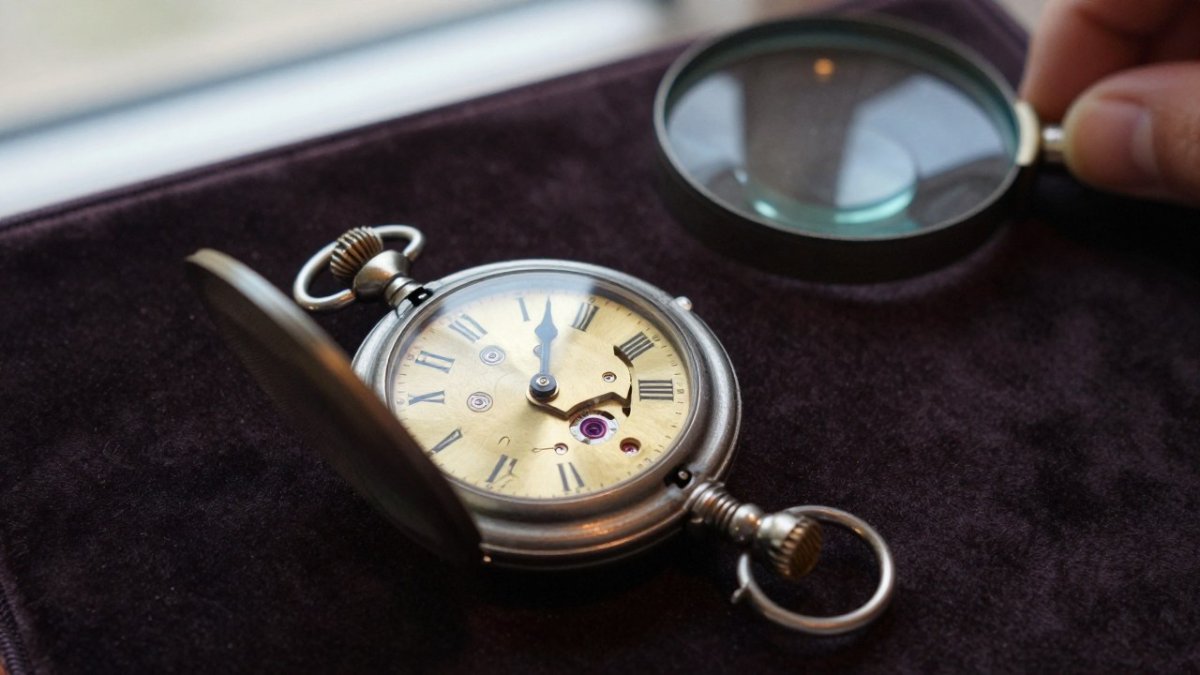
Start by identifying the case-back type, because each opens differently:
- Hinged back (hunter or half-hunter): Look for a small lip at the edge, usually opposite the hinge. A case knife or your thumbnail goes under the lip, and the cover swings open on the hinge.
- Screw-back: The cover has fine threads and often a knurled edge or notches. Use a rubber case wrench or a friction ball, turn counterclockwise, and keep the case flat so the threads do not cross.
- Snap-back: The cover is held by friction and usually has a lip or a small opening notch. A case knife lifts it straight up; do not pry from the side.
- Swing-out movement: Some cases hold the movement in a hinged ring. Open the back, then release the small catch or screw that lets the movement swing out.
Work over a soft cloth on a clean, flat table. Use a case knife or your thumbnail on the lip, never a screwdriver, and open the cover slowly. Stop if it resists.
Watch out: forcing a hinged cover can bend the hinge or crack the crystal, and prying a screw-back with a knife can strip the threads or gouge the case. If the cover will not move, stop and let a watchmaker open it.
Distinguishing Movement and Case Serial Numbers
A pocket watch usually carries two different numbers. The movement serial number sits on the metal works and ties to the maker's factory records. The case serial number is stamped inside the back cover and belongs to the case company, not the watchmaker. Case makers stamped their own numbers, and those numbers do not follow the watchmaker's sequence.
These numbers rarely match, and that is normal. Cases were often made by separate firms and matched to movements at the jeweler, and a replacement case fitted decades later is common. When you run a lookup, always use the movement number first.
A common pattern is a movement number in the millions paired with a case number in the hundreds of thousands, or the reverse. Treat the two as separate records: the movement number dates the works, and the case number identifies the housing.
Step 2: Read the Movement Markings and Inscriptions
Movement markings tell you who made the watch and how good it was. Read every word stamped on the plates, then note the jewel count.
Look for these details:
- Maker name: Waltham, Elgin, Illinois, Hamilton, and similar American brands.
- Grade name or number: often stamped near the center bridge.
- Jewel count: stamped as "15 Jewels," "17 Jewels," or similar.
- Adjustment marks: words like "Adjusted" or "Adjusted to Temperature."
- Movement type: a lever-set or pendant-set layout.
Write everything down exactly as stamped, including odd spellings. Those details matter when you match records.
Step 3: Recognize American Pocket Watch Maker Marks
Maker marks are the fastest way to place a watch. American factories stamped their names in consistent styles, so the lettering itself is a clue.
Common marks include Waltham, Elgin, Illinois Watch Co., Hamilton, Hampden, and Columbus. A name in a curved arc, a script signature, or a shield logo each points to a different maker and era.
For the wider story behind these names, our guide to American watchmaking heritage explained shows how the factories rose, merged, and closed.
Watch out: a dial name does not always match the movement. Dials were swapped over decades of repair. Trust the movement stamp over the dial signature.
Step 4: Run a Vintage American Pocket Watch Serial Number Lookup
A serial number lookup can help turn a stamped number into an approximate production year, since many American factories kept sequential records.
Enter the movement number, not the case number. The Pocket Watch Serial Number Lookup Database then returns a production range, grade details, and often a movement photo you can compare side by side.
Expect some limits:
- Records are strongest for major makers and weaker for small firms.
- A number can span a range of years, not one exact date.
- Private-label watches may not appear at all.
If your number falls in a gap, check a second resource before you settle on a date.
Step 5: Estimate Vintage Pocket Watch Value by Serial Number
Serial number lookup gives you a date and grade, and those two facts shape vintage pocket watch value by serial number.
Use the number to build a profile:
- Confirm the maker and grade.
- Note the production year range.
- Check the jewel count against that grade.
- Compare your movement photo to known examples.
That profile tells you whether you hold a common workhorse or a scarce grade. It does not set a price on its own. Condition, originality, and case material still drive the final number.
Step 6: How to Tell If a Pocket Watch Is Valuable
Value rests on four things: maker, grade, condition, and originality. A rare grade in poor condition can be worth less than a common grade in fine shape. The hard part is not knowing the four factors; it is weighing them when the evidence conflicts. A watch can carry a scarce movement in a replacement case, a correct dial with refinished enamel, or a high jewel count with a cracked crystal. Learn to grade each factor separately, then combine them.
Maker and grade. Start with the movement stamp and the serial lookup. Grade names and numbers matter: a Waltham Riverside or a Hamilton 992 is a different proposition from an unmarked movement of the same age.
Condition. Check these points in order:
- Dial: Hairlines, chips, and cracks cut value.
- Plating and finish: Worn gold fill, brassing at the edges, and rust on steel parts all reduce value.
- Crystal: Cracks and chips are common and replaceable, but a damaged crystal can hide dial damage.
- Hands: Mismatched or bent hands suggest repair; correct hands in good condition support originality.
Originality. Matching case, correct dial, and original hands matter.
Case material. Solid gold and coin silver carry more than base metal.
Complications. Verify that the complication matches the movement and that the dial openings align with the mechanism.
When markings conflict, weigh evidence rather than treating one number as definitive. The movement number is the strongest single identifier for maker and date. The case number is secondary and speaks to the housing.
To understand why certain makers carry a premium, read our piece on why American watchmaking heritage matters for collectors. If you are weighing whether to keep or buy an American piece, our case for American-made watches and their craftsmanship explains what drives long-term appeal.
Step 7: Photograph and Document Your Watch for Identification
Good photos can help you document a vintage pocket watch for your records. Shoot in soft daylight and skip the flash.
Capture these shots:
- Full front of the dial, straight on.
- The movement with the serial number sharp and readable.
- Inside the case back, showing the case number and any inscriptions.
- The crown and any case engravings from the side.
Name each file with the serial number so records stay matched. Store the set with your written notes on maker, grade, and jewel count.
From Identification to Your Own Collection
Reading a serial number is a skill, and it rewards patience. The next challenge is finding a modern watch with the same care behind it. At Haim Watch Company, we build timepieces for people who notice details. The Legacy Automatic is 100% US-assembled, the Viajero SE is Swiss-made, and each piece features custom-designed calibers and hand-finished titanium cases with ornate dial decoration. Get started with Haim Watch Company and find a watch made to be part of your story.
Frequently Asked Questions
How do I know if my old pocket watch is valuable?
Value depends on maker, age, condition, and originality. Start by identifying the manufacturer and checking the movement serial number against factory records. A high jewel count, adjusted movement, and rare grade can add significant value. Case material matters too: solid gold or coin silver cases are worth more than gold-filled. Condition and whether parts are original also affect price. Use the serial number to confirm production date and then compare recently sold examples of the same grade, not asking prices.
Where can I find the serial number on an American pocket watch?
The movement serial number is the most important identifier. Open the back cover carefully and look for a number engraved on the metal plates of the movement, often near the balance wheel or on the barrel bridge. The case may also have its own serial number, usually stamped inside the back cover. Always record both, but use the movement number for dating and maker research. If the number is missing or worn, look for other markings like maker names or grade stamps.
Can a pocket watch case serial number identify the movement?
No, case serial numbers are separate from movement numbers. Case makers used their own numbering systems. A case serial number can help identify the case manufacturer and approximate date, but it does not tell you who made the movement or when. To identify the movement, you need the movement serial number and any maker marks on the movement itself. Use case numbers as supporting evidence, not as the primary identifier.
How do I find the age of a Waltham pocket watch?
Locate the movement serial number and use a serial number lookup database for Waltham. These databases map serial number ranges to production years and grades. A serial number lookup database can help you match your watch to records. Enter the serial number and compare the result with the movement markings. If the number falls near a known transition, the database often gives a date range. Always cross-check with the movement's grade and jewel count for accuracy.
