

Table of Contents
- What Defines a Microbrand Dive Watch
- Microbrand Dive Watch Water Resistance: What You Need to Know
- Movement Type and Specifications That Matter
- Case Materials, Size, and Wearability
- Best Microbrand Dive Watches Under $500
- Design Aesthetics: Vintage-Inspired vs. Modern
- Microbrand Dive Watch Buying Guide: Selection Criteria
- Common Mistakes When Buying Microbrand Dive Watches
- Frequently Asked Questions
Last Updated: October 18, 2026
What Defines a Microbrand Dive Watch
A microbrand dive watch is a timepiece created by an independent watchmaker or small production house that emphasizes custom engineering, limited production runs, and distinctive design. Unlike mass-market brands, microbrands operate with complete creative control over movement design, case finishing, and dial aesthetics. They typically produce fewer than 500 pieces annually and maintain direct relationships with their customer base.
The appeal of microbrand dive watches lies in their combination of accessibility and authenticity. At Haim Watch Company, this philosophy defines everything we create, from our Swiss-made Viajero SE to our 100% US-assembled Legacy Automatic, each piece reflects custom engineering and ornate dial decoration.
Independent Design and Custom Movements
Microbrand makers don't rely on off-the-shelf movements. Many develop their own calibers or significantly modify existing ones to match their vision. This independence means you're not wearing the same movement as thousands of other watch owners. The design choices, hand-finishing, custom rotor decoration, personalized engravings, reflect the maker's philosophy rather than a corporate mandate.
This commitment to custom engineering comes with real trade-offs. Development takes longer. Production costs rise. Warranty support depends entirely on the maker's infrastructure. But for collectors who value horological craftsmanship over brand recognition, these constraints are precisely what make the watch meaningful.
Limited Production and Artisanal Craftsmanship
Production limits are intentional, not accidental. Most microbrands cap annual output to preserve exclusivity and maintain quality control. Hand-finishing, polishing bezels, decorating rotors, applying lume to dial markers, cannot be rushed. Each watch requires individual attention.
This artisanal approach means availability matters. A microbrand may release 50 pieces in a given year. Once sold, the next batch may not arrive for months. Resale value often reflects scarcity rather than depreciation, though this depends entirely on the maker's reputation and the watch's reception over time.
Microbrand Dive Watch Water Resistance: What You Need to Know
Water resistance ratings tell only part of the story. A 300-meter dive watch can handle recreational diving, but the construction quality, crown design, caseback sealing, crystal installation, determines real-world reliability. Microbrands vary dramatically in how they approach these critical details.
Understanding Depth Ratings and Real-World Limits
A 300-meter water resistance rating means the watch passed ISO 6425 testing at that depth under controlled laboratory conditions. It does not mean you should dive to 300 meters.
For recreational diving (depths under 40 meters), a 200-meter rated watch is adequate. For technical diving or professional use, 300 meters or higher becomes relevant.
The critical distinction is between 100-meter, 200-meter, and 300-meter ratings. Each step up requires significantly more engineering. A 100-meter watch suits daily wear and splash resistance. A 200-meter watch handles snorkeling and shallow recreational diving. A 300-meter watch represents serious dive-watch construction.
Screw-Down Crowns and Case Construction
A screw-down crown is the hallmark of legitimate dive-watch engineering. The crown threads into the case, creating a seal that prevents water ingress. A pull-out crown, by contrast, relies on gaskets alone, adequate for water resistance but not dive-ready construction.
Equally important is the caseback. A screw-down caseback offers superior sealing compared to a press-fit design. The best microbrands use both features as standard.
Case thickness and material also matter. Thicker cases distribute pressure more evenly. Stainless steel and titanium both resist corrosion, but titanium offers superior strength at lower weight. The choice reflects the maker's priorities: durability versus wearability.
Movement Type and Specifications That Matter
The movement, the mechanism that keeps time, defines reliability, accuracy, and maintenance costs. Microbrands use three primary types, each with distinct advantages and limitations.
Automatic vs. Quartz: Trade-Offs in Reliability and Cost
An automatic movement winds itself through wrist motion, eliminating battery replacement. It requires periodic servicing (every 5-10 years), costs more upfront, and demands regular wear to stay wound.
A quartz movement runs on a battery, typically lasting 2-3 years. It's more accurate, requires minimal maintenance, and costs significantly less to produce. Quartz movements appeal to buyers who prioritize reliability and simplicity over mechanical tradition.
Microbrands increasingly offer both options. A quartz dive watch from a respected maker often outperforms an automatic from a careless producer. The maker's reputation matters more than movement type alone.
Power Reserve and Accuracy Standards
Power reserve, how long an automatic watch runs without winding, typically ranges from 40 to 70 hours. A longer reserve means fewer days of unwound downtime. Most microbrands target 50+ hours as a baseline for credibility.
Accuracy standards for automatic watches typically fall between -10 and +20 seconds per day. Better microbrands achieve tighter tolerances through careful regulation and quality control. Quartz watches are accurate to within 15-20 seconds per month, orders of magnitude better than mechanical movements.
Neither standard is inherently superior. Collectors accept mechanical variance as part of the experience. Daily wearers often prefer quartz reliability. The choice depends on what you value: tradition or precision.
Case Materials, Size, and Wearability
The case material and dimensions fundamentally shape how a watch feels and performs. Two watches with identical movements can offer completely different experiences based on these factors alone.
Stainless Steel vs. Titanium: Durability and Feel
Stainless steel is the industry standard. It's affordable, widely serviceable, and resistant to corrosion. A well-finished stainless steel case develops character over time, light scratches and patina tell a story of use.
Titanium offers superior strength at 40% lower weight. It resists corrosion better than steel and feels noticeably lighter on the wrist.
Haim Watch Company uses hand-finished titanium cases for specific models, prioritizing the refined aesthetic and durability that titanium delivers.
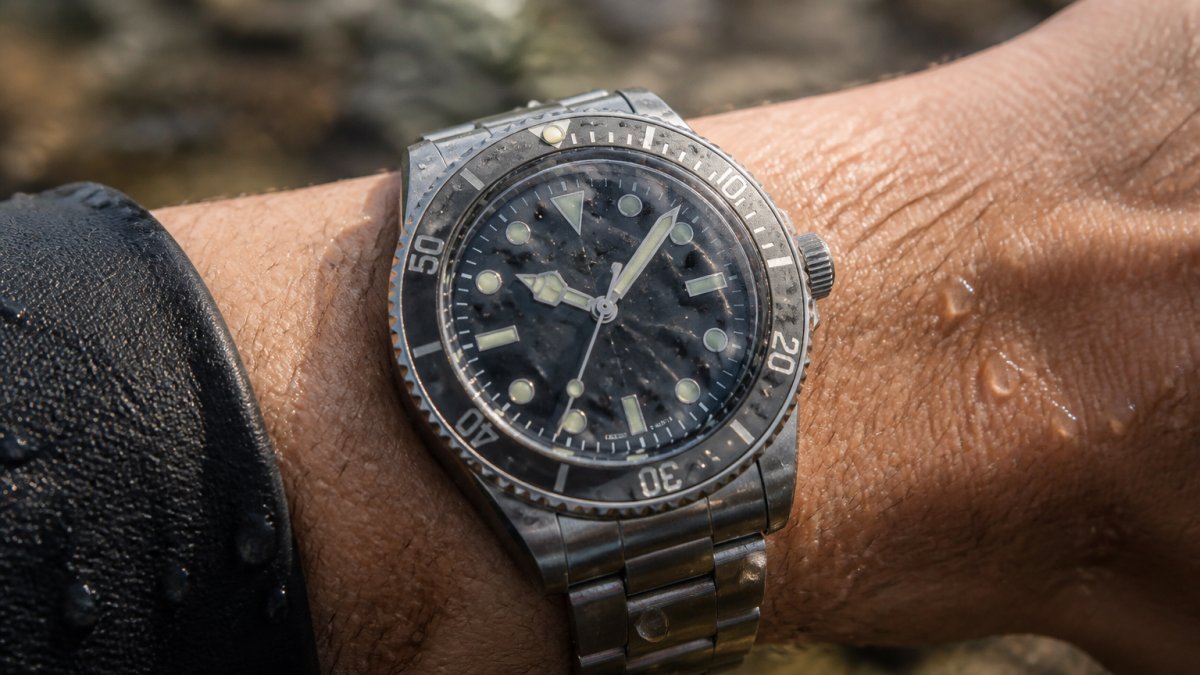
Case Diameter and Lug-to-Lug: Finding Your Fit
Most dive watches range from 38mm to 44mm in diameter. Smaller wrists (under 6.5 inches) wear 38-40mm watches best. Larger wrists (over 7.5 inches) suit 42-44mm cases. The 40-42mm range works for most people.
Lug-to-lug distance, the measurement from one strap attachment point to the other, determines how a watch sits on your wrist. A watch may have a modest diameter but feel large if the lug-to-lug exceeds 50mm.
Microbrands often publish these specifications. Compare them before buying. A watch that looks perfect in photos may feel uncomfortable in person if the proportions don't match your wrist.
Best Microbrand Dive Watches Under $500
Finding a quality microbrand dive watch under $500 requires understanding where makers allocate resources. Most budget-conscious microbrands compromise on case finishing or movement complexity rather than core construction.
Watches in this range typically feature stainless steel cases, reliable quartz or basic automatic movements, and functional (if not ornate) dial design. Water resistance usually reaches 200-300 meters.
The real value proposition at this price point is exclusivity and authenticity.
Research the maker's reputation before committing. Read reviews from actual owners. Verify that serviceability is realistic, a watch with no local service network becomes a paperweight if the movement fails.
Design Aesthetics: Vintage-Inspired vs. Modern
Design philosophy divides the microbrand space. Some makers draw inspiration from 1960s-70s tool watches, emphasizing minimalist dials and functional bezels.
Vintage-inspired watches appeal to traditionalists. They reference proven designs while incorporating modern manufacturing precision. The aesthetic feels timeless because it draws from designs that already proved their worth.
Modern designs take more risk. Unconventional dial patterns, unusual color combinations, and experimental case shapes appeal to collectors seeking distinctiveness.
Your choice depends on personal preference and long-term vision. A vintage-inspired watch feels safer for resale. A bold modern design reflects individual taste and may appreciate if the maker's reputation grows.
Microbrand Dive Watch Buying Guide: Selection Criteria
Choosing a microbrand dive watch requires evaluating factors beyond specifications. You're assessing the maker's credibility, your personal fit preferences, and realistic long-term ownership costs.
Evaluating Build Quality and Finishing
Examine photos closely. Hand-finished cases should show evidence of deliberate polishing, brushed surfaces with consistent direction, polished bevels that catch light evenly. Dial printing should be crisp. Lume application should be consistent and bright under UV light.
Request additional photos if the maker's website lacks detail. Legitimate makers respond to questions. Evasiveness is a red flag.
Visit forums and social media. Owner feedback reveals whether a watch performs as promised. Look for patterns: Do owners report movement issues? Does the maker stand behind warranty claims? Are there complaints about customer service?
Warranty, Serviceability, and Long-Term Support
Most microbrands offer 1-2 year warranties covering defects. Understand what's covered, manufacturing defects usually yes, accidental damage usually no.
More importantly, determine who services the watch if issues arise. Does the maker maintain a service center? Can local watchmakers handle the movement? If the maker uses a custom caliber, only they can service it. This creates dependency.
Ask directly: "If my watch needs service in 3 years, what's the process and cost?" A maker unwilling to answer this question is signaling risk.
Availability, Limited Production, and Resale Value
Limited production creates scarcity, which supports resale value. But scarcity only matters if demand persists. A watch from an unknown maker with 50-piece annual production may be impossible to sell if the brand never gains traction.
Research the maker's history. How long have they been producing watches? Is demand growing or stagnating? Do older models hold value or depreciate?
Resale value depends on reputation, not production limits alone. A respected maker's 5-year-old watch often retains 60-70% of original value. An unknown maker's watch may drop to 40-50% within 12 months.
Common Mistakes When Buying Microbrand Dive Watches
Most first-time microbrand buyers repeat predictable errors. Awareness prevents costly missteps.
Buying based on specs alone. A watch with impressive specifications from an unknown maker offers no guarantee of reliability.
Ignoring fit and wearability. Ordering online without trying the watch on creates risk.
Underestimating serviceability costs. A $400 watch that requires $300 servicing every 5 years becomes expensive over a decade.
Chasing the newest release. New models from unproven makers carry execution risk. Early production runs often contain unforeseen issues.
Dismissing established microbrands. Makers with 10+ years of consistent production have proven their model works.
Choosing a microbrand dive watch means valuing craftsmanship and individuality over brand prestige.
Frequently Asked Questions
What is a microbrand dive watch?
A microbrand dive watch is a timepiece from an independent, typically small-scale watchmaker that designs and produces limited-edition watches with custom movements or heavily modified calibers. Unlike mass-produced brands, microbrands emphasize artisanal craftsmanship, hand-finished details, and unique dial designs. They combine technical dive-readiness, water resistance of 200m or more, screw-down crowns, and legible bezels, with aesthetic sophistication, making them appealing to collectors who value both function and design storytelling.
Are microbrand dive watches reliable and worth the investment?
Yes, when sourced from established microbrands with transparent manufacturing practices. Reliability depends on movement quality, case construction, and after-sales support. Microbrands using proven automatic movements or custom-engineered calibers deliver consistent timekeeping. However, value depends on your priorities: if you seek horological craftsmanship, limited availability, and design distinction, microbrands offer genuine worth. For purely functional dive capability at the lowest cost, mass-market alternatives exist. Research warranty terms, serviceability, and the maker's track record before committing.
What water-resistance rating should a microbrand dive watch have?
For actual diving, aim for 200m or greater water resistance. This depth rating indicates the watch has undergone rigorous pressure testing and features a screw-down crown and case back, which are essential for dive-readiness. However, 200m is suitable for recreational diving only; professional or technical diving requires 300m or more. For everyday wear and occasional swimming, 100m suffices. Always verify that water resistance is tested and certified, not merely claimed, and understand that depth ratings assume static pressure, active water sports demand higher margins.
What should I look for when buying a microbrand dive watch?
Prioritize: movement type and accuracy (automatic or quartz, power reserve, and certified precision), case material and construction (stainless steel or titanium, screw-down crown, sapphire crystal), size and wearability (case diameter, thickness, lug-to-lug distance for your wrist), dial legibility (lume quality, contrast, unidirectional bezel), and maker credibility (warranty length, serviceability, production transparency, and resale market). Request specification sheets, examine finishing details, and confirm after-sales support before purchase. Limited production and artisanal finishing justify premium pricing only if the maker's reputation and design execution are verifiable.