

Table of Contents
- Why Swiss Automatic Movements Matter to Collectors
- The Core Benefits of Automatic Watches for Today's Collector
- Automatic vs. Quartz Watches: What Collectors Gain and Give Up
- How to Evaluate a Watch Movement Before You Buy
- Identifying Hand-Finishing and Artisanal Craftsmanship
- Automatic Watch Maintenance and Servicing: What to Expect
- Assessing Value Beyond Branding: A Collector's Framework
- Conclusion
- Frequently Asked Questions
Last Updated: October 9, 2026
Why Swiss Automatic Movements Matter to Collectors
Swiss automatic movements are self-winding mechanical calibers powered by wrist motion, and for collectors they mark the line between a disposable accessory and a lifelong object. At Haim Watch Company, our Swiss-made Viajero SE and 100% US-assembled Legacy Automatic both use custom-designed calibers rather than off-the-shelf blanks.
Why does this matter to a collector rather than a casual buyer? Because a mechanical movement is the only part of a watch that improves with age and attention. A quartz module is replaced when it fails; a well-made automatic is serviced, regulated, and handed down.
The Core Benefits of Automatic Watches for Today's Collector
The primary benefit of an automatic watch is that it combines mechanical craft with everyday wearability: the movement winds itself as you move, so ownership is passive rather than constant.
- No battery replacement, which means no opening the case every few years and no interruption to water resistance if the seal is disturbed
- A sweeping seconds hand rather than a ticking one, a visual signature that reads as mechanical
- Serviceable architecture, where a watchmaker can clean, oil, and regulate the caliber instead of discarding it
The trade-off: left unworn, most run down within a day or two, and accuracy drifts as lubricants age. Collectors accept that because maintenance is part of the relationship with the object.
Automatic vs. Quartz Watches: What Collectors Gain and Give Up
Choosing between automatic and quartz comes down to what you value: quartz wins on accuracy and low maintenance, while automatic wins on craft, longevity, and resale relevance.
| Factor | Automatic | Quartz |
|---|---|---|
| Power source | Wrist motion winds the mainspring | Battery |
| Accuracy | Regulated, can drift by seconds per day | Very high, often within seconds per month |
| Servicing | Periodic cleaning and oiling | Battery and eventual module replacement |
| Collector appeal | High, tied to horological tradition | Limited, though some vintage quartz is collected |
| Wearability | Suits daily wear; stops if unworn | Runs regardless of wear |
The honest limitation of quartz is that it rarely rewards long-term ownership. A quartz movement is a component; an automatic is a mechanism with a service history. Quartz genuinely wins as a grab-and-go travel watch or a beater you never think about.
How to Evaluate a Watch Movement Before You Buy
Evaluating a movement means looking past the marketing name and asking four questions: who made the base caliber, how it is finished, how it is regulated, and how easily it can be serviced. "Custom-designed" should mean the brand specified or modified the architecture, not simply engraved a rotor.
- Identify the base. Ask whether the caliber is in-house, custom, or a standard ébauche. Each has different service implications.
- Inspect the finishing. Look at the bridges, rotor, and screws under magnification. Anglage, perlage, and Geneva stripes should be crisp, not stamped.
- Check the regulation. A well-regulated movement holds consistent time across positions; a poorly regulated one varies noticeably when laid flat versus worn.
- Confirm serviceability. Ask whether parts are available and whether an independent watchmaker can work on it, or whether it must return to the brand.
- Read the power reserve. A longer reserve means the watch survives a weekend off the wrist without stopping.
That fourth point is where buyers get caught out: a beautiful caliber nobody can service becomes a paperweight.
Identifying Hand-Finishing and Artisanal Craftsmanship
Hand-finishing is the visible evidence of human skill applied after a movement or case leaves the machine, and it is the hardest thing to fake convincingly. Machine stamping produces uniform surfaces; a human hand leaves subtle irregularities that read as warmth under light.
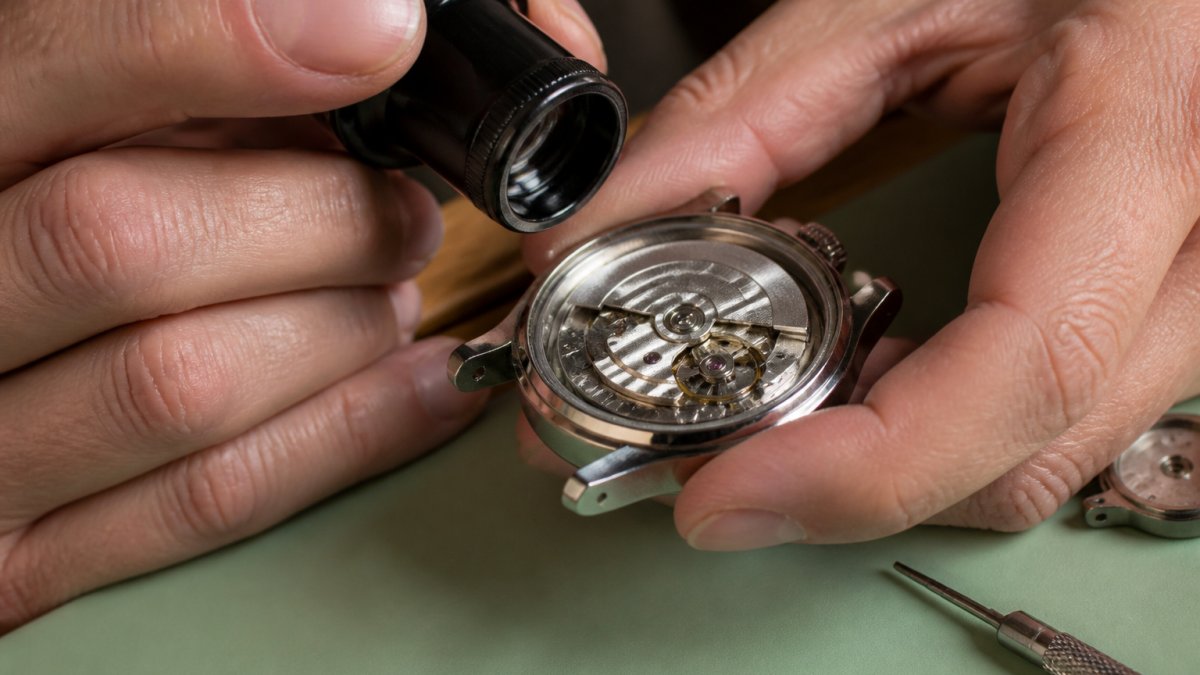
The techniques, and how to inspect each one
Anglage (beveled edges). A watchmaker draws a polished 45-degree bevel along the edge of a bridge or lever, then burnishes it.
Perlage (circular graining). Overlapping circles applied to the mainplate with a rotating abrasive tool.
Geneva stripes (côtes de Genève). Parallel waves across bridges.
Blued screws. Heat-treated steel, not painted.
Dial work. Applied indices should sit flat and align with the printed minute track; textured dials should show consistent depth.
A field method you can use in five minutes
Finishing is judged by consistency, not quantity: a single perfectly beveled bridge edge tells you more than a movement covered in uneven decoration. When you handle a watch, work in this order:
- Loupe the movement through the caseback. Check one bridge edge and one screw first. If those two are clean, the rest usually is.
- Tilt the watch under a single light source. Hand-applied bevels and blued screws change appearance as the angle shifts; stamped surfaces stay flat.
- Compare the two sides of the movement. A workshop that finishes one side and skips the other is telling you where it cut costs.
- Look at the caseback engraving and case flanks. Crisp, deep engraving and a consistent brushed or polished transition on the case are the same skill applied at a larger scale.
- Check the dial under magnification. Applied indices, printed text, and sub-dial edges should all agree with each other.
This is where artisanal craftsmanship and heritage meet innovation: the techniques are centuries old, but the execution, and the willingness to spend hours on a surface most owners will never see, separates one maker from another.
Automatic Watch Maintenance and Servicing: What to Expect
Automatic watch maintenance and servicing typically involves full disassembly, cleaning, lubrication, and regulation, and most manufacturers recommend it on a multi-year interval rather than annually. The exact schedule depends on the caliber and how you wear it, so check the maker's guidance.
What actually happens during a service:
- The movement is dismantled and each component inspected for wear
- Parts are cleaned in solution to remove old, gummy lubricant
- Fresh oils are applied at specific points, since different pivots need different viscosities
Two habits extend the interval between services. First, avoid wearing an automatic during high-impact activity, since shocks stress the balance staff.
Assessing Value Beyond Branding: A Collector's Framework
Value in a watch comes from four things a logo cannot supply: movement quality, finishing, serviceability, and design coherence. Branding influences resale, but it is a poor proxy for whether a watch is well made. The useful question is not "is this a good brand?" but "where did the money go?"
Score each watch on five axes
Use a simple 1-5 scale on each line, then look at the shape of the scores rather than the total. A watch scoring 5 on movement and 2 on serviceability is a different object than one scoring 3 across the board, even if the totals match.
- Movement architecture. Is the caliber in-house, custom-modified, or a standard ébauche? In-house and custom calibers usually mean the brand controls regulation and parts supply; a standard ébauche can still be excellent but is often shared with many other watches.
- Finishing. Can you see genuine hand-finishing on the case and movement, beveled edges, perlage, blued screws, applied indices? Use the inspection method above. Finishing is the most direct evidence of labor hours per watch.
- Serviceability. Can an independent watchmaker source parts and work on it, or must it return to the brand? A caliber only the factory can service carries a hidden long-term cost and a risk if the brand changes hands.
- Design coherence. Do the case geometry, dial, and proportions hold together as one idea, or does the watch look assembled from parts? Coherence is hard to fake and tends to age well.
- Provenance and materials. Do you know where the case was machined, where the movement was assembled, and how the materials were sourced? A maker who can answer those questions offers something a spec sheet cannot.
How the axes trade off
- High movement, low finishing. Common in watches that advertise a famous caliber but hide it behind a solid caseback. You are paying for the movement's name, not the work on it.
- High finishing, low serviceability. Beautiful but fragile ownership. Fine for a safe queen, frustrating for a daily wearer.
- High design, low movement. Fashion-led watches often score here. The watch looks right but will not reward long-term ownership.
A worked example of the logic
Suppose two watches cost the same. Watch A has an in-house caliber, visible hand-finishing, and independent serviceability, but a busy dial. Watch B has a standard ébauche, minimal finishing, and a widely praised dial.
That last axis, provenance and materials, is where many collectors now focus, and rightly so. Ethical sourcing and material provenance are becoming part of how a watch is judged, not an afterthought.
This is the approach we take at Haim Watch Company. Our hand-finished titanium cases, custom-designed calibers, and ornate dial decoration are meant to be assessed on exactly these terms rather than on a badge alone.
Conclusion
The hardest part of collecting is separating genuine craft from a well-told story, and the only way through is to learn what good finishing, a well-regulated caliber, and honest serviceability look like. Once you can read those signals, brand names matter far less than the object in your hand. Haim Watch Company builds for that kind of owner, with Swiss-made timepieces, custom-designed calibers, hand-finished titanium cases, and ornate dial decoration across a curated collection.
Frequently Asked Questions
What are the benefits of a Swiss automatic movement?
Swiss automatic movements offer self-winding convenience, high precision, and artisanal hand-finishing that quartz cannot match. Collectors value their mechanical complexity, heritage, and the fact that a well-maintained movement can last generations. Many Swiss movements also hold value better over time because of their craftsmanship and brand reputation. For example, a hand-finished rotor and decorated bridges are signs of quality that appeal to enthusiasts.
Are Swiss automatic watches more reliable than quartz watches?
Swiss automatic watches are reliable when serviced regularly, but quartz watches are generally more accurate and require less maintenance. Automatic movements can drift a few seconds per day, while quartz is accurate to within seconds per month. However, the mechanical robustness of a well-made Swiss automatic, like those with shock protection and anti-magnetic properties, makes them dependable for daily wear. Collectors often accept the trade-off for the craftsmanship and emotional appeal.
How often does a Swiss automatic watch need servicing?
Most Swiss automatic watches need servicing every 5 to 7 years, depending on wear and environmental conditions. Signs it's time include inaccurate timekeeping, reduced power reserve, or unusual noises. Servicing involves disassembly, cleaning, lubrication, and reassembly by a watchmaker. For collectors, regular servicing preserves the movement's condition and value. Always use a qualified watchmaker familiar with the specific caliber.
What should collectors look for in an automatic watch movement?
Collectors should examine finishing (e.g., Geneva stripes, perlage), the quality of components (jewels, balance wheel), and the movement's origin and reputation. A custom-designed caliber with hand-finishing often indicates higher craftsmanship than a standard off-the-shelf movement. Also check power reserve, accuracy specifications, and serviceability. Evaluating these factors helps assess value beyond branding and ensures long-term satisfaction.
Do automatic watches hold their value?
Some automatic watches hold value well, especially those from established brands with limited production or historical significance. However, value retention depends on brand reputation, rarity, condition, and market demand. Microbrands may not hold value as consistently, but unique designs and high craftsmanship can still appeal to collectors. Always buy what you love first, and consider value retention as a secondary factor.