

Table of Contents
- What Sets Custom Watch Calibers Apart
- In-House Watch Movement vs. Ebauche: Why Ownership Matters
- Watch Movement Finishing Techniques and Their Impact
- Mechanical Watch Accuracy Standards and Custom Regulation
- How Custom Calibers Affect Resale Value and Collectibility
- Sourcing and Compatibility: The Technical Reality
- Frequently Asked Questions
Last Updated: September 22, 2026
What Sets Custom Watch Calibers Apart
A custom watch caliber is the mechanical signature of a brand's engineering philosophy. When a watchmaker designs and manufactures their own caliber instead of relying on an off-the-shelf ebauche, they control every aspect of how a watch functions, from balance wheel frequency to movement finishing.
A standard ebauche is functional and reliable but fundamentally anonymous. A custom caliber is proprietary, reflecting intentional design choices that shape performance, aesthetics, and the watch's identity in the collector's market.
At Haim Watch Company, our Caliber HWC-1 powers the Legacy Automatic and represents years of engineering refinement. Building a custom movement signals a commitment to mechanical excellence that extends beyond marketing.

Custom calibers allow for complications like the complete calendar with moonphase in our Annum, nearly impossible to integrate into a standard ebauche without compromise. They also enable precise regulation to chronometer standards.
The real cost of custom calibers isn't just manufacturing, it's the engineering investment required to make them reliable, serviceable, and worth wearing for decades.
In-House Watch Movement vs. Ebauche: Why Ownership Matters
An ebauche is a partially finished movement sold by suppliers like ETA or Sellita. Brands purchase them, add complications or decorations, and market the result as their own movement. It's efficient and proven.
An in-house movement means the brand owns the architecture and controls the gear train, escapement, balance wheel frequency, and fundamental engineering that determines accuracy and longevity.
Chronometer standards established by COSC define precision benchmarks that movements must meet. A custom caliber can be engineered specifically to exceed these standards because the designer understands every variable in the system. An ebauche, by contrast, is optimized for a broad range of applications, which means it's rarely optimized for any single brand's specific requirements.
In-house movements can be serviced by the brand that created them, with documentation, spare parts, and mechanical knowledge to restore original specifications. Ebauche-based movements, once modified, become harder to service because the original manufacturer didn't design them with those modifications in mind.
This is where custom watch calibers prove their value. Brands that invest in proprietary movements signal they'll support their watches long-term. They're betting their reputation on reliability and longevity.
Watch Movement Finishing Techniques and Their Impact
Movement finishing, decorative and functional surface treatments, separates a mass-produced timepiece from a craft object.
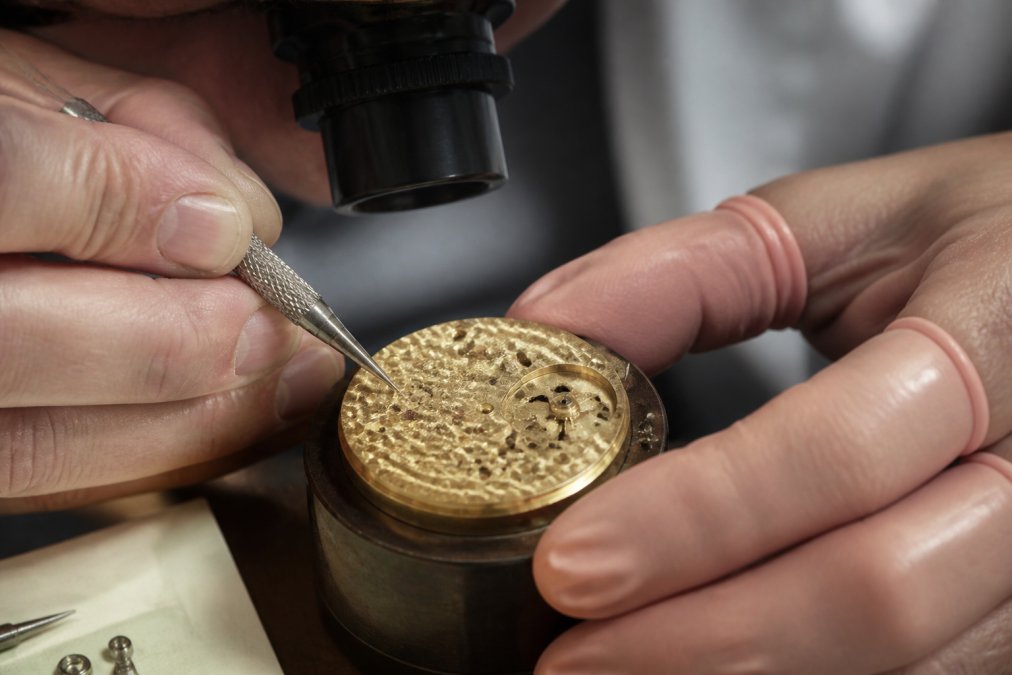
Common finishing techniques include perlage (circular brushing), Geneva stripes (parallel lines), and hand-engraving. Perlage alone takes hours per movement, yet most owners never see it, the movement sits behind an exhibition caseback.
Finishing serves two functions: it protects the movement from oxidation and signals craftsmanship. A properly finished movement ages gracefully and extends the service interval.
The Annum's custom Caliber HWC-2 features hand-finished surfaces that reflect a philosophy: a movement worth displaying is worth building to last. Collectors recognize this distinction immediately.

Mechanical Watch Accuracy Standards and Custom Regulation
Accuracy in mechanical watches is measured in seconds per day of deviation. A well-regulated movement should keep time within minus 4 to plus 6 seconds daily, the COSC chronometer standard. Achieving this requires understanding the mechanisms that govern timekeeping precision.
Custom calibers allow for precision regulation that's difficult to achieve with mass-produced movements because the designer controls the variables that determine accuracy from the ground up.
The Engineering Variables Behind Regulation
Three primary factors determine how accurately a mechanical movement keeps time:
Isochronism is the movement's ability to maintain a consistent rate regardless of mainspring power reserve state. A poorly designed hairspring oscillates at different frequencies depending on balance wheel amplitude. A custom caliber can be engineered with hairspring geometry that compensates for this variation through material selection, thickness, length, and terminal curve design.
Beat error is the timing discrepancy between the balance wheel's two oscillations per cycle. A custom caliber can be designed with escapement geometry optimized for minimal beat error through lever angles, pallet fork geometry, and escape wheel tooth profile adjustments. Chronometer-grade movements achieve beat error below 0.5 milliseconds; mass-produced movements often run 1-2 milliseconds or higher.
Rate stability is how consistently the movement gains or loses time over days and weeks. A custom caliber benefits from tighter tolerances in balance wheel dynamic balance, hairspring consistency, and escapement cleanliness, reducing friction variations.
How Custom Calibers Achieve Chronometer Performance
Mass-produced movements are designed to be "good enough" across a range of applications. A custom caliber is optimized for a specific frequency, typically 28,800 vibrations per hour (4 Hz), though some brands choose 21,600 (3 Hz) or 36,000 (5 Hz).
Once frequency is locked, the designer calculates exact hairspring length, balance wheel diameter, and escapement geometry. Mass-produced movements use broad tolerances and post-assembly adjustments; custom calibers use tighter tolerances from the start, reducing regulation needs.
A properly regulated custom movement maintains rate stability for years, typically losing or gaining no more than 5-10 seconds per month. An ebauche-based movement may drift more noticeably as components age, requiring more frequent adjustments.
The Regulation Process for Custom Calibers
Regulation of a custom caliber involves several steps:
-
Hairspring adjustment: The watchmaker may shorten or lengthen the hairspring to adjust the overall rate. A shorter hairspring increases the frequency (makes the movement run faster); a longer hairspring decreases it.
-
Balance wheel truing: The balance wheel must be perfectly balanced. Any asymmetry in weight distribution will cause the movement to run faster or slower depending on the watch's position. The watchmaker uses a balance wheel truing tool to identify heavy spots and carefully removes metal to achieve dynamic balance.
-
Escapement regulation: Fine adjustments to the escapement geometry, the angle of the lever, the position of the pallet forks, can reduce beat error and improve rate stability. This is where hand-finishing and precision tools become critical.
-
Testing across positions: A chronometer-grade movement is tested in multiple positions (dial up, dial down, crown up, crown down, crown left, crown right) to ensure the rate remains consistent. A custom caliber designed with proper geometry will show minimal variation across positions.
The custom caliber designer understands every variable and can minimize regulation work required at the end of manufacturing. This is impossible with an ebauche, where the designer has no control over base architecture.
Why This Matters for Long-Term Ownership
A properly regulated and finished custom caliber maintains accuracy far longer than a standard movement. After five years of daily wear, a well-designed custom caliber keeps time within original specification. A mass-produced movement may drift 10-15 seconds per day or more.
How Custom Calibers Affect Resale Value and Collectibility
Resale value correlates with brand recognition, rarity, and mechanical integrity. Custom calibers influence all three.
A proprietary movement carries a secondary market premium because it creates scarcity and dependency that collectors value for long-term support.
The Legacy Automatic, powered by Caliber HWC-1, holds value differently than a watch with a standard ETA movement. ETA movements are interchangeable; the HWC-1 is singular to Haim Watch Company. This exclusivity matters to collectors.
Limited production runs, like the Legacy Automatic: Azure (25 pieces), create collectibility because the movement cannot be found elsewhere. Controlled production volumes ensure individual significance.
A 10-year-old watch with a serviceable, accurate custom movement commands respect. Collectors price accordingly.
Sourcing and Compatibility: The Technical Reality
Building a custom caliber requires sourcing specialized components from suppliers who understand the brand's specifications and can deliver chronometer-grade precision. This is where many brands discover that custom caliber development is far more complex than designing on paper.
Component Selection and Tolerance Stacking
Every component has a tolerance range. When assembled, tolerances stack, a balance wheel at the high end combined with a hairspring at the low end produces different frequency than the opposite combination.
Mass-produced movements use post-assembly regulation and shims. Custom calibers tighten tolerances with suppliers, reducing adjustment needs and improving consistency across production runs.
Jewel count directly affects friction and longevity. A 21-jewel movement is more refined than 17-jewel because more pivot points use low-friction ruby. A custom caliber specifies jewels from suppliers known for tight tolerances; mass-produced movements accept jewels from multiple suppliers meeting minimum specifications.
Case-to-Movement Compatibility
A critical constraint is the physical fit between movement and case. The movement's diameter is typically 2-3 mm smaller than the case diameter. The movement's height determines case thickness and influences proportions.
Complications increase movement height. A standard automatic is 7.5 mm; a calendar complication adds 1-2 mm. This affects case design, weight, wrist presence, and proportions.
The dial must clear the balance wheel, hairspring, and other tall components. A high-frequency movement (36,000 Hz) may have a larger balance wheel, requiring a taller dial or thinner movement. These constraints force trade-offs between performance, aesthetics, and manufacturability.
Complication Integration and Power Reserve Calculation
Complications multiply engineering complexity. A complete calendar module requires multiple cams and wheels precisely integrated into the gear train.
The gear train must drive the calendar mechanism without binding.
Supply Chain Constraints and Lead Times
Service and Repair Implications
Frequently Asked Questions
What distinguishes a custom watch caliber from a mass-produced movement?
Custom watch calibers are engineered specifically for a brand's design and performance requirements, often featuring proprietary escapement designs, unique balance wheel configurations, or bespoke complications like custom calendar modules. Mass-produced movements (ebauches) are generic platforms sold to multiple brands. Custom calibers allow brands to control power reserve, frequency, accuracy specifications, and aesthetic finishing, elements that define the watch's character and reliability.
How does a custom caliber affect the long-term value of a watch?
Custom calibers significantly enhance resale value because they create brand identity and scarcity. A watch powered by a proprietary movement cannot be easily replicated or serviced by competitors, making it more desirable to collectors. Additionally, boutique brands investing in custom calibers signal long-term commitment, reducing buyer anxiety about parts availability and brand longevity, critical factors in the secondary market.
Are custom watch movements more accurate than standard movements?
Custom movements can achieve superior accuracy when properly regulated, but accuracy depends on regulation precision and quality control, not the movement type alone. A well-regulated custom caliber targeting chronometer-grade accuracy (within -4 to +6 seconds per day) will outperform an unregulated standard movement. Custom calibers allow brands to optimize balance wheel frequency, escapement geometry, and isochronism specifically for their design, enabling tighter tolerances and beat error control than generic platforms permit.
Why do boutique brands invest in developing custom calibers?
Custom calibers differentiate boutique brands in a crowded market and justify premium pricing. They enable unique complications, distinctive finishing, and proprietary features that mass-market brands cannot offer. Beyond marketing, custom calibers solve real design constraints: fitting a specific case size, achieving a desired power reserve, or implementing hand-finished decoration. Brands like Haim Watch Company develop custom calibers to control quality, ensure long-term parts availability, and build a coherent horological vision that resonates with collectors seeking authenticity and craftsmanship.