

Table of Contents
- What Makes a Watch Dial Ornate
- Quick Comparison: Ornate Dial Styles at a Glance
- Enamel Watch Dial Craftsmanship
- Guilloché Watch Dial Finishing Techniques
- Skeleton Watch Dial Designs
- Watch Dial Finishing Techniques and Decorative Methods
- How to Evaluate and Care for Ornate Timepieces
- Frequently Asked Questions
Last Updated: October 14, 2026
What Makes a Watch Dial Ornate
An ornate watch dial design is defined by decorative embellishment, intricate finishing techniques, and artistic expression that elevate the timepiece beyond pure function. At Haim Watch Company, we see ornate dials as the intersection of horological craftsmanship and artistic vision.
Ornate watch dial designs distinguish themselves through layered visual complexity: multiple finishing techniques, hand-applied details, and decorative patterns that catch light differently depending on the angle and time of day.
What separates ornate from merely decorated is intentionality and depth. A printed pattern is decoration; an ornate dial involves actual craft, hand-drawn elements, textured surfaces, applied markers, and finishes that create dimensional interplay.
Quick Comparison: Ornate Dial Styles at a Glance
| Dial Style | Technique | Visual Character | Complexity Level | Best For |
|---|---|---|---|---|
| Enamel | Hand-painted Grand Feu enamel | Vibrant, painterly, dimensional | Very High | Artistic expression, vintage aesthetic |
| Guilloché | CNC or hand-engine turning | Linear patterns, light-catching texture | High | Classic elegance, technical precision |
| Skeleton | Cutaway dial revealing movement | Mechanical artistry, dynamic | Very High | Movement enthusiasts, technical showcase |
| Subdial | Multiple dial windows with complications | Functional complexity, organized | Medium-High | Chronographs, calendars, GMT watches |
| Applied Markers | Hand-set hour indices | Dimensional, refined | Medium | Luxury finishing, vintage homage |
The core trade-off: hand-applied techniques (enamel, applied markers) deliver artistic depth but cost more and take longer, while mechanical techniques (guilloché, skeleton) offer repeatable precision with visual drama.
Enamel Watch Dial Craftsmanship
Enamel dials represent a pinnacle of ornate watch dial designs, requiring centuries-old techniques adapted for horological precision. Grand Feu enamel involves hand-painting designs onto a dial base, then firing it in a kiln at extreme temperatures, producing a vitrified surface of remarkable depth and luminosity.
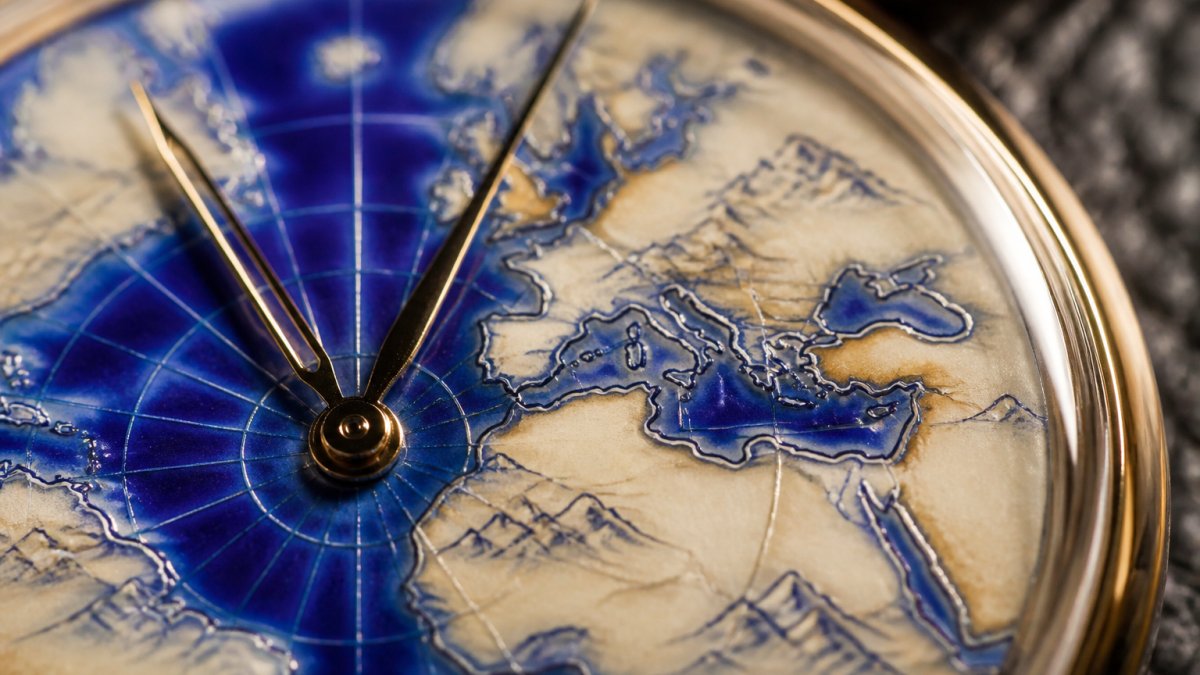
Each enamel dial is hand-drawn, often freehand without guides. For designs like the Viajero SE, which features hand-drawn 17th Century maps on Grand Feu enamel dials, this means each watch is subtly unique, variations in brushwork, color saturation, and line weight become features rather than defects.

What makes enamel dials so visually compelling is their dimensional quality: a cobalt blue enamel dial appears almost luminous in certain conditions, then shifts to deeper tones in others.
The limitation is production time and cost. Each dial requires multiple firing cycles, and if a firing goes wrong, a bubble, a color shift, a crack, the entire dial is lost, which is why enamel dials command premium pricing and longer lead times.
Guilloché Watch Dial Finishing Techniques
Guilloché is a mechanical pattern-making technique that creates rhythmic, textured surfaces through repetitive linear or geometric designs.
The visual effect is immediate: fine parallel lines or geometric grids catch light as the watch moves, creating a subtle shimmer. Unlike enamel's painterly depth, guilloché offers refined, architectural elegance, enhancing the dial through texture and light play rather than obscuring it.
Haim Watch Company's Annum exemplifies guilloché craftsmanship.

The advantage over hand-applied techniques is consistency and speed: once the CNC pattern is programmed, each dial is identical, allowing tight tolerances alongside ornate dial designs. It also pairs well with applied hour markers and hands, creating a layered visual hierarchy.
Guilloché patterns range from simple linear designs to complex geometric arrangements, concentric circles, waves, or sunburst effects. Pattern choice shapes the dial's character: linear guilloché reads formal and structured, while radial patterns feel dynamic and eye-catching.
Skeleton Watch Dial Designs
Skeleton dials take a fundamentally different approach: rather than adding decoration, they remove portions of the dial to reveal the movement beneath, creating an ornate effect through transparency and mechanical artistry.
A true skeleton dial requires significant engineering: cutting away sections while maintaining structural integrity and legibility, positioning hour markers around the openings, and finishing the movement to a display-worthy standard, decorative striping, perlage, and polishing become visible and expected.
The visual impact is dramatic: gear wheels, the balance wheel's oscillation, and the escapement become part of the experience. For mechanical devotees, skeleton dials offer the ability to see the watch working in real time.
The limitation is legibility. Some skeleton designs sacrifice practicality for drama, making it hard to tell time at a glance; the finest balance mechanical showcase with functional timekeeping.
L2 Chronograph (Anniversary Edition) →
Watch Dial Finishing Techniques and Decorative Methods
Enamel, guilloché, and skeleton work get the headlines, but most ornate dials are a stack of smaller techniques layered together.
Hand-engraved dials. A graver is pushed by hand across a metal blank, cutting scrollwork, floral motifs, or figurative scenes directly into the surface.
Miniature painting. A brush with just a few hairs lays down enamel pigment in layers, each fired before the next is applied.
Marquetry and stone dials. Some makers inlay thin slices of wood, mother-of-pearl, meteorite, or semi-precious stone such as lapis, malachite, or onyx.
Applied markers and hands. Hand-applied indices, often gold, rhodium-plated brass, or with luminous fill, are set individually into drilled or soldered feet.
Sunburst, perlage, and circular graining. Sunburst (soleillage) is a radial brushed finish that throws light outward from the center.
Combining these techniques produces the most visually complex ornate dials. The L2 Chronograph, powered by the VK64 caliber, demonstrates this layering, its four dial themes showcase different finishing combinations that create visual interest while maintaining chronograph functionality.

How to Evaluate and Care for Ornate Timepieces
Ornate dials are a rewarding category of watch to own. The difference comes down to how carefully the buyer evaluated the piece and planned for its care. The checklist below covers what to look at, what to ask, and what to expect.
Price context: what drives the number
Ornate dial pricing is not arbitrary. The main cost drivers, in order of impact:
- Hand-applied technique. A hand-painted Grand Feu or miniature enamel dial can take many times the workshop hours of a printed dial, with a high failure rate during firing, the single largest price driver.
- Hand engraving and hand-turned guilloché. Skilled engravers and rose-engine operators are scarce, and their time is billed accordingly.
- Precious materials. Gold, platinum, mother-of-pearl, lapis, malachite, and meteorite add material cost on top of labor.
- Gem-setting. Even a modest ring of set stones adds significant cost because each stone is placed by hand.
- Brand and finishing standard. Two dials using the same technique can differ by thousands of dollars based on the maker's finishing reputation and the movement underneath.
Authenticity and condition checks
- Look at the dial under magnification. Hand work shows micro-variation, brush strokes, slight asymmetry, tiny tool marks. A perfectly uniform surface on a dial advertised as hand-painted is a warning sign.
- Check for cracks, chips, and hairlines in enamel. Enamel is glass; it does not flex. A hairline crack can propagate with temperature change or impact. Hold the watch at an angle under a light, cracks often hide in the reflection.
- Inspect applied markers for lift. A lifting marker casts a visible shadow gap at one edge. Repairable, but price it in.
- Confirm the dial matches the reference. Aftermarket or refinished dials are common in the vintage market and can dramatically change value. Ask for service records and, where possible, an extract from the maker's archive.
- Check the caseback and movement finishing if the watch has an exhibition back. Rough machine marks suggest the maker spent the budget on the front only.
Legibility under real conditions
View the watch in at least three lighting environments, bright outdoor sun, indoor overhead light, and low light, and read the time in each. Ornate dials that sacrifice legibility for decoration create daily frustration; a dial that fails the low-light test will usually fail the owner within a month.
Care and fragility by technique
- Enamel (Grand Feu, champlevé, cloisonné, miniature). Avoid sudden temperature swings, heated car to freezing air, or a sauna, which can crack the surface. Keep it away from harsh solvents and prolonged direct sunlight, which can fade pigments over years. Clean with a soft, dry brush only.
- Hand engraving and guilloché. More durable than enamel but vulnerable to deep scratches, which cannot be polished out without erasing the pattern. Wipe with a microfiber cloth; avoid abrasive polishes.
- Stone and marquetry dials. The edges of inlaid pieces are the weak point. Avoid knocks to the crystal and case, and have the watch inspected after a hard impact even if nothing looks broken.
- Skeleton dials. The movement is exposed to dust through the dial opening. Service on the maker's recommended interval and avoid opening the case yourself.
Service, restoration, and lead times
Enamel dials, hand engraving, and marquetry generally cannot be restored by a general watchmaker, restoration means returning the watch to the maker or a specialist dial restorer, and can take months. Before buying, ask two questions: does the maker support dial restoration, and what is the expected turnaround? For hand-applied dials, expect lead times of weeks to months, the Viajero SE, with its hand-drawn enamel dials, ships approximately 45 days after order. That is not a deficiency; it is evidence of genuine craft.
A short pre-purchase checklist
- Identify the technique(s) and confirm they match the maker's description.
- Inspect under magnification for cracks, lifted markers, and refinishing.
- Read the time in three lighting conditions.
- Ask about service history, restoration support, and lead time.
- Confirm the price matches the labor the dial represents.
When evaluating ornate watch dial designs, prioritize makers committed to genuine craftsmanship. Haim Watch Company's approach, hand-finished details with custom-designed calibers, provides sophisticated style with reliable performance for watch enthusiasts.
Frequently Asked Questions
What makes a watch dial ornate?
An ornate watch dial combines decorative techniques, artistic designs, and meticulous finishing to create visual depth and sophistication. Ornate dials feature hand-drawn elements, textured surfaces like guilloché patterns, enamel work, applied hour markers, and sculpted hands. The Viajero SE exemplifies this with hand-drawn 17th-century maps on Grand Feu enamel, while the Annum showcases CNC guilloché patterns that create interplay of light and depth. Ornate dials transform a timepiece from functional to a conversation piece and wearable art.
What are the most popular decorative watch dial techniques?
The finest ornate watch dials employ enamel work, guilloché patterns, applied hour markers, and relief designs. Grand Feu enamel, used on the Viajero SE, involves hand-drawn artwork fired at high temperatures for durability and luminosity. Guilloché creates mechanical patterns through precision engraving, as seen on the Annum's Dark Cobalt and Stone White variants. Three-dimensional relief dials, like those on the Viajero, add depth without sacrificing readability. Skeleton dials expose internal mechanisms, combining form and function. Each technique requires specialized craftsmanship and elevates the artistic value of the timepiece.
How are enamel watch dials made?
Grand Feu enamel dials begin with hand-drawn artwork on a metal base, typically copper or gold. The design is then fired in a kiln at temperatures exceeding 800 degrees Celsius, fusing the enamel permanently to the surface. This process creates a glass-like finish with exceptional durability and a luminous quality that cannot be replicated by printing. The Viajero SE's enamel dials feature hand-drawn maps in three colorways, Antique Cobalt, Grayscale, and Polyglot, each individually crafted. Multiple firing cycles may be necessary to achieve the desired depth of color and artistic effect, making enamel dials among the most labor-intensive and valued in horology.
What is a guilloché watch dial?
A guilloché dial features precise, repetitive mechanical patterns created through specialized engraving or CNC machining. These patterns catch light differently depending on viewing angle, creating a dynamic, textured appearance that adds visual interest and sophistication. The Annum incorporates intricate CNC guilloché patterns on two of its three colorways, offering a textured interplay of light and depth. Guilloché differs from enamel in that it is a surface treatment of the dial itself rather than a separately applied coating. This technique has roots in classical watchmaking and remains a hallmark of refined, artistic timepieces that demand attention to detail.