

Last Updated: October 22, 2026
Quick Summary
Watch manufacturing depth describes how much of a timepiece a brand actually makes versus assembles from purchased parts. Brands that machine their own cases, finish their own dials, and regulate their own movements operate at real depth, while brands that buy a complete movement and drop it into a catalog case work only at the surface.
- Most brands fall into three tiers: Assembler, Integrator, and Manufacturer, based on production depth.
- The watch manufacturing process runs from design and development through component production, movement preparation, assembly, regulation, and quality control.
- Automation handles repeatable work like CNC machining and dial stamping, but hand finishing and final adjustment remain manual.
- Vertical integration means a brand controls more of its own supply chain, from component sourcing to final assembly.
- Treating Swiss made or assembled in as a complete depth signal is the most common buyer mistake.
Table of Contents
- What Watch Manufacturing Depth Actually Means
- Watch Components Explained: The Anatomy of a Timepiece
- Mechanical Watch Movement Manufacturing, From Gear to Escapement
- The Watch Manufacturing Process, Step by Step
- Watch Assembly and Quality Control: Where Depth Gets Proven
- Handcrafted vs. Machine-Made: What the Finishing Tells You
- Supply Chain, Sourcing, and Vertical Integration
- How to Judge Manufacturing Depth Before You Buy
- Frequently Asked Questions
What Watch Manufacturing Depth Actually Means
Watch manufacturing depth describes how much of a timepiece a brand actually makes versus assembles from purchased parts. A brand that machines its own cases, finishes its own dials, and regulates its own movements operates at real depth.
That distinction matters because it drives everything a buyer eventually notices: how the watch ages, how serviceable it is, and whether the price reflects craft or marketing. At Haim Watch Company, we build both Swiss-made and US-assembled pieces, and we have watched the word "manufacture" get stretched past breaking point across the industry.
The Three Tiers of Production Depth
Most brands fall into one of three tiers, and the tier tells you more than any marketing page will.
- Tier 1, Assembler: Buys a finished movement and a catalog case, then assembles and brands the watch. Depth is minimal.
- Tier 2, Integrator: Designs its own cases and dials, sources a proven movement, and finishes key components in-house or with dedicated partners.
- Tier 3, Manufacturer: Produces or heavily modifies its own movement, machines cases, decorates dials, and regulates each watch before it ships.
The tier is not a quality verdict on its own. A careful Tier 1 brand can beat a sloppy Tier 3 brand. But depth tells you where the engineering actually happens, and that is the number worth knowing.
Watch Components Explained: The Anatomy of a Timepiece
Every watch reduces to a handful of parts, each with a job. Understanding them is the fastest route to judging how much real watchmaking sits behind a design.
- Case: The housing that protects the movement. Material, finishing, and water resistance all live here.
- Dial: The face. Ornate dial decoration is one of the clearest signals of handwork.
- Hands: Hour, minute, and second indicators, often the finest finished parts on the watch.
- Crystal: The transparent cover, typically sapphire or mineral glass.
- Bezel: The ring framing the crystal, functional on dive watches, decorative elsewhere.
- Crown, lugs, and strap: The interfaces between watch and wearer.
Case, Dial, Hands, Crystal, and Bezel
The case is where manufacturing depth shows first. A machined titanium case with hand-finished bevels takes far more passes than a stamped steel shell, and you can feel the difference at the edges. Dials separate brands even more sharply.
Crystals split into sapphire, which resists scratching, and mineral glass, which does not. Bezels range from fixed decorative rings to unidirectional dive bezels with precise click springs. None of these parts is exotic.
Mechanical Watch Movement Manufacturing, From Gear to Escapement
Mechanical watch movement manufacturing is the deepest layer of the craft.
The mainspring sits in a barrel and unwinds slowly through the gear train. Those gears step the energy down to the escapement, which releases it in controlled pulses to the balance wheel.
Brands that manufacture movements in-house control every one of those interfaces. Brands that buy movements inherit whatever tolerances the supplier delivers.
The Watch Manufacturing Process, Step by Step
The watch manufacturing process runs from design to dispatch in a sequence most buyers never see, and the depth of each step separates a catalog assembly from a genuinely engineered timepiece. Here is the workflow in order, with the component-level methods that matter.
- Design and development: Sketches become technical drawings, and the case, dial, and movement are specified together. Computer-aided design (CAD) files define tolerances before any metal is cut, and prototypes are often produced via CNC machining or 3D printing to validate fit and ergonomics.
- Component production: Cases are machined from solid billet or cast, then finished. Dials are stamped, then decorated with applied indices, sunburst brushing, or lacquer. Hands are cut, polished, and sometimes heat-blued. Each component has its own tolerance stack that affects final alignment.
- Movement preparation: Movements are assembled, lubricated, and adjusted before they meet a case. In-house calibers may be regulated on a timing machine across multiple positions; purchased movements arrive with supplier tolerances that the brand may or may not refine.
- Assembly: The dial, hands, and movement are fitted into the case under magnification in a clean environment. Hand-setting must align precisely with the movement's hour wheel, and dust control is critical.
- Regulation: Each watch is timed in multiple positions and adjusted. This is where daily rate targets are met or missed.
- Quality control: Water resistance, alignment, and finish are checked before packing. Testing may include pressure testing, visual inspection under magnification, and timing verification.
Where Modern Automation Fits In
Automation handles the repeatable work: CNC machining of cases, stamping of dials, and consistency checks during regulation. Computer numerical control (CNC) machining allows complex case shapes and tight tolerances that would be impractical by hand at scale. Automated timing machines can measure a movement's rate in multiple positions quickly, but the adjustment itself often remains a skilled manual task. It does not replace hand finishing on bevels, dial decoration, or final assembly under a loupe.
Manufacturing Depth by Component
Depth varies by component, and understanding this helps you read a spec sheet. Cases differ in material (stainless steel, titanium, precious metals), machining method (billet vs. cast), and finishing (polished, brushed, sandblasted, or hand-bevelled). Dials range from flat printed surfaces to multi-layer constructions with applied indices and guilloché decoration. Hands can be stamped or machined, painted or heat-blued. Crystals are typically sapphire or mineral glass, with sapphire offering superior scratch resistance.
Watch Assembly and Quality Control: Where Depth Gets Proven
Quality control is where manufacturing depth gets tested, because a beautiful watch that fails after a year was never deep, only well photographed. Assembly happens under magnification in a clean environment, with each component placed by hand or with tweezers.
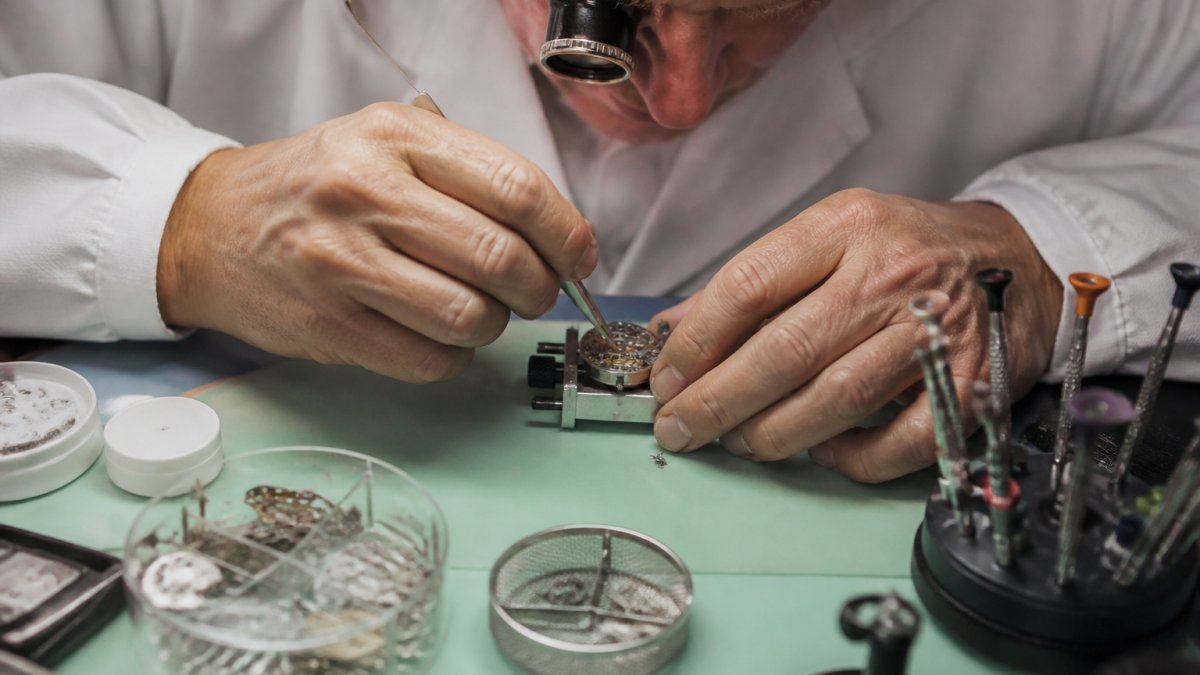
Regulation comes next. A watch is timed across several positions, because gravity affects a mechanical movement differently depending on how the wrist sits.
Handcrafted vs. Machine-Made: What the Finishing Tells You
Finishing is the most honest disclosure a watch makes. Machine finishing produces even, uniform surfaces, which is not a flaw.
Neither approach is automatically superior. Machine finishing delivers consistency at scale, and hand finishing adds character and cost. What matters is honesty. A brand that claims handcrafted work should show it in the details, and a brand that machines its parts should say so.
Supply Chain, Sourcing, and Vertical Integration
Vertical integration means a brand controls more of its own supply chain, from component sourcing to final assembly. It is expensive, slow, and one of the clearest markers of manufacturing depth.
Sourcing decisions shape everything downstream. A Swiss-made movement carries a different cost and service story than an Asian-sourced caliber, and case material sourcing affects both durability and repairability. A brand that assembles domestically, as we do with our Legacy Automatic, takes on more operational burden than one that imports finished watches.
How to Judge Manufacturing Depth Before You Buy
Use this checklist before you commit to any watch. It turns vague marketing language into concrete questions.
- Does the brand state which components it makes versus buys?
- Is the movement described by caliber name and origin, or only as "precision"?
- Are finishing methods named, such as hand-finished bevels or applied indices?
- Does the brand publish regulation targets or position testing?
- Is assembly location stated plainly, with specifics rather than a flag?
- Can the brand explain how the watch will be serviced years from now?
| Signal | Shallow Depth | Real Depth |
|---|---|---|
| Movement | Unnamed "quality movement" | Named caliber with origin and specs |
| Case finishing | Generic "polished steel" | Named materials and finishing method |
| Dial | Printed design only | Applied indices, layered decoration |
| Regulation | Not mentioned | Stated positions and daily rate target |
| Assembly | Flag and a slogan | Named location and process detail |
Two brands can sit at the same tier and still differ enormously in care. The checklist above is how you tell them apart without a loupe and a bench.
Depth in watch manufacturing is not a badge you can buy; it is a set of decisions made long before the watch reaches your wrist.
Frequently Asked Questions
What is the difference between watch assembly and watch manufacturing?
Assembly means putting together components that were made elsewhere, often a purchased movement dropped into a case with a dial and hands. Manufacturing depth means the brand actually makes or customizes key parts: the caliber, the case, the dial, or the finishing. The distinction matters because a watch assembled from catalog parts can still be well made, but the brand's engineering control is limited. When you evaluate watch manufacturing, ask which components are produced or specified in-house versus bought off the shelf.
What are the main components of a mechanical watch?
A mechanical watch has five broad groups: the movement (mainspring, gear train, escapement, balance wheel, jewels), the case (often steel or titanium, with lugs and a crown), the dial, the hands, and the crystal, plus the bezel and strap. Each part has a job. The mainspring stores energy, the gear train transmits it, the escapement releases it in regulated pulses, and the balance wheel keeps time. Understanding these watch components explained in order shows where manufacturing depth actually lives.
How do watchmakers test a watch for accuracy and reliability?
Accuracy testing usually runs the finished watch on a timing machine that measures rate and amplitude in several positions, since gravity changes how a movement performs. Reliability testing adds case pressure checks for water resistance, shock and temperature exposure, and a running period to confirm the power reserve holds. Tolerances are stated in seconds per day. A brand that publishes its testing positions and accepted tolerances is showing real watch assembly and quality control depth rather than just claiming precision.
How long does it take to manufacture a watch?
Timelines vary widely with depth. A watch assembled from a bought-in movement and catalog case can be finished in weeks. A custom caliber with in-house design, tooling, component production, finishing, assembly, and testing can take many months to over a year from design freeze to delivery. Made-to-order and custom watch production adds lead time because small batches share tooling and bench time. Ask a brand where its time goes: design, component production, finishing, or testing.
What does it mean for a watch to be assembled in the United States?
It means the final assembly and testing happen domestically, but it does not automatically mean every part was made here. US assembly can still rely on Swiss or Japanese movements and imported cases. The meaningful question is how much of the watch is produced or finished domestically, and whether the brand can document it. A watch with a US-assembled movement and hand-finished case shows more watch manufacturing depth than a label alone suggests.
Is a custom-engineered movement worth more than a standard ETA movement?
It depends on what you value. A standard ETA or similar Swiss caliber is proven, easy to service, and parts are widely available. A custom-designed caliber gives the brand control over architecture, finishing, and decoration, and it can be tuned to the case. The premium buys engineering and exclusivity, not automatically better timekeeping. Weigh serviceability and parts availability against the design story before you pay more for watch manufacturing depth.