

Last Updated: October 29, 2026
Quick Summary
The benefits of high beat watch movements come from a faster balance wheel: a higher beat rate resists knocks and positional disturbance better, so the watch holds its rate more consistently through daily wear, and it produces a visibly smoother seconds hand sweep. The trade-offs are higher energy consumption, more escapement friction, and shorter service intervals.
- A 4 Hz movement equals 28,800 beats per hour, and 5 Hz equals 36,000 beats per hour.
- At 28,800 beats per hour the seconds hand advances eight times per second; at 36,000 it advances ten.
- Raising the beat rate from 28,800 to 36,000 vibrations per hour increases impulses by roughly 25 percent.
- Escapement efficiency, mainspring capacity, and movement design can offset much of the power-reserve penalty.
- Have the rate checked every couple of years to catch drift before it becomes wear.
Table of Contents
- Why High-Beat Movements Earn Their Following
- Watch Movement Beats Per Hour, Explained in Plain Terms
- High-Beat vs Low-Beat Watch Movements: The Real Differences
- The Seconds Hand Sweep and What It Signals
- High-Beat Watch Accuracy: What the Rate Gain Actually Delivers
- Power Reserve, Friction, and the Cost of Speed
- Automatic Watch Movement Maintenance on a High-Beat Caliber
- Which Movement Suits How You Actually Wear a Watch
- Frequently Asked Questions
Why High-Beat Movements Earn Their Following
A high-beat movement is a mechanical watch caliber whose balance wheel oscillates at a higher frequency than the traditional standard, and the benefits of high beat watch movements flow directly from that single design choice. At Haim Watch Company, we build around custom-designed calibers, so we think hard about what frequency buys a wearer and what it costs. The short answer: a faster oscillator resists disturbance better and produces a visibly smoother seconds hand. The longer answer involves real trade-offs in wear, energy, and servicing that most enthusiast discussions gloss over.
Here's what most guides get wrong. They treat a higher beat rate as an automatic accuracy upgrade. It isn't. Frequency changes how a movement behaves under disturbance and how it looks on the wrist; it does not guarantee better timekeeping on a still desk. Keep reading, because the distinction matters when you're choosing a watch.
Watch Movement Beats Per Hour, Explained in Plain Terms
Beats per hour is the number of times a watch's balance wheel completes a half-oscillation in one hour, and it is the clearest way to compare movement frequencies. A balance wheel swings back and forth; each full swing is one oscillation, and each swing direction is one beat. Multiply oscillations by two and by 3,600 seconds and you have beats per hour.
The common figures you'll see quoted are 28,800 beats per hour and 36,000 beats per hour. The first equals 4 Hz, the second 5 Hz. Both sit above the older 18,000 and 21,600 standards that defined mid-century mechanical watchmaking. For a deeper look at how automatic calibers compare on these specs, our guide to automatic watch movement vs ETA covers accuracy, reliability, and servicing side by side.
Frequency, Hertz, and Vibrations: One Number, Three Names
Frequency, hertz, and vibrations per hour describe the same property measured three ways. Hertz counts full oscillations per second; vibrations per hour counts beats per hour. A 4 Hz movement oscillates four times per second, which is eight beats, which is 28,800 beats per hour. Watch listings mix these terms constantly, which is why buyers get confused.
The practical upshot: 4 Hz and 28,800 vph are the same movement. So are 5 Hz and 36,000 vph. Once you can translate between them, spec sheets stop being cryptic.
High-Beat vs Low-Beat Watch Movements: The Real Differences
The core difference between high-beat and low-beat watch movements is how quickly the balance recovers from a knock. A faster oscillator returns to its rhythm sooner after a disturbance, which is why high-beat calibers tend to hold rate better when the watch is moving around. A slower oscillator takes longer to settle.
That advantage is real but conditional. As watch enthusiasts on WatchUSeek's discussion of hi-beat trade-offs have noted, the factors determining accuracy are complex, and the potential advantage of a high beat rate does not always translate into practice. Regulation quality, positional adjustment, and lubrication matter at least as much as frequency.
The Seconds Hand Sweep and What It Signals
A high-beat movement produces a smoother, more continuous seconds hand sweep because the balance ticks more times per second. At 28,800 beats per hour the hand advances eight times per second; at 36,000 it advances ten. The eye reads that as fluid motion rather than a series of discrete steps.
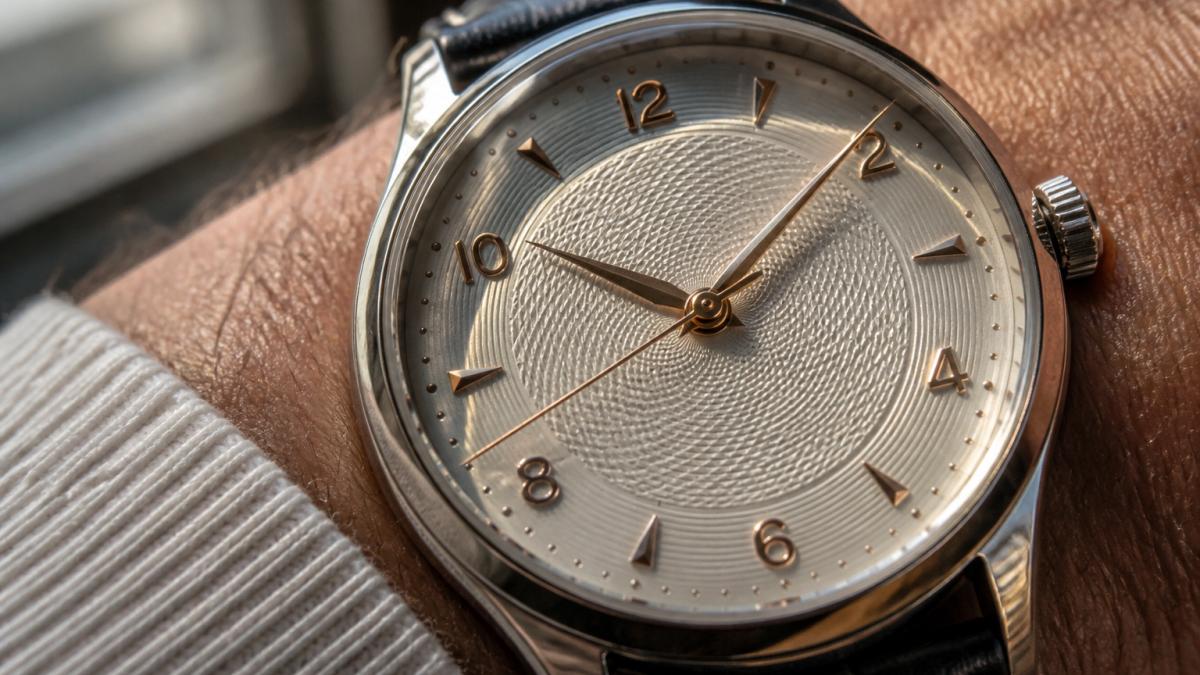
What the sweep signals is mechanical intent. A sweeping hand is the visual signature of a traditional escapement doing its work, and it's one of the small pleasures that draws people to mechanical watches over quartz. It is not, however, a measure of accuracy. A smooth sweep and precise timekeeping are related but separate qualities.
High-Beat Watch Accuracy: What the Rate Gain Actually Delivers
High-beat watch accuracy gains are most visible in rate stability, not in raw precision on a bench. The faster oscillator resists transient shock and positional variation better, so the watch holds its rate more consistently through daily wear. That consistency is what most people actually notice.
Shock, Position, and Rate Stability
When your wrist takes a knock, the balance wheel is thrown off its rhythm. A 5 Hz balance recovers faster than a 4 Hz one, and a 4 Hz balance recovers faster than a 3 Hz one. The result is less rate deviation after the disturbance. Positional variation, the difference in rate as the watch sits in different orientations, also tends to tighten with careful regulation at higher frequencies, though the movement design and adjustment work do most of the heavy lifting.
Power Reserve, Friction, and the Cost of Speed
Speed costs energy, and that is the honest downside of a high-beat caliber. A faster balance consumes more power from the mainspring, and more oscillation means more friction at the escapement. The 1916 Company notes that high-beat movements tend to produce more wear, while Time+Tide's coverage of high-frequency movements reports higher energy consumption.
To see why, follow the energy path. The mainspring stores potential energy; the gear train delivers it to the escapement; the escapement releases it to the balance in small impulses, one per beat. Each impulse must overcome the balance's inertia and the friction in the pivots, jewels, and pallet fork.
The practical consequence is a power-reserve penalty. A high-beat caliber with the same mainspring capacity as a standard-frequency movement will generally run a shorter reserve, because it is draining the barrel faster. The penalty is not fixed, though, and three design levers can offset it:
- Escapement efficiency. A well-designed pallet fork and escape wheel geometry loses less energy per impulse. Silicon escapement components can reduce friction and partially offset the high-beat penalty.
- Mainspring capacity. A larger barrel or a longer, thinner mainspring stores more energy. Many high-beat calibers are paired with oversized barrels precisely to protect reserve.
- Movement design. Thinner gear trains, lower-friction jewels, and reduced balance inertia all change the energy budget. Two 5 Hz movements from different makers can post noticeably different reserves.
Published reserve figures vary widely, and the movement's design matters more than the beat rate alone.
There is also a wear dimension. If power reserve matters more to you than sweep smoothness, our article on whether power reserve matters more than accuracy digs into that trade-off directly.
Automatic Watch Movement Maintenance on a High-Beat Caliber
Automatic watch movement maintenance matters more on a high-beat caliber because the added friction and energy draw accelerate wear on lubricants and escapement components. Service intervals for high-beat movements tend to run shorter than for slower calibers, though the exact figure depends on the movement and how you wear it.
Service intervals depend on the movement and how the watch is worn, and high-beat calibers generally call for more frequent attention. Always follow the maker's guidance for a specific caliber.
What drives the bill when service does come:
- Parts availability. High-beat calibers are less common than standard-frequency workhorses, so replacement balance staffs, escape wheels, and pallet forks can be scarcer and more expensive. In-house or low-volume calibers are the hardest case; widely used high-beat movements are easier.
- Escapement condition. More cycles mean more wear at the pallet stones and escape wheel teeth. A watch that has run well past its interval may need component replacement, not just cleaning and lubrication.
- Regulation and adjustment. Restoring rate stability after service requires positional adjustment, which is skilled labor and a meaningful share of the cost.
- Case and gasket work. Routine service usually includes resealing, which adds to the total regardless of beat rate.
A sensible ownership pattern: budget for service as a recurring cost rather than a surprise, keep the watch away from heat and magnetic fields, and have the rate checked every couple of years. If you want to understand what that servicing involves financially, our breakdown of what it costs to service an automatic watch walks through the factors that drive the bill.
| Movement Type | Typical Beat Rate | Sweep Quality | Wear & Servicing | Power Reserve |
|---|---|---|---|---|
| Low-beat | 18,000-21,600 vph | Stepped, visible ticks | Lower friction, longer intervals | Generally longer |
| Standard high-beat | 28,800 vph | Smooth, fluid | Moderate friction | Balanced |
| High-frequency | 36,000 vph | Very smooth | Higher friction, shorter intervals | Often shorter |
Which Movement Suits How You Actually Wear a Watch
Buying guidance comes down to your habits, not the spec sheet. If you wear a watch daily and value a smooth sweep and steady rate through active days, a high-beat caliber earns its keep. If you rotate watches, care about long power reserve between wears, and prefer longer service intervals, a lower-frequency movement may serve you better.
At Haim Watch Company, our Legacy Automatic pairs a custom-designed caliber with 100% US assembly, and our guide to the benefits of custom watch calibers explains why we engineer movements in-house rather than sourcing off the shelf. For a watch that reads as refined on a casual wrist as it does with a jacket, the sweep and rate stability of a well-regulated high-beat movement are worth the maintenance commitment.
Frequently Asked Questions
What is a high-beat watch movement?
A high-beat movement runs its balance wheel at a higher frequency, typically 36,000 beats per hour (5 Hz) rather than the 28,800 beats per hour (4 Hz) found in most modern automatics. The balance oscillates more times per second, which makes the seconds hand sweep more smoothly and helps the escapement recover faster after a knock. It is a design choice with real trade-offs in wear and power use, not an automatic upgrade in everyday accuracy.
Are high-beat watches more accurate?
Not automatically. High-beat watch accuracy gains come from faster recovery after disturbance and finer rate adjustment, but watch enthusiast discussion notes that the factors determining accuracy are complex and the theoretical advantage does not always show up in practice. Regulation quality, positional variation, and how well the movement is adjusted matter as much as beat rate. A well-regulated 4 Hz caliber can outperform a poorly adjusted 5 Hz one.
Do high-beat watch movements wear out faster?
They can wear faster. High-beat movements generally tend to produce more wear and consume more energy, though the size of that trade-off varies by movement. More oscillations per hour means more escapement cycles, more friction at the pallet jewels, and more demand on lubrication. That makes automatic watch movement maintenance more critical, not optional, on a high-beat caliber.
Does a high-beat movement need more frequent servicing?
Plan on shorter intervals than you would for a 4 Hz automatic. Because the escapement cycles roughly 25 percent more often at 36,000 beats per hour than at 28,800, lubricants at the pallet and balance staff see more work. Service intervals for high-beat calibers are generally shorter than for slower movements, and you should have the watch serviced sooner if you notice rate deviation, reduced amplitude, or a wandering seconds hand.
The real challenge is matching frequency to how you actually live with a watch, not chasing the highest number on a spec sheet. Haim Watch Company builds timepieces around custom-designed calibers, hand-finished titanium cases, and ornate dial decoration, so the engineering and the aesthetics carry equal weight. Explore the collection and find the caliber that fits your wrist and your routine. Get started with Haim Watch Company and wear a movement built with intent.
