

Table of Contents
- What Defines a Dress Watch
- Dress Watch Features That Matter
- Dress Watch Case Thickness and Slim Profiles
- Dress Watch Dial Design Principles
- Dress Watch Movement Types and Trade-Offs
- Practical Fit Guide: Cuff Clearance and Wrist Measurements
- Modern Exceptions to Traditional Dress Watch Rules
- Choosing Your Dress Watch: A Decision Framework
- Frequently Asked Questions
Last Updated: October 19, 2026
What Defines a Dress Watch
A dress watch is a timepiece designed to complement formal or business attire without drawing excessive attention. The purpose is elegance through restraint: a watch that enhances your wrist without competing with your outfit or conversation.
The distinction governs every design decision that follows. A dress watch isn't simply small or thin, it's built around the principle that less visual noise equals greater sophistication, shaping everything from case diameter to dial typography to movement visibility.
At Haim Watch Company, we approach dress watch design by honoring this restraint while incorporating craftsmanship enthusiasts value. The ornate dial decoration we employ shows that minimalism doesn't mean bareness, it means intentional design where every element earns its place.
The core tension in dress watch design: how do you create something compelling enough to wear daily without making it visually demanding? That balance separates a dress watch from a casual watch or a formal prop.
Dress Watch Features That Matter
Not all dress watch characteristics carry equal weight. Understanding which features actually matter, and which are marketing, helps you decide based on practical wearability rather than conventional dogma.
Case Size and Wrist Fit
Case diameter is the first visible signal of dress watch identity. Most dress watches fall between 36 and 40 millimeters in diameter, though the sweet spot depends entirely on your wrist size and personal proportions.
A common mistake is assuming smaller is always more formal. A 36mm watch sits elegantly on a small wrist but risks looking undersized on a large one; conversely, a 40mm watch on a small wrist can overwhelm the forearm.
The practical test: hold your arm straight out, palm down. Does the watch occupy roughly one-quarter to one-third of your wrist width? If it swallows your wrist or sits dwarfed on it, recalibrate.
Wrist shape also matters: a flat wrist accommodates slightly larger cases, a rounded wrist benefits from slightly smaller ones.
Case Materials and Finishing
Material affects both visual weight and durability. Stainless steel remains the dress watch standard, offering a refined appearance while resisting daily wear. Yellow, white, and rose gold elevate formality but add maintenance considerations and significantly higher costs.
Titanium represents a modern alternative that combines the refined aesthetic of precious metals with the durability of steel. Hand-finished titanium cases, like those Haim Watch Company produces, offer a matte or brushed surface that reads as sophisticated without the reflectivity of polished steel. The finish matters as much as the material: a polished case projects brightness and formality, while a brushed or matte finish conveys understated elegance.
Case finishing determines how the watch catches light and ages. A well-finished dress watch shows minimal scratching over years, and those scratches blend into the patina rather than appearing as damage. This is where artisanal finishing separates a genuinely refined watch from one that merely looks refined in the store.
Dress Watch Case Thickness and Slim Profiles
Case thickness is where dress watch design reveals its true constraint: fitting a mechanical movement into a form factor that slips comfortably under a dress shirt cuff.
A slim dress watch typically measures under 10 millimeters in total thickness. This measurement includes the crystal, the case, the movement, and the caseback.
The challenge is that mechanical movements require vertical space. A standard ETA movement occupies roughly 7 to 7.5 millimeters of height alone; add a crystal, caseback, and gaskets and you're at the thickness limit.
Quartz movements solve this through inherent thinness, a module occupies perhaps 3 millimeters, but the mechanical experience many enthusiasts value is absent. A dress watch under 8 millimeters thick with a mechanical movement represents genuine engineering sophistication.
The practical implication: if you want a dress watch that feels like a serious timepiece rather than a fashion accessory, expect to pay for the engineering that keeps it slim while maintaining mechanical integrity.
Dress Watch Dial Design Principles
The dial is where dress watch philosophy becomes visible, communicating whether a watch prioritizes form or function, restraint or statement.
Minimalist Dials and Negative Space
A minimalist dress watch dial embraces what's absent as much as what's present. This doesn't mean blank, it means intentional: a refined dial uses negative space as an active design element, not emptiness.
The most effective dress watch dials typically feature a single color or a subtle two-tone contrast. A white or cream dial paired with black hands creates maximum legibility while maintaining visual calm.
Dial texture adds depth without clutter. The ornate dial decoration Haim Watch Company employs shows minimalism can incorporate artisanal detail, provided the decoration serves the overall design rather than competing with it.
What most guides miss: a minimalist dial still requires intentional design choices. A blank white dial is harder to execute well than one with subtle texture and carefully placed indices. The restraint is the difficulty, not the simplicity.
Hands, Indices, and Typography
Hand style communicates formality more directly than almost any other element. Dress watches typically employ one of three profiles: dauphine (elongated and tapered), sword (elongated with a wider base), or baton (simple rectangular).
Dauphine hands project classical elegance and read as distinctly formal. Sword hands offer a compromise between classical and contemporary. Baton hands are the most minimalist and modern, though they can appear austere if not paired with a complementary dial.
Indices follow similar logic. Applied indices appear more refined than printed ones. Stick indices are minimalist; Arabic numerals at all positions are rare and typically reserved for vintage-inspired designs.
Typography, when present, should be restrained. A dress watch dial typically limits text to the brand name and perhaps a complication indicator. Sans-serif fonts read as modern; serif fonts read as classical. The size and weight of the typeface should never compete with the time display.
Dress Watch Movement Types and Trade-Offs
The movement you choose is a fundamental decision about what the watch means to you: a functional instrument or a mechanical art object?
Mechanical movements, hand-wound and automatic, offer the tactile experience and visual appeal of visible gears and escapements. An automatic winds itself through wrist motion; a hand-wound requires manual winding every 24 to 48 hours but offers a ritual and direct connection to the watch's function.
Quartz movements offer unmatched accuracy and minimal maintenance, a battery change every few years. They're also significantly thinner, which matters for dress watches that must slip under cuffs.
Ownership costs differ substantially. A mechanical dress watch requires professional servicing every 5 to 10 years, typically several hundred dollars; a quartz watch needs a battery change and occasional cleaning. That's not minor in the luxury segment.
Custom-engineered movements, like those Haim Watch Company designs, represent a third category: mechanical reliability optimized for a specific case and aesthetic.
Practical Fit Guide: Cuff Clearance and Wrist Measurements
Understanding how a dress watch actually fits on your wrist determines whether it functions as intended or becomes an uncomfortable compromise.
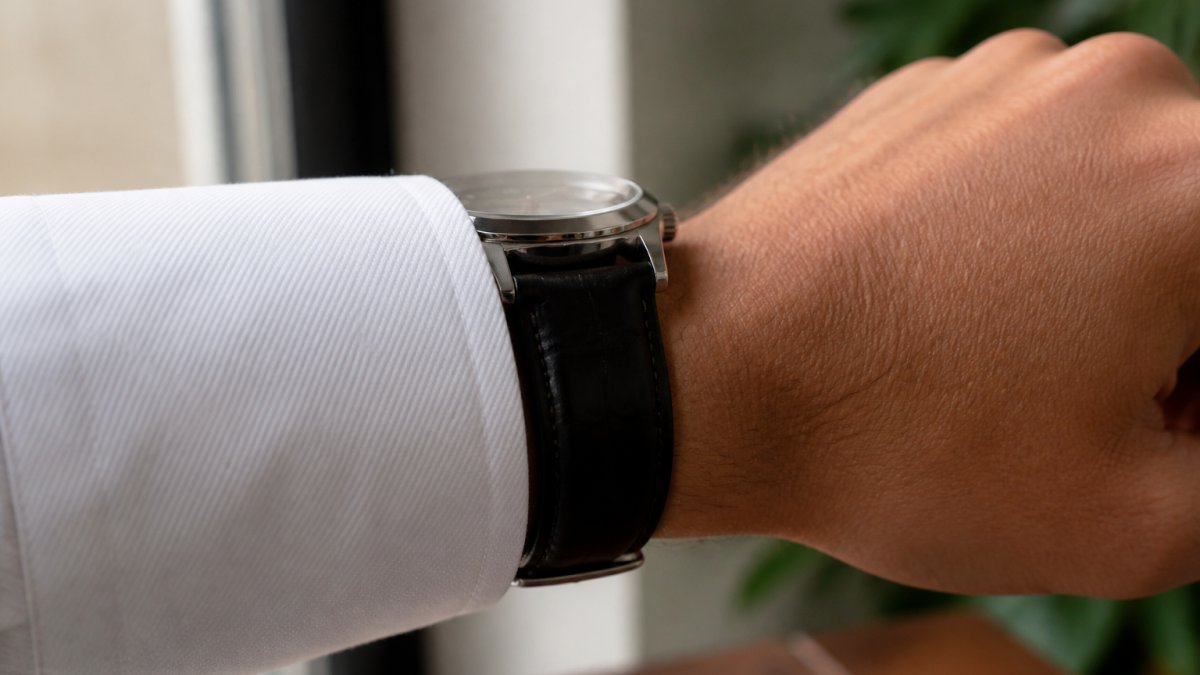
Start with your wrist circumference. Measure the inside of your wrist with a soft tape where you normally wear a watch, then add about one-half inch for comfortable fit without excessive looseness.
Cuff clearance is where many dress watch purchases fail.
Case diameter interacts with wrist size predictably. Measure your wrist width where you wear the watch and divide it by the case diameter. A result of 2.5 or higher looks proportionally small; below 2.0 looks oversized.
Lug-to-lug distance, from one strap attachment point to the opposite one, determines how the watch sits.
The practical test: put on the watch with the strap you'll actually wear and button your dress shirt cuff over it. Can you button the cuff comfortably without excessive tension? Does the watch sit flush without gaps?
Modern Exceptions to Traditional Dress Watch Rules
Conventional dress watch wisdom was established decades ago, when formal dress was more universal and wrist-wearing culture narrower. The landscape has shifted, and some old rules no longer apply universally.
The first exception is case size. A 42mm or even 44mm watch can function as a dress watch if the case is thin, the dial minimalist, and the aesthetic refined.
The second exception is water resistance. Traditional dress watches were rated for 30 meters, enough for hand-washing and splashes but not swimming.
The third exception is movement visibility.
The fourth exception is color. Dress watches historically favored white or cream dials, but modern dress watches successfully employ deep blues, forest greens, and even burgundy while maintaining formal character.
What hasn't changed is the core principle: a dress watch should enhance your wrist without demanding attention. The specific rules about how to achieve that are more flexible than tradition suggests.
Choosing Your Dress Watch: A Decision Framework
The right dress watch for you depends on three variables: your wrist size and proportions, your lifestyle and frequency of wear, and your mechanical philosophy.
| Decision Factor | If You Have Small Wrists | If You Have Large Wrists | If You Wear Frequently | If You Wear Occasionally |
|---|---|---|---|---|
| Ideal Case Diameter | 34-38mm | 40-42mm | 38-40mm | 36-38mm |
| Ideal Thickness | Under 9mm | Under 11mm | Under 10mm | Under 9mm |
| Movement Type | Quartz or thin mechanical | Mechanical preferred | Automatic (self-winding) | Hand-wound or quartz |
| Strap Choice | Leather (lighter visually) | Leather or metal | Leather (less durable) or metal | Leather (more formal) |
Start by identifying your wrist size category. Measure your circumference and width: below 6.75 inches is a small wrist, above 7.75 inches is large, and between those points is medium.
Next, consider how often you'll wear it. A daily driver suits an automatic movement, no winding needed and accurate through regular wear.
Finally, decide whether you value the mechanical experience or practicality. If you enjoy winding a watch or watching a rotor spin, a mechanical movement is non-negotiable.
The dress watch market offers options across all these variables.
Choosing a dress watch means understanding that the watch serves your wardrobe, not the reverse. The best dress watch is the one that disappears under your cuff and reappears as an elegant accent when you glance at your wrist.
Frequently Asked Questions
What are the main characteristics of a dress watch?
A dress watch combines slim proportions, restrained dial design, and refined case finishing to complement formal attire. Key characteristics include a case diameter between 36 and 40 mm, case thickness under 10 mm, a minimalist dial with limited complications, and refined materials like polished steel or hand-finished titanium. The overall aesthetic emphasizes elegance and understatement rather than functionality or sportiness.
How thin should a dress watch case be?
Dress watch case thickness should ideally stay under 10 mm to ensure the watch sits comfortably under a dress shirt cuff without creating an obvious bulge. Most refined dress watches fall between 6 and 9 mm thick. This slim profile is essential for the watch to feel like a natural extension of formal attire rather than a tool watch or sports model.
What makes dress watch dial design different from other watch types?
Dress watch dials emphasize negative space, restrained typography, and minimal complications. Traditional designs use simple hour markers (Roman numerals, applied indices, or printed stick markers), elegant hands without lume, and often omit date windows or subdials. The goal is legibility without visual clutter, creating an uncluttered appearance that suits business and formal occasions. Some modern dress watches break this rule with ornate decoration when it serves the overall aesthetic.
What movement is best for a dress watch?
Automatic and quartz movements both work well for dress watches. Automatic movements offer traditional appeal and mechanical sophistication, though they require periodic servicing and winding if not worn regularly. Quartz movements provide superior accuracy, lower maintenance, and are ideal for occasional formal wear. The choice depends on your budget, how often you wear the watch, and whether you value horological craftsmanship over practicality.
Can you wear a dress watch every day?
Yes, but it depends on your lifestyle and the watch's water resistance. Traditional dress watches have limited water resistance (typically 30-50 meters) and thin cases that are less durable than sports models. For everyday wear, choose a dress watch with at least 100 meters of water resistance and hand-finished cases designed to develop character over time. Many modern dress watches balance formal aesthetics with practical durability for professional environments.
How do I know if a dress watch will fit under my shirt cuff?
Measure your wrist circumference and check the watch's case diameter and thickness specifications. A dress watch should sit 1-2 mm below your shirt cuff when worn. Most dress watches between 36 and 40 mm work for average wrists. If your wrist is smaller than 6.5 inches, look for cases under 36 mm. If larger than 7.5 inches, you may need a 40-42 mm case to maintain proportions without appearing undersized.