

Last Updated: November 5, 2026
Quick Summary
Investing in restored vintage horological pieces means buying older mechanical watches brought back to working condition and holding them as collectible assets. Sympathetic restorations that keep original dials, hands, and case profiles support value, while heavy rebuilds with replacement parts usually reduce it. Documentation and reversibility are the strongest signals of a sound restoration.
- Set a budget ceiling, a target brand or era, and a minimum condition rule before buying.
- Mechanical service with correct parts generally preserves value; cosmetic refinishing usually reduces it.
- A restoration with service records, parts lists, and before-and-after photos resells far more easily.
- At under $1,000, condition beats rarity because recognizable references sell faster.
- Add purchase price, restoration, service, insurance, and selling fees before calling a restoration an investment.
Table of Contents
- Why Restored Vintage Watches Deserve a Place in Your Collection
- Investing in Vintage Watches for Beginners: Start With a Plan
- How Restoration Changes Vintage Watch Restoration Value
- How to Evaluate a Vintage Watch Before You Commit
- Best Investment Watches Under $1,000: Where the Smart Money Goes
- Original Parts vs. Replacement Parts: What Collectors Pay For
- The Total Cost of Ownership: Purchase, Restoration, and Resale
- Choosing a Restored Piece That Fits Your Collection
- Frequently Asked Questions
Why Restored Vintage Watches Deserve a Place in Your Collection
Investing in restored vintage horological pieces means buying older mechanical watches that have been brought back to working condition, then holding them as collectible assets. A well-restored vintage piece carries horological history you cannot manufacture, plus a level of dial and case character that modern production rarely matches. That same appreciation for mechanical craft and preserved character extends beyond the wrist, where vintage motoring history offers another way to connect material objects with the past.
The catch is that "restored" covers a wide spectrum. A sympathetic restoration that preserves original parts tells a very different story than a heavy-handed rebuild with a replacement dial. That distinction drives collector demand, resale value, and long-term value retention more than almost anything else.
Below, we break down how to evaluate a vintage watch, what restoration does to value, and where the smart money actually goes. If you want a wider view of whether watches hold value at all, our guide on whether microbrand watches are good investments is worth reading first.
Investing in Vintage Watches for Beginners: Start With a Plan
Beginners should set three limits before buying anything: a budget ceiling, a target brand or era, and a rule about condition. Watches bought on impulse are the ones collectors regret.
Start narrow. Pick one watch brand, one movement family, or one decade and learn it deeply. A collector who understands a single reference number will spot a bad redial faster than someone who reads broadly and buys widely.
A common mistake is treating "vintage" as a synonym for "valuable." Plenty of older watches are worth less than a service costs. Rarity, brand reputation, and collector demand decide value, not age.
- Set a total budget that includes restoration and maintenance
- Choose one brand or era to study first
- Decide your minimum acceptable condition before you shop
- Keep written notes on every piece you evaluate
How Restoration Changes Vintage Watch Restoration Value
Restoration can raise or destroy vintage watch restoration value, depending on what was replaced, how reversibly it was done, and how well the work is documented. A clean service that keeps the original dial, hands, and case profile usually supports value. A rebuild with a refinished dial and a swapped movement often does the opposite.
Originality is the word that matters. Collectors pay for patina, an untouched dial, and correct original parts. Polishing that rounds a case edge or a reprinted dial logo can cut market value sharply, even though the watch looks "better" to a casual buyer.
Sort restoration work into three buckets before you assign any value to it:
- Mechanical restoration, movement service, new mainspring, gaskets, and seals. This is expected maintenance and generally preserves value when performed to spec with correct parts.
- Cosmetic restoration, case polishing, dial refinishing, hand re-luming, crystal replacement. This is where value moves, and usually down. A light polish that preserves case geometry is tolerable; a heavy polish that softens lugs and bevels is a permanent discount.
- Structural restoration, laser welding, case recutting, replacement cases or casebacks. These can rescue a damaged piece but rarely restore collector value, because the case no longer matches the reference.
What most guides miss is how much documentation changes the equation. A restoration with service records, watchmaker notes, parts lists, and before-and-after photographs is far easier to resell than an undocumented one, and buyers will pay for that paper trail.
Run the math before you call a restoration an investment. Add purchase price, restoration cost, a full service, insurance, and selling fees, then compare that total to a realistic restored-state selling price. Understanding how resale value works for independent watch brands helps you judge what a restoration actually returns.
Watch out: over-polishing, incorrect parts, undisclosed moisture damage, and restorations that cannot be reversed are the red flags that turn a restored piece into a liability rather than an asset.
How to Evaluate a Vintage Watch Before You Commit
Evaluate a vintage watch by checking five things in order: authenticity, movement condition, dial originality, case condition, and service history. Skip any one of these and you are guessing.
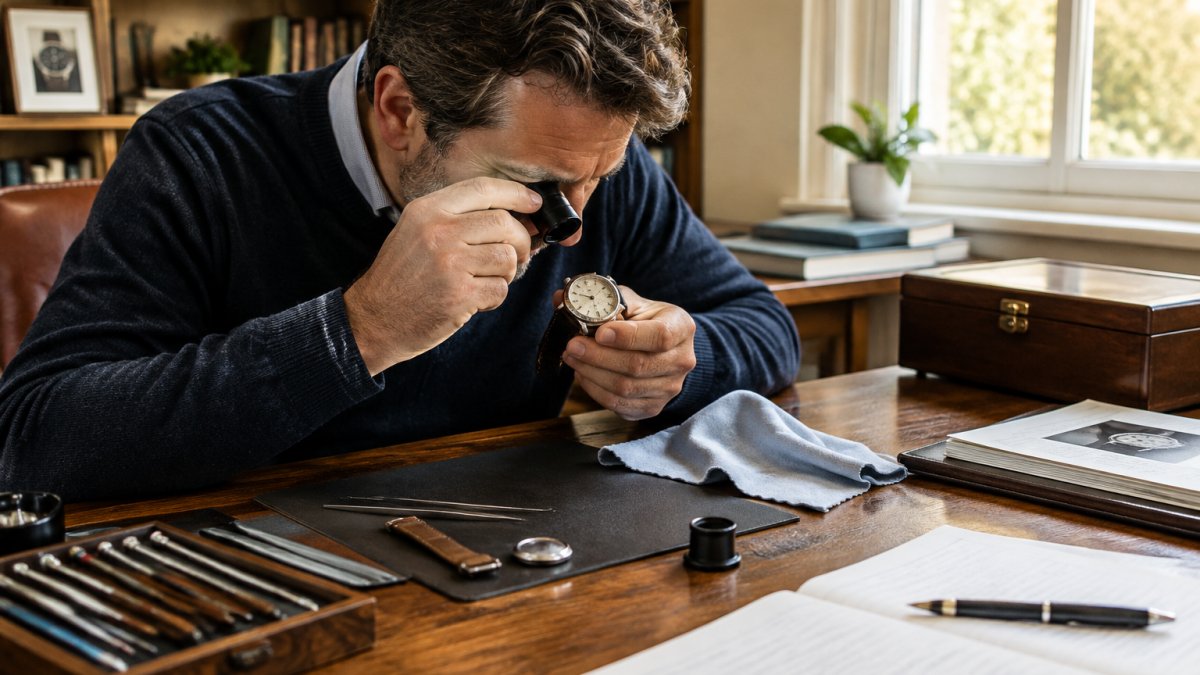
Bring a loupe. Look at the dial printing under magnification for uneven lettering or fuzzy edges, both signs of a redial. Check the case for over-polishing, especially around the lugs. Ask for movement photos and service records.
Authenticity means the watch is what it claims to be, with correct parts for its reference number. A watchmaker's inspection is worth the fee before you commit to a rare edition.
For movement quality specifically, our guide on how to tell if a watch movement is chronometer grade covers the standards to look for.
Watch out: water damage and rust inside a mechanical movement are often invisible from the caseback. Always get a movement inspection before paying for a rare piece.
Best Investment Watches Under $1,000: Where the Smart Money Goes
The best investment watches under $1,000 are usually well-known vintage references in original condition, not obscure rarities. Liquidity matters at this price point: a watch collectors recognize sells faster than one they have to research.
At this budget, condition beats rarity. A common reference in excellent original shape holds value better than a rare one with a replacement dial. Stick to brands with established collector demand and documented service history.
Modern heritage pieces also belong in this conversation. A new watch with vintage aesthetics and a custom-designed caliber offers modern performance and a predictable, serviceable movement. Our roundup of modern heritage watches under $2,500 shows what that looks like at the accessible end of the market.
| Factor | What to Look For | Why It Matters |
|---|---|---|
| Brand demand | Established collector following | Easier resale |
| Originality | Original dial, hands, case | Supports value retention |
| Condition | Light wear, no over-polishing | Protects selling price |
| Documentation | Service records, photos | Builds buyer trust |
| Movement | Mechanical, serviceable parts | Lower maintenance risk |
Original Parts vs. Replacement Parts: What Collectors Pay For
Collectors pay a premium for original parts, and replacement parts usually reduce what a watch sells for. That holds even when the replacement is higher quality than the worn original, because the buyer is paying for authenticity and provenance, not just function.
Original parts carry the watch's provenance. A correct dial, matching hands, and the right crown for the reference number prove the piece is intact. Replacement parts break that chain, and buyers discount accordingly.
Assess replaced components with a simple hierarchy:
- Consumables, mainspring, gaskets, seals, jewels, and shock springs. Replacement is routine and does not reduce collector value when correct parts are used.
- Movement components, balance staff, escape wheel, bridges. Acceptable if the replacement is period-correct or a documented service part, but note it in the record.
- Cosmetic components, dial, hands, bezel insert, crown. These are the value drivers. A refinished dial, re-lumed hands, or a service crown that does not match the reference will be flagged by any experienced buyer.
- Case and caseback, replacement or recutting is the most damaging, because the case carries the reference number and the watch's identity.
Inspect for replacement parts with a loupe and a reference guide. Look for dial printing that is too crisp or too uniform for the era, lume that glows evenly under UV when the original would be dead, hands that do not match the dial's patina, and a crown with the wrong logo or thread pitch.
Where this gets nuanced is function. A replacement mainspring or gasket inside the movement is normal and expected during servicing. Replacement cosmetic parts are where value shifts.
Documentation is the tiebreaker. A parts list, watchmaker invoice, and before-and-after photos let a future buyer verify what was changed and why. Without them, assume the worst and price the watch as a rebuilt piece rather than an original one. Watch out: undisclosed replacement parts are the most common source of post-sale disputes in restored vintage watch transactions.
The Total Cost of Ownership: Purchase, Restoration, and Resale
Total cost of ownership means adding purchase price, restoration cost, and ongoing maintenance, then comparing that sum to a realistic selling price. Many collectors track only the first number.
Budget for a full service on any vintage mechanical watch you buy, plus a margin for parts. Add maintenance every few years. Then ask what the watch realistically sells for in its restored state, not in perfect condition.
This is where investment risk lives. A piece bought well and restored sympathetically can hold value. A piece bought at a high price and then heavily restored can leave you underwater even if the watch looks superb.
- Purchase price
- Full service and any parts
- Restoration work, if not already done
- Ongoing maintenance
- Realistic selling price after restoration
Choosing a Restored Piece That Fits Your Collection
Choose a restored piece by matching it to what you already own and how you actually wear watches. A collection with three dress watches does not need a fourth.
Think about wrist time. A hand-finished titanium case and an ornate dial suit someone who wants a piece that reads as artisanal on the wrist, not a safe queen. If your style is casual, a refined vintage piece works with more outfits than you might expect.
At Haim Watch Company, our approach blends heritage with modern horological progress. The Swiss-made Viajero SE and the 100% US-assembled Legacy Automatic blend heritage with modern horological progress. You can browse all current Haim Watch Company timepieces, including Limited Editions and Standard Production pieces.
Best for: collectors who want vintage character with modern reliability. Skip if: you only want pre-owned pieces with documented decades of history.
The real challenge with restored vintage pieces is not finding them; it is judging them well enough to protect your money. That takes a plan, a loupe, and honest documentation. Where vintage character meets modern reliability, Haim Watch Company builds timepieces with ornate dial decoration, hand-finished titanium cases, and custom-designed calibers, so you get the aesthetic you love without the restoration risk. Get started with Haim Watch Company and find a piece that earns its place in your collection.
Frequently Asked Questions
Are restored vintage watches a good investment?
They can be, but only when the restoration is documented and reversible. A well-restored piece from a sought-after reference can hold value and even appreciate if original parts are retained and service records exist. Treat restoration as a value factor, not a guarantee, and budget for maintenance.
Does restoring a vintage watch reduce its value?
It depends on what was replaced. Polishing that thins the case, aftermarket dials, and non-original hands typically reduce collector interest. A mechanical service with correct parts and full documentation often preserves or improves value. Before buying, ask for before-and-after photos and a list of replaced components. If the seller cannot provide them, assume the restoration is undocumented and price accordingly.
How can you tell if a vintage watch has been restored?
Look for mismatched lume color, overpolished case edges, reprinted dial text, and service marks inside the caseback. Request service records and compare the movement to known examples of the same reference. A watchmaker's inspection with photos of the movement adds confidence. Restoration documentation and provenance are the strongest signals; without them, treat the watch as a project and negotiate on that basis.
What should you check before buying a restored vintage watch?
Check the case for overpolishing, the dial for reprinting, and the movement for correct parts. Confirm water resistance is not assumed, and ask for timing results and service history. Verify the seller's return policy and whether the watchmaker is independent. For beginners, set a budget that includes a follow-up service, and favor pieces with clear provenance over anonymous listings.
