

Last Updated: October 30, 2026
Quick Summary
A watch movement is chronometer grade when an official testing body certifies it after a defined precision test, not when a brand simply labels it. COSC tests uncased movements over 15 days in five positions and three temperatures, and the movement must pass seven separate criteria, including a mean daily rate of -4 to +6 seconds per day.
- COSC tests uncased movements, not finished watches, and issues a certificate tied to the movement's unique number.
- The 15-day sequence runs five positions for two days each at 23°C, then 8°C, 23°C, and 38°C.
- A movement fails if any single metric falls outside its limit, even when the average looks fine.
- Movement grade is a manufacturer's internal tier; chronometer grade is an external certification with a paper trail.
- Verify a claim by matching the certificate's movement number to the number on the movement itself.
Table of Contents
- What Chronometer Grade Actually Means
- COSC Chronometer Certification: What the Test Involves
- Chronometer Accuracy Standards Beyond the -4/+6 Tolerance
- Watch Movement Grades: Standard, Adjusted, and Certified
- What Certification Does Not Guarantee
- How to Assess a Watch Movement Before Buying
- Interpreting Daily Rate in Everyday Wear
- Choosing a Chronometer-Grade Watch That Fits Your Wrist
- Frequently Asked Questions
What Chronometer Grade Actually Means
Chronometer grade describes a movement that has passed an official precision test, not one that simply runs well.
This term is often misused in the market. Sellers sometimes apply "chronometer" to listings with no paperwork behind it, and buyers can pay more for the label without asking who tested the movement.
The distinction matters because chronometer grade is a certification status, not a manufacturing tier. A movement earns it by passing a defined test.
So what makes a watch movement chronometer grade?
Chronometer Grade vs. Movement Grade: The Distinction That Matters
These two terms get swapped constantly, and that swap costs buyers money.
Movement grade is a manufacturer's internal classification.
Chronometer grade is an external certification. An official testing organization runs the movement through a fixed protocol and issues a certificate if it passes.
Here is the practical difference. Our guide on custom engineered calibers versus ETA movements breaks down how accuracy and serviceability compare.
COSC Chronometer Certification: What the Test Involves
COSC certification is the best-known chronometer standard, run by the Contrôle Officiel Suisse des Chronomètres, an independent Swiss testing body. Chronometer certification involves a formal, multi-part precision test.
Who Tests the Movement, and What Gets Tested
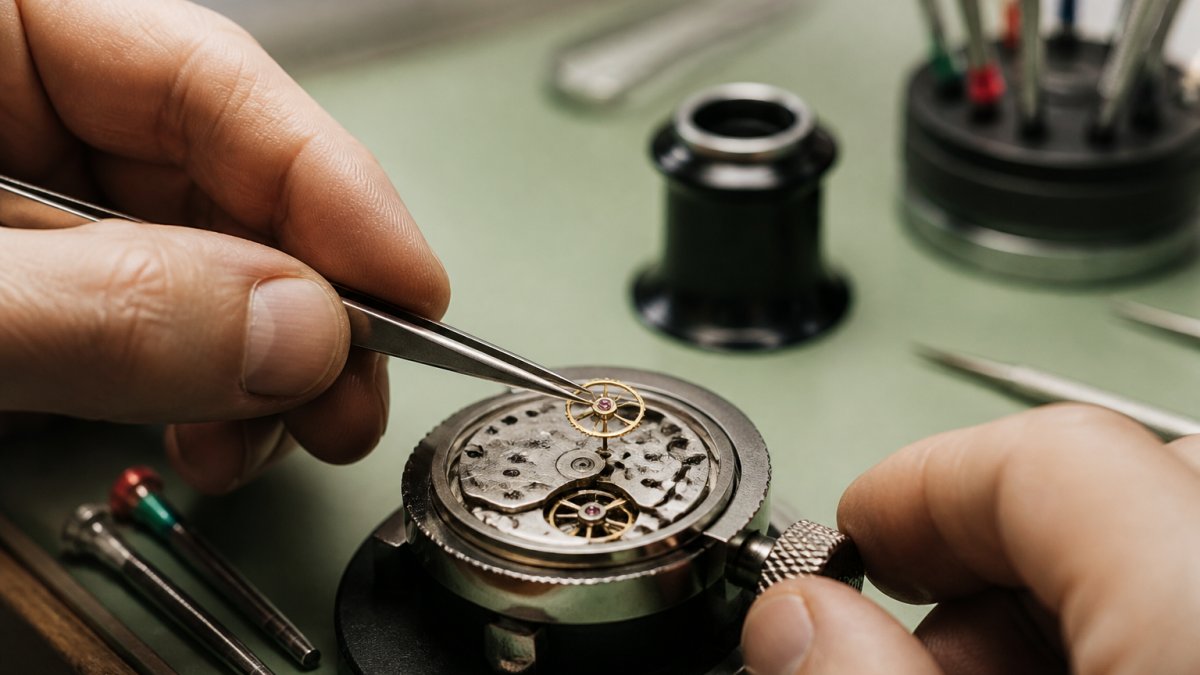
COSC is an independent Swiss testing body, and manufacturers submit movements, not finished watches, for evaluation. Movements are tested uncased, without a dial or hands.
That uncased detail matters. A movement can pass on the bench and behave differently once it is inside a case on your wrist, because the case, dial, and hands add mass and can shift the movement's orientation and thermal environment.
The 15-Day Testing Sequence, Step by Step
Here is how the sequence runs:
- Days 1-10: The movement runs in five positions, each for two days, at 23°C. The five positions are dial up, dial down, crown left, crown up, and crown down, the orientations a watch actually experiences on a wrist and at rest.
- Days 11-13: Testing continues at 8°C, then 23°C, then 38°C to measure temperature response. Each temperature is held for one day.
- Days 14-15: The movement returns to the first two positions to check rate stability over time.
- Scoring: Testers calculate the mean daily rate, mean variation, and the largest deviation between positions, then compare each against its limit.
The Seven Criteria a Movement Must Pass
The -4/+6 average is the most quoted number, but COSC scores seven separate metrics. A movement fails if any single metric falls outside its limit, even when the average looks fine. The commonly cited criteria are:
- Mean daily rate: -4 to +6 seconds per day.
- Mean variation in rates: no more than 2 seconds per day across the five positions.
- Greatest difference in rates between positions: no more than 5 seconds per day.
- Greatest difference between the mean daily rate and any single rate: no more than 5 seconds per day.
- Rate variation due to temperature: no more than ±0.6 seconds per day per degree Celsius.
That is why "within -4/+6" alone does not make a movement chronometer grade. A movement can average 2 seconds per day and still fail on positional spread or temperature response.
How COSC Compares to Other Certifying Bodies
Certification standards differ by certifying body. Some programs test the movement and others the cased watch, so when a seller claims "chronometer," the first question is which body issued the certificate and what it tested.
Chronometer Accuracy Standards Beyond the -4/+6 Tolerance
A single headline tolerance does not describe the full exam. Certification also limits how much a movement's rate can swing between positions and with temperature.
Precision timekeeping demands regularity, not just a good average. A movement that gains 5 seconds one day and loses 5 the next averages zero, yet it is not a good timekeeper.
Other standards exist too, and some brands run their own in-house certification programs. Ask which body issued the certificate before you accept the claim.
Watch Movement Grades: Standard, Adjusted, and Certified
Manufacturers sort movements into grades, and the labels vary by maker.
Adjustment is the key word. A watchmaker regulates a movement by tweaking the balance wheel and escapement until it keeps time within a target range.
Certification sits above all of this. For a closer look at how movement types differ, our breakdown of mechanical watch movement types covers the main families.
| Grade Level | Who Sets It | What It Means |
|---|---|---|
| Standard | Manufacturer | Basic adjustment, minimal finishing |
| Adjusted | Manufacturer | Regulated in multiple positions |
| Top | Manufacturer | Best components, careful regulation |
| Chronometer | External testing body | Passed a formal precision test |
What Certification Does Not Guarantee
A certificate describes tested performance on the day of testing. It is not a promise about tomorrow. Certified movements can drift out of adjustment and lose accuracy over time, as noted in horological analysis of fine wristwatch accuracy.
Certification also says nothing about:
- How the movement performs once cased and worn
- Long-term reliability or service life
- Water resistance, finishing quality, or design
- Whether the watch was ever serviced properly
That last point matters for vintage watch buyers. A vintage chronometer may have a genuine certificate and a movement that now runs poorly. Condition and service history outweigh the paperwork.
How to Assess a Watch Movement Before Buying
Start with the certificate, then verify it. A real chronometer claim should come with a movement number you can check against the testing body's records. No number, no proof. That single step filters out most false claims before you ever discuss price.
Verifying a Specific Watch's Chronometer Status
A chronometer certificate is tied to a specific movement number, not to a model name or a brand. Here is how to verify one in practice:
- Ask for the certificate. A legitimate chronometer sale should include the certificate or a clear photo of it. The certificate lists the movement number, the test results, and the issuing body.
- Match the movement number. The number on the certificate should match the number engraved or stamped on the movement itself. On many watches, the movement number is visible through a display caseback; on others, a watchmaker must open the case.
- Check the issuing body. COSC certificates are the most common, but some brands issue their own. Confirm which body tested the movement and whether the test covered the bare movement or the cased watch.
- Look for the marking. Many chronometer watches carry the word "Chronometer" on the dial or caseback, but the marking alone proves nothing, it is the certificate and movement number that carry the claim.
- Ask about service history. A movement that has been serviced may no longer meet its original certified rate. Ask whether the watch was serviced, by whom, and whether it was re-tested afterward.
Questions to Ask a Seller
- Who certified it? An official testing body or the brand's own lab?
- What is the certificate number and movement number? Can they be matched?
- What is the stated daily rate? A range with numbers beats a vague "highly accurate."
- Was the movement or the cased watch tested? Cased testing is closer to real wear.
- What is the service interval, and has it been serviced? Regular maintenance protects accuracy over years.
If you are evaluating watches that use Swiss movements, browsing microbrand watches with Swiss Made movements shows how different makers handle certification claims in practice. A common mistake is trusting the word "chronometer" on a dial with no documentation behind it. Ask for the paperwork before you pay a premium.
What Certification Does Not Tell You About Condition
Even a verified certificate describes tested performance on the day of testing, not the watch's condition today. Wear, shock, magnetism, and skipped service all move a movement's rate. For vintage watch buyers especially, a genuine certificate and a movement that now runs poorly can coexist. Condition and service history outweigh the paperwork when the two disagree.
Interpreting Daily Rate in Everyday Wear
Daily rate is the seconds a watch gains or loses per day, measured against a reference clock.
Three factors move a rate in daily use:
- Position: A watch resting crown-up runs differently than one on your wrist.
- Temperature: Cold and heat shift the oscillator's behavior.
- Activity: Shock and magnetism from phones, laptops, and door frames all interfere.
If you want to check your own watch, our guide on how to test mechanical watch accuracy at home walks through measuring daily rate with a reference clock and consistent timing.
Watch out: judging a watch by a single day's reading leads to false conclusions. Rate deviation is a trend, and you need several days of data to see it.
Choosing a Chronometer-Grade Watch That Fits Your Wrist
Specifications only matter if the watch suits how you live. A certified movement inside a case you never wear is a waste of money.
Weigh these before you commit:
- Case size and weight: A titanium case wears lighter than steel at the same diameter.
- Dial legibility: Ornate dial work is beautiful, but check that the hands read clearly at a glance.
- Versatility: A refined piece should move from desk to dinner without feeling out of place.
- Certification proof: Confirm the movement's testing status before purchase.
If you want concrete starting points, our roundup of value automatic watches shows what to expect at different levels. At Haim Watch Company, our Swiss-made Viajero SE and 100% US-assembled Legacy Automatic pair custom-designed calibers with hand-finished titanium cases and ornate dial decoration.
Frequently Asked Questions
What does chronometer grade mean for a watch movement?
Chronometer grade means a movement has passed an independent precision test across multiple positions and temperatures, usually a formal test protocol. The label describes tested performance at the time of certification, not a permanent property. A certified movement can drift out of adjustment with wear or a knock, so the grade is a starting point for accuracy, not a lifetime guarantee.
Can a watch be accurate without being chronometer certified?
Yes. Plenty of well-adjusted mechanical movements keep time within a few seconds per day without ever being submitted for certification. Certification costs money and time, and some brands skip it to keep prices lower or because their production volume makes submission impractical. A watchmaker with a timing machine can measure your watch's daily rate in minutes, which tells you more about that specific watch than a certificate does.
How can you check whether a watch movement is chronometer certified?
Ask for the certificate number and the movement serial, then confirm the two match. Certifying bodies typically issue a numbered certificate for each tested movement. For a used watch, request service records and have a watchmaker run a timing check on a timegrapher. A printed dial logo alone proves nothing; the paperwork and the measured rate are what count.
What are the key differences between a master chronometer and a superlative chronometer?
Some brands use labels such as "superlative" or "master" chronometer for their own certification programs. These are brand-specific rather than a universal industry benchmark, so read the criteria each program publishes.
The gap between a "chronometer" label and a certified movement comes down to proof. Ask for the test record, check the daily rate, and confirm who signed off. Get started with Haim Watch Company and find a timepiece whose precision you can verify, not just admire.
