

Table of Contents
- The Shift Toward US Assembled Watches
- What 'Made in USA' Actually Means: FTC Guidelines Explained
- American Made Watches and the Microbrand Movement
- Transparency in Watchmaking: Why Buyers Are Demanding Proof
- Automatic Watch Movements and the Case for Domestic Calibers
- The Value Proposition: Cost, Quality, and Long-Term Serviceability
- Conclusion: Why US Assembled Watches Are Here to Stay
- Frequently Asked Questions
Last Updated: September 16, 2026
The Shift Toward US Assembled Watches
Walk into any watch meetup this year and you'll hear the same conversation: collectors are trading notes on small American workshops the way they once swapped gray-market Rolex dealer contacts. That shift is real, and it's the reason why US assembled watches are gaining popularity right now. At Haim Watch Company, our 100% US-assembled Legacy Automatic exists because buyers stopped asking "which Swiss brand?" and started asking "who actually built this?" A Federal Trade Commission guidance on Made in USA claims sits behind much of that curiosity, because it defines what a domestic claim can legally mean. Below, we break down the regulation, the microbrand movement, and the serviceability math that makes domestic assembly worth considering.

What 'Made in USA' Actually Means: FTC Guidelines Explained
Made in USA is a regulated marketing claim, not a loose description. The FTC's Made in USA standard requires that "all or virtually all" of a product's significant parts and processing be of domestic origin, a bar most watches cannot clear because movements, cases, and crystals often originate overseas.
This is where the language gets slippery. A watch can be "assembled in the USA" without being "Made in USA," and the two phrases carry completely different legal weight.
- Made in USA: all or virtually all significant parts and processing domestic
- Assembled in USA: final assembly domestic, components may be imported
- American-owned: corporate ownership only, no manufacturing claim implied
The distinction matters because it's the first thing a serious buyer should verify. Vague heritage marketing collapses the moment you ask which category a brand actually falls into.
American Made Watches and the Microbrand Movement
The microbrand wave changed what "american made watches" means in practice, but it also muddied the vocabulary. Most small workshops today are not manufacturing watches in the strict sense, they are assembling them, and the distinction is the single most useful thing a buyer can learn before spending money.
Start with the legal framework. The FTC's Made in USA standard requires that "all or virtually all" of a product's significant parts and processing be of domestic origin. For a mechanical watch, that bar is extraordinarily difficult to clear: movements, mainsprings, jewels, crystals, and often cases originate overseas. A brand that stamps "Made in USA" on a watch with a Swiss or Japanese ébauche inside is making a claim the FTC has repeatedly challenged in other product categories.
The safer, more honest label is "Assembled in USA." That phrase means final assembly happened domestically, while components may be imported. It is not a lesser claim, it is a more precise one. The FTC's Made in USA standard treats the two phrases as legally distinct, and a serious buyer should treat them as distinct too.
- Made in USA: all or virtually all significant parts and processing domestic, rare in watches
- Assembled in USA: final assembly domestic, components may be imported, common and defensible
- American-owned: corporate ownership only, no manufacturing claim implied, the weakest of the three
Why does this matter to the microbrand story? Because the microbrand movement is what made the distinction visible. When a workshop produces 50 or 100 pieces, the founder can tell you exactly which parts came from where. When a legacy brand produces 50,000 pieces, that traceability disappears into a supply chain no one can audit. The microbrand's small scale is not a limitation, it is the mechanism that makes an honest domestic claim possible.
A common pattern among domestic microbrands is a hybrid sourcing model: a domestic or Swiss-made movement, a case finished overseas to the brand's specification, and final assembly, regulation, and quality control performed in a domestic workshop. That model is not a compromise. It is how nearly every watch under a certain price point gets made, and the brands that disclose it earn more trust than the ones that hide it.
Haim Watch Company fits this pattern with a twist: the Legacy Automatic is limited to 50 pieces per dial variant, and the brand states 100% US assembly including the movement. That combination, small runs plus a domestic caliber, is the rare end of the microbrand spectrum, and it is only possible because the run size is small enough to control.
The trade-off is scale. You will not find these watches in a mall display case, limited runs sell through, and service depends on the builder staying in business. That last point is the real risk of the microbrand model, and it is worth weighing honestly against the transparency you gain.
Transparency in Watchmaking: Why Buyers Are Demanding Proof
Transparency in watchmaking is the practice of disclosing where a watch's movement, case, dial, and assembly originate, and buyers now treat it as a baseline requirement rather than a bonus. The reason is simple: the word "Swiss" and the word "American" have both been stretched past usefulness by marketing departments. Discerning collectors now look past these vague labels to understand how the true cost of American manufacturing dictates the value and integrity of the timepieces they choose to support.
What proof actually looks like:
- Named assembly facility, not a country
- Movement origin stated explicitly (domestic caliber vs. imported ébauche)
- Case and dial finishing location disclosed
- Limited-run numbering or serialized casebacks
- A service policy that survives the warranty period
Haim Watch Company's Legacy Automatic states 100% US assembly including the movement, and each caseback is individually numbered. That's the standard buyers should hold every brand to.
Automatic Watch Movements and the Case for Domestic Calibers
Automatic watch movements are mechanical calibers wound by the motion of the wearer's wrist rather than a battery, and the caliber inside a watch determines both its character and its long-term serviceability. The National Institute of Standards and Technology overview of timekeeping standards is a useful reminder of how much precision engineering sits behind a simple time-and-date display.
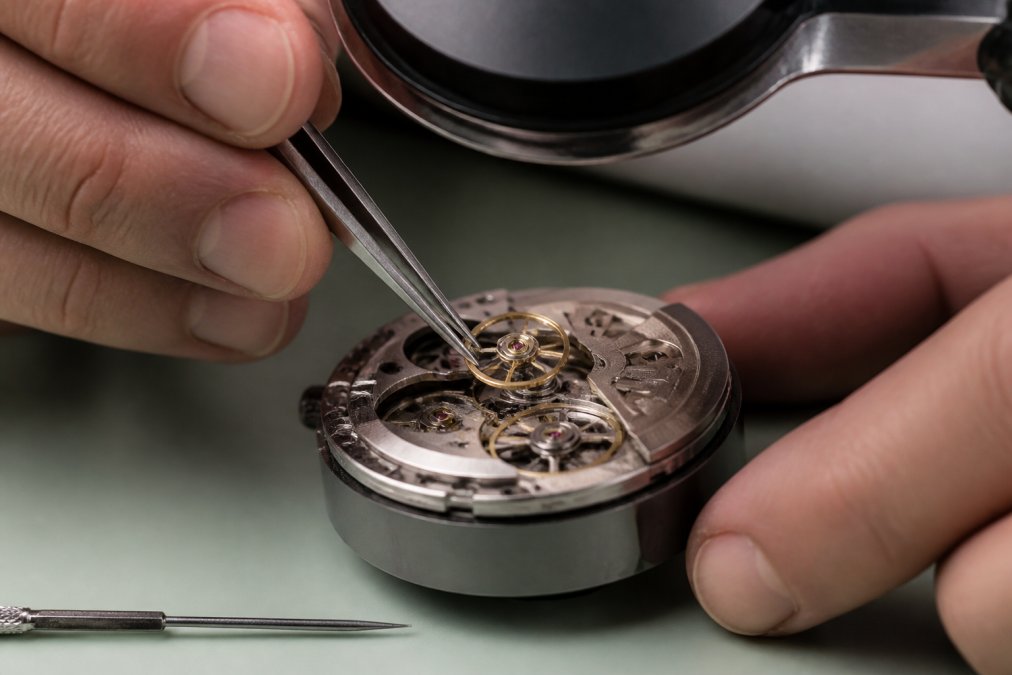
Domestic calibers matter for two reasons. First, they're serviceable: a watchmaker who built the movement can maintain it. Second, they're designable: Haim Watch Company's custom-designed Caliber HWC-1 in the Legacy Automatic: Azure exists because a stock caliber forces compromises on dial depth and case height. The 38mm Legacy Automatic sits at just 10.5mm tall, thin enough to slide under a shirt cuff while keeping visual depth in the dial.
The Value Proposition: Cost, Quality, and Long-Term Serviceability
The value proposition of domestic assembly comes down to three variables: what you pay, what you get, and what happens in year seven. Most articles stop at the first two. The third is where domestic assembly actually wins.
Start with the cost picture. The comparison is not against a $200 quartz watch, it is against a similarly priced imported mechanical watch.
| Factor | US Assembled | Imported Assembly |
|---|---|---|
| Movement origin | Domestic caliber possible | Typically imported ébauche |
| Serviceability | Built-in-house, easier to maintain | Dependent on parts availability |
| Supply chain visibility | Direct from workshop | Often undisclosed |
| Production scale | Limited runs, numbered | High volume |
| Long-term parts support | Tied to the builder | Tied to the importer |
Now the part most buyers overlook: serviceability. A mechanical movement needs servicing every several years, cleaning, re-lubrication, and regulation. On an imported mass-produced caliber, that service depends on the importer or a third-party watchmaker having access to parts.
The honest caveat: domestic assembly costs more up front, and the long-term value only materializes if you keep the watch and service it. Buyers who flip watches every two years will not capture the serviceability benefit. Buyers who keep them for twenty will.
Conclusion: Why US Assembled Watches Are Here to Stay
The momentum behind US assembled watches comes from a durable shift in buyer behavior, not a trend cycle. Collectors want claims they can verify, movements a watchmaker can service, and a supply chain short enough to inspect. Haim Watch Company builds to that standard: the Legacy Automatic pairs a custom-designed caliber with hand-finished titanium cases, 100% US assembly including the movement, and dials like the Aventurine "Stargazer" that are limited to 50 numbered pieces.
Frequently Asked Questions
What is the difference between 'Made in USA' and 'Assembled in USA' for watches?
The FTC requires 'Made in USA' claims to mean all or virtually all components and labor are domestic. 'Assembled in USA' means the product was put together in the country but may contain foreign components. For watches, this distinction matters because many brands use imported movements even when the case and final assembly happen domestically. Understanding this difference helps buyers evaluate what they are actually paying for.
Are there any fully American made watches available today?
Fully American made watches are rare because domestic sources for hairsprings, jewels, and certain movement components are limited. However, brands like Haim Watch Company offer 100% US assembled watches with custom-designed calibers, meaning the movement itself is built domestically. The Legacy Automatic, priced at $1,350, is an example of a timepiece where assembly and movement production happen entirely in the US.
How does US assembly impact the price and value of a watch?
Domestic assembly typically raises the price because skilled labor and local component sourcing cost more than overseas alternatives. However, that premium often reflects easier after-sales service. A watch like the Legacy Automatic at $1,350 offers a custom caliber and hand-finished titanium case, which is competitive for the specifications.
Why are watch enthusiasts shifting toward domestic assembly?
Enthusiasts value transparency in watchmaking, and domestic assembly makes it easier to verify where components come from and how the watch was built. They also appreciate supporting local skilled labor and the ability to have their timepiece serviced without shipping it overseas. The rise of microbrands has made these watches more accessible, offering unique designs and custom movements at prices that compete with established Swiss alternatives.