

Last Updated: November 8, 2026
Quick Summary
To choose a durable watch for field work, start with the job rather than the catalog: identify what hits your wrist, what you need to read, and how often the watch comes off. Then match four parts to that abuse: case protection, crystal hardness, crown security, and strap practicality. A watch whose weakest component outlasts your job's specific hazards is the right pick.
- Write down your job's top two hazards before shopping; that list eliminates half the market.
- Sapphire ranks about 9 on the Mohs hardness scale, versus roughly 5.5 for mineral glass.
- 100 m water resistance with a screw-down crown is the practical minimum for most field crews.
- A compass bezel is a sun-and-shadow tool that is useless on an overcast day or after dark.
- Test glove fit with your work gloves on so the watch slides under the cuff without catching.
Table of Contents
- Start With the Job, Not the Watch
- The Anatomy of a Durable Watch for Field Work
- What Makes the Most Durable Field Watch
- Best Field Watch Automatic vs. Quartz
- Field Watch With Compass: Useful or Gimmick?
- Why a Titanium Watch for Outdoor Work Holds Up
- Straps, Gloves, and Everyday Wear
- Pick Your Field Watch at Haim Watch Company
- Frequently Asked Questions
Start With the Job, Not the Watch
The most reliable way to choose a durable watch for field work is to start with the job, not the catalog.
Haim Watch Company offers timepieces designed for people who want one watch that handles real conditions and still looks considered at dinner.
Below, we'll show you how to match a watch to your job, which specs matter, and where most buyers overspend.
Match the Watch to the Work
Field work is a broad term, so narrow it before you shop. Ask three questions: What hits your wrist during a shift? What do you need to read, and when? And how often will the watch come off?
- Impact and vibration: Mechanics, loggers, and equipment operators take repeated knocks. Look for a recessed crystal and a protected crown.
- Abrasion: Masonry, concrete, and trail work grind against stone and grit. Case finish and crystal hardness matter more than brand name.
- Gloves and sleeves: Cold-weather crews and linemen wear heavy gloves. Case thickness and crown size decide whether you can adjust the watch without removing a glove.
- Water and dust: Irrigation, marine, and agricultural work demand real water resistance and a tight seal.
Write your answers down. That short list becomes your filter and eliminates half the market before you compare movements.
The Anatomy of a Durable Watch for Field Work
Durability in a field watch comes down to four parts: the case, the crystal, the crown, and the movement mount.
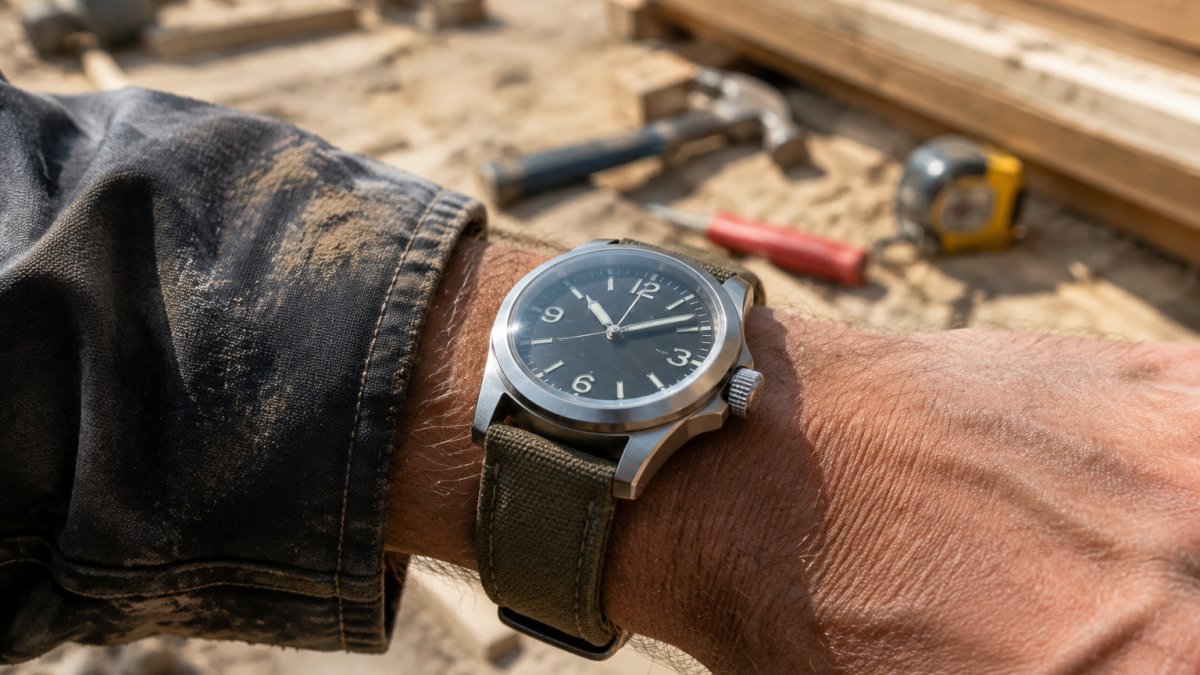
Case, Crystal, and Crown
The case protects the movement. Stainless steel is the standard for toughness; titanium drops weight without giving up strength.
The crystal takes the most direct hits. Sapphire resists scratching far better than mineral glass or acrylic, and a slightly domed or recessed crystal deflects glancing blows rather than catching them.
The crown is the most exposed weak point on any watch. A screw-down crown seals against dust and water; a crown guarded by case shoulders resists sideways impacts.
For a deeper look at protecting the crystal specifically, our guide on how to protect watch crystals from daily wear damage covers the practical habits that keep a dial clear for years.
What Makes the Most Durable Field Watch
The most durable field watch is not the one with the longest feature list. It is the one whose weakest component outlasts the specific abuse your job delivers.
Here is the criteria framework we use, with the numbers and mechanisms that separate a work watch from a fashion watch.
Water Resistance: Read the Rating, Not the Label
Water resistance is expressed in meters or atmospheres, but the number is a static pressure rating, not a depth rating. A 100 m rating means the watch survived 100 m of static pressure in a test, not that you can dive to 100 m. For field work:
- 30 m (3 ATM): Splash resistance only. Not suitable for irrigation, marine, or heavy-sweat work.
- 50 m (5 ATM): Handwashing and rain. Marginal for agricultural work.
- 100 m (10 ATM): Swimming and full immersion. The practical minimum for most field crews.
- 200 m (20 ATM): Diving and pressure-washer exposure. Appropriate for marine and heavy-washdown jobs.
A screw-down crown and a caseback with a proper gasket are what make the rating hold over time. Gaskets compress and dry out; most manufacturers recommend a water-resistance test every one to two years for watches used in wet conditions.
Crystal: Hardness Versus Impact
Sapphire ranks about 9 on the Mohs hardness scale, versus roughly 5.5 for mineral glass and 3 for acrylic, which is why it resists scratching from grit, stone, and concrete dust. The trade-off is brittleness: a hard, sharp impact can chip sapphire where acrylic would deform and survive.
For most field work, sapphire is the right call because abrasion is the daily hazard and catastrophic impact is rare. If your job involves heavy overhead impact, a recessed sapphire under a proud bezel is the safer geometry.
Shock Protection: How the Movement Is Mounted
Shock resistance is the system that holds the movement. Look for a movement holder that suspends the caliber rather than clamping it rigidly, and jeweled shock absorbers at the balance staff. Quartz movements tolerate impact better because they have fewer moving parts, but a poorly mounted quartz can still crack its circuit or dislodge the battery contact.
A practical test: tap the case firmly against your palm. A well-mounted movement produces a solid, damped sound; a loose one rattles.
Case Construction and Serviceability
Stainless steel is the standard for toughness and repairability. Titanium saves weight and resists corrosion but scratches more visibly. Check that the case has thickness at the lugs, a bezel proud of the crystal, and a crown guarded by case shoulders.
Serviceability matters as much as construction. A watch with a common movement, standard lug widths, and available gaskets can be maintained for decades; a proprietary case with no parts support becomes disposable after the first failure.
The Durability Scorecard
Run any candidate through this list and score each line pass or fail:
- Water resistance of 100 m or better with a screw-down crown
- Sapphire crystal, flush or recessed below the bezel
- Shock-mounted movement with jeweled absorbers
- Case guards around the crown
- Standard lug width with replaceable spring bars
A watch that fails the crystal or crown line is a repair bill waiting to happen. A watch that passes seven of eight is worth a closer look.
Watch out: a high water-resistance rating on a watch with a push-pull crown is a marketing number, not a field guarantee. The crown is the seal that fails first.
Best Field Watch Automatic vs. Quartz
The best field watch movement depends on how you work: quartz wins on accuracy and low maintenance, while automatic wins on craftsmanship and never needing a battery.
Quartz movements run on a battery and keep excellent time with almost no attention.
Automatic movements wind from the motion of your wrist and need no battery.
If you're weighing the two in detail, our explainer on automatic vs. quartz watches breaks down the differences in accuracy, maintenance, and long-term cost.
| Movement | Accuracy | Maintenance | Best For |
|---|---|---|---|
| Quartz | Excellent, very stable | Battery swap every few years | Crews who need set-and-forget reliability |
| Automatic | Good, varies with wear | Periodic servicing | Daily wearers who value mechanical craft |
| Hand-wound | Good, depends on winding routine | Periodic servicing | Wearers who like a daily ritual |
Field Watch With Compass: Useful or Gimmick?
A compass bezel is a genuine tool for a narrow set of field jobs and a dial-cluttering gimmick for everyone else. The more useful question is not whether the feature works, but whether your job makes it worth the trade-off in legibility and cost.
How a Bezel Compass Actually Works
The compass on most field watches is not a magnetic instrument but a sun-and-shadow tool.
That limitation defines who should care. If you work off-trail, in featureless terrain, or on remote survey lines where a rough heading is a real backup, the bezel earns its place. If you carry a phone, a GPS unit, or a dedicated baseplate compass, the bezel is redundant.
When to Skip It
Skip the compass bezel if any of these apply:
- You already carry a dedicated navigation tool.
- Your job keeps you on marked routes or within sight of landmarks.
- You need maximum dial legibility and minimum clutter.
- You would rather spend the budget on a better crystal or a tougher strap.
A compass bezel also adds one more thing to knock out of alignment, and a misaligned bezel is worse than no bezel because it gives false confidence.
The Bigger Gap: Match the Watch to the Job
Most guides, including this one, spend too much time on features and too little on the job itself.
Mechanics and equipment operators. Repeated knocks and vibration are the main hazard.
Construction and masonry crews. Abrasion from stone, concrete, and grit is constant.
Surveyors and trail crews. Off-trail navigation and weather exposure dominate.
Marine and agricultural workers. Water, salt, and chemical exposure are the hazards.
Write your job's top two hazards down before you shop. That short list eliminates half the market and points you toward the features that actually matter for your work.
Why a Titanium Watch for Outdoor Work Holds Up
Titanium is a common material choice for outdoor watches because it is lighter than steel and resists corrosion.
The practical benefits show up over a full day. A lighter case means less fatigue and less swinging against tools.
There are trade-offs. Titanium scratches more visibly than steel, and the marks polish out differently.
For the full case on the material, read why titanium watches are better, and for long-term care, our guide on how to maintain titanium watches covers cleaning and finish preservation.
Straps, Gloves, and Everyday Wear
Strap choice decides whether a durable watch actually stays comfortable through a shift.
For field work, a woven nylon or rubber strap with a standard lug width is a practical choice because it can be swapped quickly.
Glove compatibility is the detail most guides miss. A thick case and a large crown are hard to manage under a glove cuff.
Watch out: a loose strap on a vibrating tool can snag, so check the buckle and keepers before every shift.
Pick Your Field Watch at Haim Watch Company
Choosing a durable watch for field work comes down to matching four things to your job: case protection, crystal hardness, crown security, and strap practicality. Get those right and the watch will serve you for years, not seasons.
Haim Watch Company's collection includes the Swiss-made Viajero SE and the Legacy Automatic, which is 100% US-assembled and features a custom-designed caliber.
If you want one watch for the job site and the dinner table, browse the collection and find the piece that fits your wrist and your work. Our Descent sports watch blends classic dress style with the readiness the elements demand.
The right field watch should disappear on your wrist during a shift and still earn a second look afterward.
Frequently Asked Questions
What features should I look for in a durable watch?
Focus on four things: a case material that resists dents (stainless steel or titanium), a scratch-resistant crystal, at least 100 meters of water resistance, and a movement you can service. Legibility matters too, so look for high-contrast dials with Arabic numerals and luminous markers. A replaceable strap is a practical bonus, since straps wear out long before the case does.
Is a quartz or automatic watch better for field work?
Quartz wins on accuracy, low maintenance, and battery life, which suits workers who need set-and-forget reliability. Automatic movements offer mechanical craftsmanship and no battery changes, but they need regular wear or winding to keep time. If you want the best field watch automatic option, look for a movement with solid shock protection and a serviceable design.
Are titanium watches good for field work?
Yes. Titanium is lighter than steel and resists corrosion, which keeps a watch comfortable during long shifts and tough on sweat and weather. It does scratch more easily than steel, so a scratch-resistant crystal and a hand-finished case help. A titanium watch for outdoor work is a strong pick if weight and comfort matter most.
How much water resistance does a field watch need?
Aim for at least 100 meters (10 ATM). That covers rain, splashes, hand washing, and accidental dunks. If your work involves water, mud, or heavy cleaning, 200 meters gives more margin. Avoid anything rated below 50 meters for field use, since those ratings only protect against light splashes.
