

Table of Contents
- Should You Clean the Dial at All?
- Identify Your Dial Type Before You Touch It
- How to Clean Delicate Watch Dials at Home: Tools and Materials
- Step-by-Step: Removing Dust and Debris From the Dial
- How to Clean Watch Dial Glass Without Reaching the Dial
- Can You Clean a Watch Dial With Alcohol? When It Helps and When It Harms
- How to Restore a Watch Dial and When Not To
- Stop Conditions and Your Next Step With a Watchmaker
- Frequently Asked Questions
Last Updated: November 5, 2026
Not every dial should be cleaned at home, since a careful clean watch dial starts with knowing when to leave it alone.
A watch dial is the face you read the time from. It is often printed, painted, or finished by hand, and its surface can be thinner and softer than it looks. Some dials are also made from materials that react badly to moisture or chemicals.
Should You Clean the Dial at All?
Many owners see a bit of dust under the crystal and assume the dial needs a wash. In many cases, the safest choice is to leave it alone. A dial that is clean enough to read is usually better off untouched.
A decision tree: clean, leave alone, or seek help
Use these questions to decide your next move:
- Is the dust only on the crystal, not on the dial? Clean the crystal only, and leave the dial alone.
- Is there loose dust or debris on the dial, and is the dial otherwise intact? Remove it gently with a soft brush or blower, as described in Step 4 below.
- Are there stains, moisture marks, flaking paint, or lifting markers? Stop. Do not clean the dial. Take the watch to a watchmaker.
Watch out: Water and cleaning solution can seep under the dial and damage the movement. Never soak a watch or spray liquid directly onto the dial.
Identify Your Dial Type Before You Touch It
Cleaning methods are not interchangeable. A method that works on one dial can ruin another, so you need to know what you have before you start. The table below is the core of this guide: it pairs each common dial construction with what is safe, what is risky, and when to stop and hand the watch to a professional.
| Dial type | What it is | Safe at home | Risky or prohibited | Verdict |
|---|---|---|---|---|
| Lacquer (painted and clear-coated) | A glossy sprayed or brushed coating over a base | Blower, soft dry brush, barely damp swab on the coating only | Solvents, alcohol, repeated rubbing, anything abrasive | Dust removal only; stains and clouding go to a professional |
| Enamel (fired glass-like) | Powdered glass fused to a metal base at high heat | Blower, soft brush, lint-free cloth | Impact, heat, sudden temperature change, chipping at the edges | Dust removal only; cracks and chips are a professional matter |
| Paper or foil | Printed sheet under a protective coating | Blower only, from a distance | Water, soap, solvents, swabs, any pressure | Do not clean; moisture causes bubbling and lifting |
| Luminous (modern lume) | Applied paint that glows after light exposure | Blower, soft dry brush | Scrubbing, water, solvents, poking flaked lume | Dust removal only; flaking lume goes to a professional |
| Luminous (vintage radium) | Older luminous paint that may contain radium | Nothing beyond a blower used with care | Any disturbance of the paint, dry brushing that frees particles, household vacuums | Do not clean; seek professional assessment |
| Refinished or restored | A dial already repainted, reprinted, or recoated | Blower, soft brush | Water, solvents, swabs, anything that can lift the new finish | Treat as the most fragile type; professional only for anything beyond dust |
| Applied-marker and printed modern | Factory-finished metal markers and pad-printed text | Blower, soft brush, barely damp swab on sturdy finishes | Alcohol, abrasion, pressure on the markers | Light dust removal is reasonable; test any liquid first |
How to tell which type you have
- Look at the surface under a loupe or a phone macro lens. A lacquer dial shows a continuous glossy coat; an enamel dial shows a glassy, slightly uneven surface with a distinct edge at the chapter ring.
- Check the edges and any chips. Enamel chips expose metal and look like broken glass; lacquer wears as a soft scuff or cloud.
- Look for a step or lip at the markers. Applied markers sit proud of the surface; printed markers are flush.
If you cannot confirm the dial type, assume it is delicate and skip the home methods.
Watch out: Vintage luminous paint may contain radium. Do not dry-brush it, do not use a household vacuum near it, and do not seal it in a bag with other items; have a watchmaker assess it before any handling beyond a careful visual check.
How to Clean Delicate Watch Dials at Home: Tools and Materials
If you decide to clean, gather the right tools first. Most damage comes from using the wrong item in a rush.
- Soft, dry brush with natural bristles
- Blower bulb or compressed air used in short bursts from a safe distance
- Cotton swabs and a few wooden or plastic pegwood sticks
Prohibited substitutes: Do not use paper towels, tissues, toothpicks, metal tweezers, household cleaners, bleach, hydrogen peroxide, or solvents. These can scratch, stain, or dissolve the dial finish.
Step-by-Step: Removing Dust and Debris From the Dial
Work slowly, with light pressure, on a clean surface away from drafts. The goal is to lift loose particles, not to scrub the dial. Before you start, decide which of the two procedures below applies, because they carry different risks.
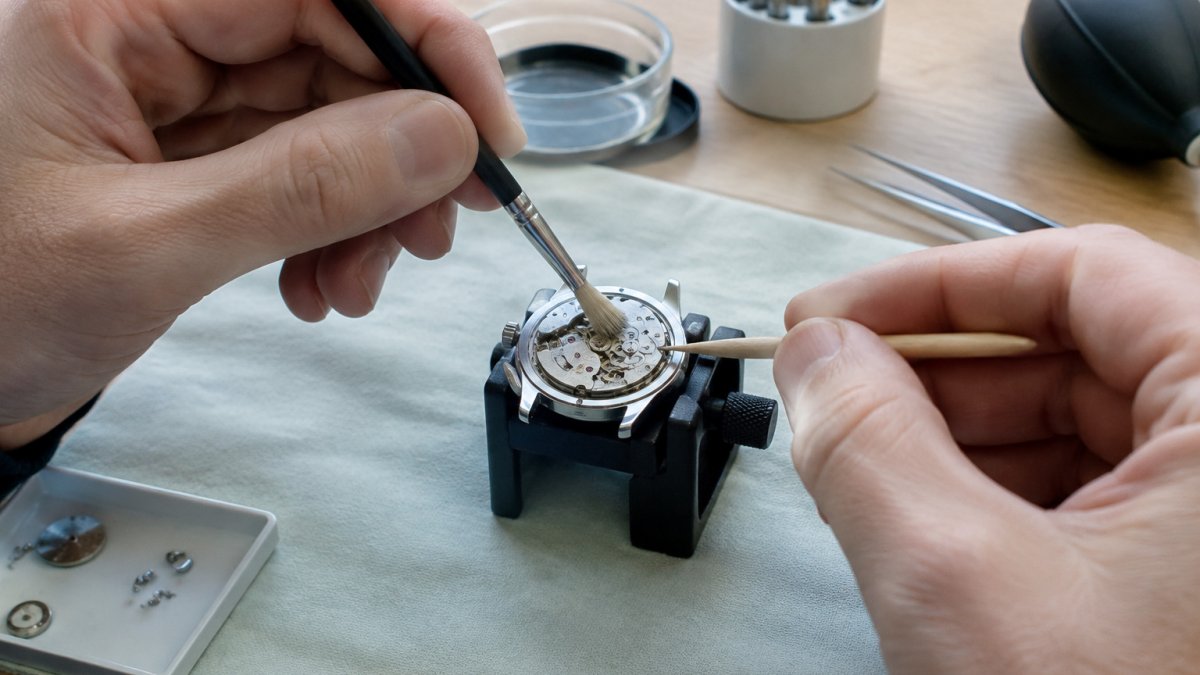
Procedure A: The dial is still in the watch
This is the common case, and it is also the one where a mistake can reach the movement. Water and cleaning solution can seep past the crystal, under the dial, and into the movement, so the in-watch procedure is dry-only unless a watchmaker has confirmed otherwise.
- Set up your space. Use a clean, padded surface, good light, and a loupe or phone macro lens. Keep the watch face-up and do not turn it over.
- Blow first. Use a blower bulb in short puffs to dislodge dust. Keep your mouth away from the dial and do not use canned air close to the surface.
- Brush gently. Sweep a soft, dry natural-bristle brush in one direction across the dial. Do not press down, and do not brush back and forth over printing or lume.
- Use the swab sparingly, dry. Lightly touch a dry swab to any stubborn spot. Do not rub, and do not introduce liquid.
- Check under magnification. Look for remaining debris and for any sign that printing, lume, or finish has changed.
- Stop if anything resists. If dust will not lift with a blower and a dry brush, leave it for a professional.
Watch out: Never soak a watch, spray liquid onto the dial, or run water over the case to clean the dial area. Moisture ingress under the dial is a movement repair, not a cleaning problem.
Procedure B: The dial has been removed from the movement
A removed dial can be cleaned more thoroughly, but only if it is a type the compatibility table above marks as safe for the method you plan to use. Removal and refitting are watchmaker tasks; do not remove a dial yourself unless you have the tools and training.
- Handle by the edges only. Support the dial from underneath and keep fingers off the finished surface.
- Blow and brush dry first. Use the same blower and soft-brush steps as Procedure A.
- Use a damp swab only on compatible types. For lacquer and sturdy modern finishes, a barely damp swab with distilled water and a trace of mild, pH-neutral soap can lift a fingerprint. Work in one direction and change the swab often.
- Rinse with a clean damp swab, not running water. Remove soap residue with a fresh swab dampened with distilled water, then dry immediately with a lint-free cloth.
- Dry thoroughly before refitting. Any trapped moisture under applied markers or in the dial feet can cause corrosion.
Stop conditions and damage warning signs
Stop immediately and seek professional help if you notice any of the following:
- Printing transfers onto the swab or cloth, or text looks softer than before
- Lume flakes, crumbles, or darkens
- The finish clouds, dulls, or changes color in the cleaned area
A common pattern is that damage shows up minutes after cleaning, not during it, so recheck the dial under magnification after it has dried and again the next day. If anything has changed, stop and have a watchmaker assess it before doing anything else.
How to Clean Watch Dial Glass Without Reaching the Dial
Many owners focus on the dial when the real mess is on the crystal. You can clean the crystal without touching the dial.
Use a microfiber cloth and a small amount of clean water or a mild, non-alcohol cleaner made for glass. Wipe lightly from the center outward.
If you are unsure whether your crystal is coated, check with a watchmaker before using any cleaner.
Can You Clean a Watch Dial With Alcohol? When It Helps and When It Harms
Isopropyl alcohol is a common suggestion online, but it is not a safe general solution. Alcohol can dissolve some lacquers, fade printing, and loosen paint or lume. It may help only in narrow cases, such as removing a fingerprint from a sturdy, factory-finished modern dial. Even then, test an inconspicuous spot first and use a barely damp swab. When in doubt, do not use alcohol.
How to Restore a Watch Dial and When Not To
Restoring a dial means repainting, reprinting, or refinishing it. This is specialized work that changes the original look and value of the watch. For most owners, restoration is not a DIY project. A reputable watchmaker or dial specialist can assess whether restoration is possible and how to preserve the original finish. Before you pursue it, ask whether the goal is simply a clean, readable dial, which is often achievable without restoration at all.
Stop Conditions and Your Next Step With a Watchmaker
Stop immediately and seek professional help if you notice any of the following:
- Stains, discoloration, or moisture inside the crystal
- Flaking, bubbling, or lifting paint or markers
- Cracks or chips in the dial or crystal
Your next step is a professional inspection. Ask the watchmaker to confirm the dial type, assess the finish, and explain any options before work begins. If your watch is an automatic that has stopped running, that is a separate issue to raise at the same visit.
For a closer look at the finishing techniques behind these dials, see our guide on Hand-Finished Watch Dial Techniques: A Complete Guide. To compare the ornate dial designs and finishes Haim Watch Company offers, browse Top 10 Ornate Watch Dial Designs. For protecting the crystal from everyday wear, read How to Protect Watch Crystals From Daily Wear Damage. If your automatic has stopped and you want to know whether it needs a service, see Does Your Automatic Watch Need Servicing?.
Frequently Asked Questions
How do you clean a delicate or vintage watch dial?
Start with the gentlest method that could work. Remove loose dust with a blower or a soft, dry brush, moving in one direction and keeping the dial level. Avoid wetting lacquer, enamel, paper or luminous dials unless you have confirmed the finish can tolerate it. For vintage pieces, the safer choice is often a watchmaker, because aged finishes and radium-era luminous material can be damaged by even light cleaning. Stop as soon as you see any change in color, texture or printing.
Are alcohol wipes safe for cleaning a watch dial?
Alcohol wipes are not a safe default for a watch dial. Alcohol can dissolve or lift lacquer, soften paper printing and dull enamel, and residue left behind can cloud the surface. If you are tempted to use alcohol, test an inconspicuous area first and use only a tiny amount on a cotton swab, never soaking the dial. Many dials should not be cleaned with alcohol at all, so when the finish type is unknown, leave it alone and ask a watchmaker.
Can you clean a watch dial at home without damaging it?
You can remove loose dust at home with a blower and a soft brush, which carries very little risk. Cleaning dirt that sits on or within the finish is riskier, because it requires moisture or pressure. Work only on a dial you have identified, with the movement protected and the crystal in place. If the dirt does not lift after gentle dry methods, stop. Persistent staining often needs a professional, and forcing it can cause permanent damage.
When should you take a watch to a professional instead of cleaning it yourself?
Take the watch to a watchmaker if the dial is vintage, has lacquer, paper, enamel or luminous material, shows lifting or flaking, or if dirt appears to be under the crystal, which signals moisture or a seal problem. Also seek help if the watch has been exposed to water, if you cannot remove the dial safely, or if any cleaning attempt causes a visible change. Professional cleaning typically involves dial removal under controlled conditions, which is far safer than improvising.
