

Last Updated: November 4, 2026
Quick Summary
A true railroad grade watch combines a size 16 or 18 movement, at least 17 jewels, lever setting, and adjustment to five positions. Miss one of those requirements and the watch was not built for the rails, no matter what the seller claims.
- The 1893 standards required 17 jewels, five-position adjustment, and a 16 or 18 size movement.
- Lever-set watches require moving a small lever before the crown turns the hands.
- A serial number lookup confirms what the factory built, not whether a railroad approved it.
- Grade names like Elgin's B.W. Raymond or Waltham's Vanguard show factory intent, not railroad approval.
- Walk away when the seller refuses clear movement photos or the serial number cannot be read.
Table of Contents
- What Makes a Pocket Watch Railroad Grade
- Railroad-Approved Pocket Watch Requirements
- Reading Movement Size, Jewels, and Setting Mechanism
- Vintage Watch Movement Identification Step by Step
- Railroad-Grade Pocket Watch Serial Number Lookup
- Identifying an Elgin Railroad-Grade Pocket Watch
- Red Flags for Altered or Misrepresented Watches
- Building a Collection With Confidence
- Frequently Asked Questions
What Makes a Pocket Watch Railroad Grade
A railroad grade watch is a pocket watch built to meet the timekeeping standards set for railroad service in the late 1800s and early 1900s.
The short answer: a true railroad grade watch combines a size 16 or 18 movement, at least 17 jewels, lever setting, and adjustment to five positions. Miss one of those and the watch was not built for the rails, no matter what the seller claims.
That distinction matters more than most buyers realize. Plenty of pocket watches carry a "railroad" label that the factory never gave them. The railroad grade watch label belongs to watches built to a standard, not to every watch that once sat in a conductor's pocket.
The 1893 Standards That Set the Bar
The 1893 railroad watch standards gave the industry a shared benchmark. According to the National Association of Watch and Clock Collectors' historical standards discussion, these rules required a minimum of 17 jewels, adjustment to five positions, and a movement in 16 or 18 size.
But here is what most guides get wrong: the 1893 rules were never one universal law. Individual railroads wrote their own requirements, and enforcement varied by company and era.
Railroad-Approved Pocket Watch Requirements
Railroad-approved pocket watch requirements came down to a short checklist. A watch needed enough jewels to reduce friction, a lever-set mechanism to prevent accidental time changes, and a dial that was easy to read at a glance.
- 17 or more jewels in the gear train
- Lever-set rather than pendant-set
- Arabic numerals for fast reading
The historical railroad watch certification standards show that consistency mattered more than any single feature. A watch that failed one requirement was not approved for service.
A railroad-approved watch had to meet a short, checkable list of requirements.
| Requirement | Standard | Note |
|---|---|---|
| Jewels | 17 or more | Fewer jewels meant more friction and less accuracy |
| Setting mechanism | Lever-set | Prevented accidental time changes |
| Dial | Arabic numerals | For fast reading at a glance |
| Adjustment | Five positions | Five-position adjustment is the railroad benchmark |
| Movement size | Size 16 or 18 | The larger American sizes |
Reading Movement Size, Jewels, and Setting Mechanism
Movement size, jewel count, and setting mechanism are the three fastest ways to judge a pocket watch. Each one is stamped or built into the watch, so a careful buyer can read them without opening the case.
Movement size refers to the width of the mechanism. Railroad watches used size 16 or 18, which are the larger American sizes.
Jewel count counts the ruby bearings inside the movement. Seventeen was the floor for railroad service.
Setting mechanism decides how you set the time.
If you want a deeper look at how these mechanisms differ, our guide to mechanical watch movement types breaks down the options.
Lever-Set Versus Pendant-Set
Lever-set and pendant-set watches set time in two different ways. On a lever-set watch, you unscrew the bezel or open a small slot, pull out a lever, and then turn the crown to set the hands. On a pendant-set watch, you simply pull the crown and turn.
Pendant-set watches were common and perfectly good for everyday use. They just were not built to railroad rules.
Vintage Watch Movement Identification Step by Step
Vintage watch movement identification follows a repeatable order. Work through these steps and you will know what you have before you spend money.
- Open the back carefully. Use a proper case knife, not a screwdriver.
- Read the movement markings. Look for the maker, grade name, and serial number.
- Note the jewel count. It is usually stamped on the movement.
- Check the setting style. Look for a lever slot near the edge.
- Measure the movement size. Size 16 or 18 points to railroad intent.
- Record the case number. Mismatched case and movement numbers are a red flag.
- Look up the serial number in a manufacturer database.
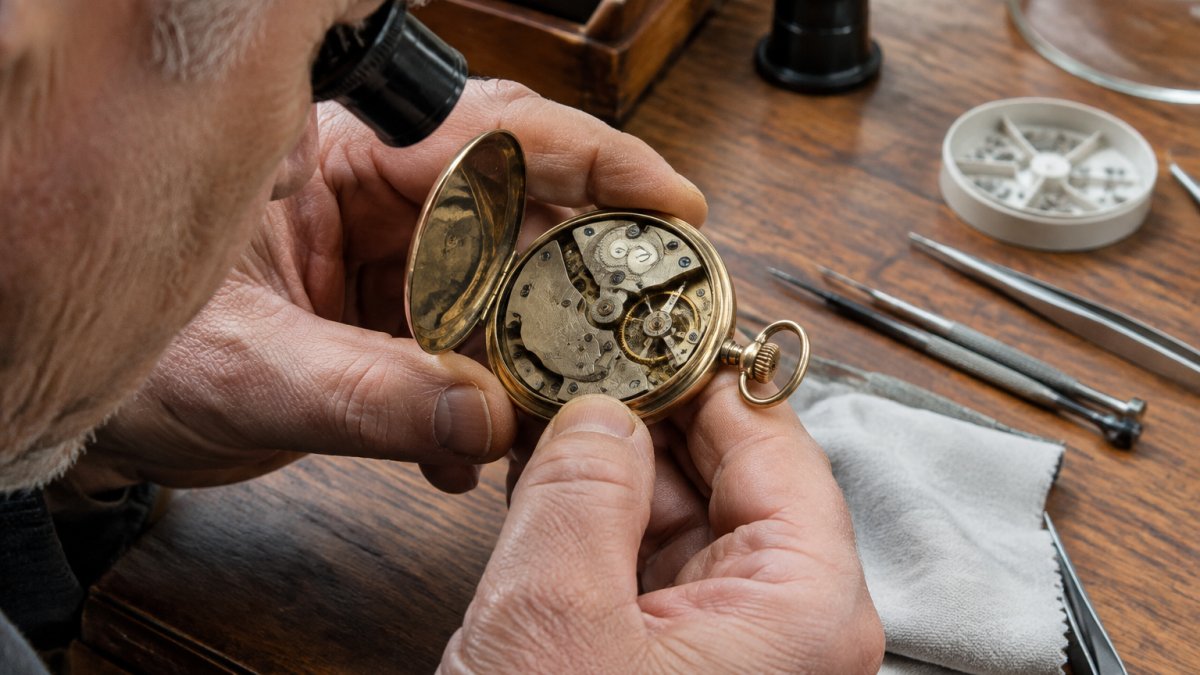
For a fuller walkthrough of the process, see our step-by-step guide to identifying vintage American pocket watches.
Railroad-Grade Pocket Watch Serial Number Lookup
A railroad-grade pocket watch serial number lookup is the fastest way to confirm what a movement was built as, but only if you know how to read the result. The Pocket Watch Database is the most widely used lookup for American makers, and the NAWCC reference materials supplement it with factory catalogs and production records.
A serial number lookup answers a narrow question: what did the factory say this movement was when it left the bench? It does not answer whether a railroad approved the watch, whether an employee carried it, or whether the parts now inside the case are the parts the factory installed.
Reading the Lookup Result
Most databases return the same fields, and each one matters:
- Grade name. This is the factory's own label, for example, Elgin's B.W. Raymond or Waltham's Vanguard. A grade name tied to railroad service is stronger evidence than any seller's description.
- Jewel count. The record should confirm 17 or more jewels. If the database says 15 and the movement is stamped 17, something has been changed.
- Adjustment. Records often note adjustment to temperature, isochronism, and positions. Five-position adjustment is the railroad benchmark; a record showing only temperature adjustment points to a lower grade.
Grade Names Are Not Approval Stamps
A common pattern is to see a famous grade name and assume the watch was railroad-approved. Grade names indicate the factory's intended market and quality tier.
Watch out: a database entry that matches the movement exactly still does not prove the case, dial, and hands are original to that movement. Serial lookup verifies the movement's identity, not the watch's assembly.
When the Serial Number Does Not Match
If the lookup returns a grade that contradicts the movement markings, stop and investigate before spending money.
For makers with sparse records, the lookup may return only a date range. In that case, combine the serial number with movement architecture, bridge shape, winding mechanism, regulator style, to narrow the grade. Our step-by-step guide to identifying vintage American pocket watches covers how those physical details complement the serial record.
Identifying an Elgin Railroad-Grade Pocket Watch
Identifying an Elgin railroad-grade pocket watch starts with the grade name on the movement. Elgin marked its railroad-intended movements with grade names, and those names are the clearest signal of intent. Waltham did the same with its Vanguard grade, which the NAWCC collector discussions recognize as its top railroad-grade movement.
Look for these on an Elgin:
- A grade name stamped on the barrel bridge
- A 17-jewel or higher count
- Lever setting
A common mistake is trusting the dial alone. Dials get swapped, and a fancy dial does not make a movement railroad grade.
Red Flags for Altered or Misrepresented Watches
Red flags matter most when they appear together. A single odd detail can be a factory variation; three odd details on the same watch usually mean someone has been at it. Work through the watch in a fixed order so you do not miss the quiet problems while focusing on the loud ones.
Check the Numbers Against Each Other
Start with the relationship between movement and case. A case number that does not match the movement, or a serial number that points to a much later production date than the case style suggests, usually means someone swapped parts.
Watch out: some makers sold movements and cases separately, and aftermarket case companies were common. A mismatched case is not automatically fraud, but the seller should be able to explain it, and the price should reflect it.
Read the Movement Markings Closely
- A "railroad" label with no grade name on the movement
- Fewer than 17 jewels on a claimed railroad watch
- A pendant-set movement sold as lever-set
Engraving and stamping wear at the same rate as the surrounding metal. Lettering that is crisp on a movement with softened bridge edges is a warning sign. Compare the depth, spacing, and style of the serial number to known examples of the same grade.
Inspect the Dial, Hands, and Case Separately
Dials get swapped more often than movements. Look for feet that do not match the movement's dial plate, enamel that is too perfect for the movement's condition, or a signature style inconsistent with the production date. Hands should match the period and the dial's intended legibility, railroad dials favored bold Arabic numerals, and ornate hands on a plain railroad dial are worth questioning.
Test the Seller's Claims Against the Evidence
Ask what the seller's claim actually rests on. "Railroad grade" should be supported by a grade name, jewel count, and setting style visible in photos. "Railroad used" needs stronger evidence, a time-service record, an inspection tag, or documented provenance.
Even the standards themselves were inconsistent. Some railroads kept accepting Roman numerals and open-face pendant-set watches long after stricter rules appeared, as historical accounts of railroad watch rules note.
Know When to Walk Away
Walk away when the seller refuses clear movement photos, when the serial number cannot be read, or when the explanation for a mismatch changes between messages. A watch that needs a story to be railroad grade is not the watch to buy. If you are unsure, have a watchmaker inspect the movement before money changes hands; the cost of an inspection is small against the cost of a misrepresented watch.
Building a Collection With Confidence
Confident collecting comes from evidence, not labels. Know the standards, read the movement, and check the serial number against a database. That habit protects you from the altered and misrepresented watches that flood the market.
If you are drawn to American-made movements, it helps to understand why US-assembled watches are gaining popularity with collectors who value craft over mass production. You can also compare how modern makers approach heritage design by reviewing Vortic watch alternatives for collectors.
Frequently Asked Questions
Does a railroad-grade movement mean the watch was railroad approved?
No. Railroad grade describes a movement built to meet railroad standards for size, jewel count, and adjustment, but it does not prove a specific railroad ever approved or used that watch. The 1893 standards called for at least 17 jewels, adjustment to five positions, and a 16 or 18 size movement, yet individual railroads set their own rules and changed them over time. Treat grade as a design claim and look for separate evidence of approval or use before paying a premium.
Where can I find the serial number on a pocket watch movement?
The serial number is usually engraved on the movement itself, most often on the bridge or barrel plate visible once the back cover is opened. On many American pocket watches it sits near the edge of the top plate, alongside the maker's name and grade markings. Record the number exactly as stamped, then compare it against manufacturer records for production date and grade. Never polish or scratch the plate while reading it.
How do I look up a vintage pocket watch serial number?
Start with the manufacturer's own production ledgers, many of which survive in digitized form through collector databases. A railroad-grade pocket watch serial number lookup typically returns a production run, grade name, and approximate date. Cross-check the result against the movement markings, because a mismatched number is one of the clearest signs of a swapped or altered watch. Two matching sources give far more confidence than one.
Can a watch movement identification app identify a vintage pocket watch?
Apps can help with modern watches, but they are unreliable for vintage American pocket watches. Identification depends on reading stamped serial numbers, grade names, and jewel counts, then matching them to manufacturer records, which is work a photo-matching app cannot do well. Use digital databases for research and reference instead. A loupe, good light, and a careful serial number lookup will outperform any app on a 100-year-old movement.
The railroad standards reward patience. Learn the three core requirements, verify every serial number, and treat any "railroad" label without proof as a question rather than a fact. When you are ready to add a modern piece built with that same care, explore the Haim Watch Company collection and find a watch made to mark your own milestones.
