

Last Updated: November 6, 2026
Quick Summary
Modernizing a heritage pocket watch means keeping the visual DNA of a classic while upgrading what sits inside, so collectors get old-world character with modern reliability. Start by auditing the original movement's four key dimensions, then choose modern materials and a legible dial without losing period character.
- The US pocket watch market reached $6.15 billion in 2025 and is projected to grow 13.63% annually through 2033.
- Record movement diameter, stem height, dial feet position, and hand clearance before buying any parts.
- Titanium is roughly 40% lighter than stainless steel, which matters for a watch carried on a chain.
- Budget 30-40% of the project for movement service and keep 10-15% as contingency.
- Keep restoration reversible: store original parts in labeled bags and avoid irreversible engravings.
Table of Contents
- Why Heritage Pocket Watch Design Still Matters in 2026
- Heritage-Inspired Watch Design: What to Keep and What to Change
- Step 1: Audit the Original Movement Before You Touch the Case
- Step 2: Choose Modern Pocket Watch Materials That Hold Up
- Step 3: Redesign the Dial for Legibility Without Losing Character
- Vintage Pocket Watch Restoration: Preservation, Reversibility, and Ethics
- Pocket Watch Design Trends Shaping 2026
- Budgeting Your Modernization Project Before You Commit
- Frequently Asked Questions
Why Heritage Pocket Watch Design Still Matters in 2026
The pocket watch market in the United States reached $6.15 billion in 2025, according to LinkedIn Pulse market analysis, and it is projected to grow at 13.63% annually through 2033.
Because a heritage pocket watch is not a tool anymore. It is a statement about taste, history, and craft.
That is exactly what modernizing heritage pocket watch designs means: keeping the visual DNA of a classic while upgrading what sits inside.
Below, we walk through the full process, from auditing a movement to budgeting the project. We also cover what to keep, what to change, and where most projects go wrong.
Heritage-Inspired Watch Design: What to Keep and What to Change
Heritage-inspired watch design keeps the visual cues that signal age and craft while replacing the parts that limit daily use. The goal is recognition, not replication.
The features that carry the heritage signal
Some details do most of the work. Keep these:
- Hand-finished bridges with visible beveling
- Enamel or lacquered dials with depth
- Applied numerals or ornate printed indices
These are the cues collectors read first. Remove them and the watch stops feeling like a pocket watch.
The details that date a design
Other elements mark a piece as old for the wrong reasons:
- Faded radium lume that no longer glows
- Cracked or yellowed crystal
- Flat, chalky dial finishes
Swap these for modern equivalents. Sapphire crystal, safe lume, and a proper dial finish keep the look without the decay.
For a deeper look at why this balance matters, read our guide on why American watchmaking heritage matters for collectors.
Step 1: Audit the Original Movement Before You Touch the Case
Every modernization project starts with the movement, not the case. Identify the caliber, its condition, and whether original parts can be saved before you plan anything else. But an audit is not just a condition check. It is a dimensional survey, because the numbers you record here decide which cases, dials, and hands are even possible.
Here is the audit order we recommend:
- Photograph the movement from every angle, including the dial side with the dial removed
- Record the serial and grade numbers
- Check for rust, hairline cracks, and replaced parts
- Test the balance and mainspring
- Note which parts are original versus swapped
- Measure the four dimensions below and write them down
The four measurements that govern every redesign decision
Recasing and redesign projects often stall on fit rather than finish. Record these before you buy a single part:
- Movement diameter and thickness. A vintage American 16-size movement is roughly 43 mm across; a 12-size is roughly 39 mm. A modern case cavity must clear the pillar plate and the tallest bridge, not just the diameter. Measure with a caliper at the widest point and at the highest point of the balance cock.
- Stem height and stem position. The winding stem must line up with the case tube and crown. On a pocket watch the crown sits at 12 o'clock, so the stem enters the movement at a fixed height above the dial plane. If a replacement case was cut for a different stem height, the crown will sit crooked or bind. Measure from the dial seat to the centerline of the stem.
- Dial feet position. Vintage dials are held by two or three feet that seat into holes in the movement's dial plate. Feet positions differ by maker and by caliber, and they are not standardized across grades. If you plan to fit a new dial, you either need a dial cut for that movement or you need to cut and solder new feet, which is a irreversible change to the dial.
A 1907 Waltham Grade 165, for example, needs careful balancing of preservation and function, as AESDES research on movement conversion notes. The same logic applies to any grade: the movement's dimensions are the fixed constraint, and the case, dial, and hands are the variables.
What the audit tells you about feasibility
Once the numbers are on paper, sort the project into one of three buckets:
- Direct fit. A modern case or dial already exists for that movement's dimensions. This is the cheapest and most reversible path.
- Adapted fit. The case or dial needs machining, new dial feet, or a custom movement ring. Feasible, but budget for a machinist and expect longer lead times.
- No fit. The movement is an odd size, the stem height is unusual, or the dial feet cannot be matched without altering original parts. In this bucket, preservation usually wins and the project should stay a restoration rather than a redesign.
Watch out: measuring the movement diameter alone and assuming the case will fit is the most common cause of a stalled project, because stem height and dial feet decide fit as often as diameter does.
Not sure what you have? Our guide on how to identify vintage American pocket watches walks through the markings step by step. And if you are weighing a custom build, see our custom watch movement design process.
Step 2: Choose Modern Pocket Watch Materials That Hold Up
Modern pocket watch materials should match the original's look while improving wear resistance. Titanium, sapphire, and hardened stainless steel are the strongest choices in 2026, but each one changes the watch in ways that matter beyond scratch resistance.
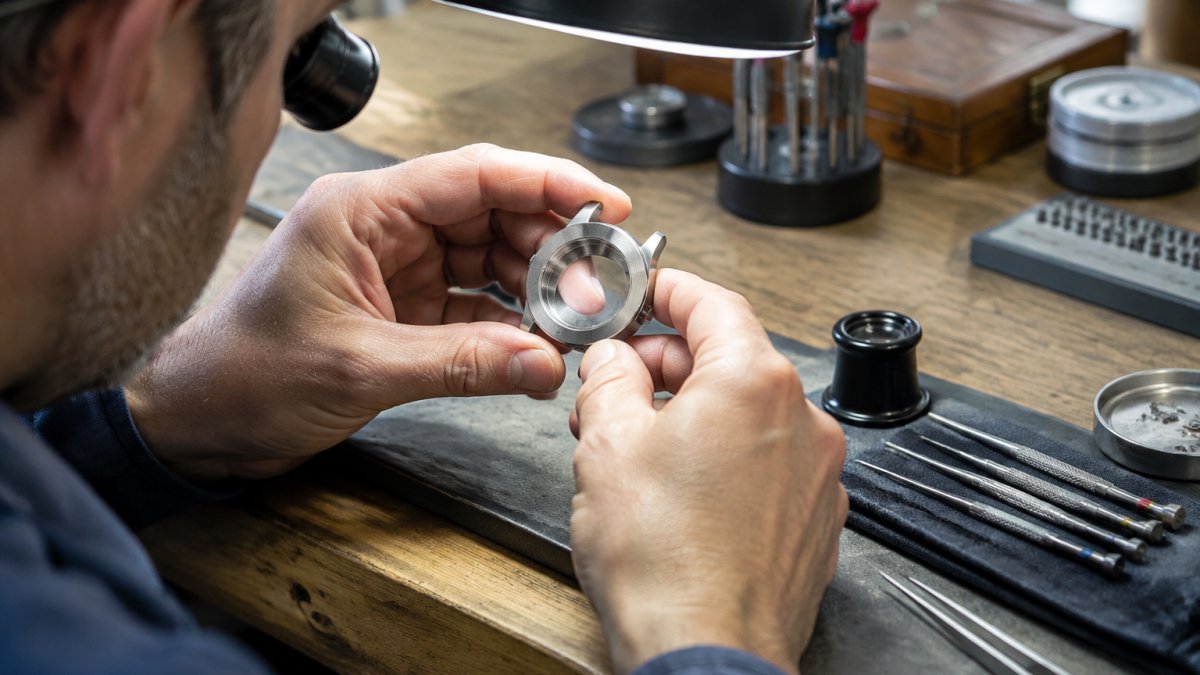
Case materials: weight, corrosion, and comfort
- Titanium. Roughly 40% lighter than stainless steel at the same volume, which matters in a pocket because a heavy watch pulls on a chain and swings against the body. It is highly corrosion-resistant and warm to the touch, but it scratches more readily than hardened steel and is harder to refinish because the scratches cannot be polished out the same way. Titanium also machines slowly and can gall against steel case backs, so threaded interfaces need care.
- 316L stainless steel. The default for good reason: it takes a polish, resists corrosion in normal daily contact, and is easy to refinish. It is heavier than titanium, and a solid steel pocket watch case can feel substantial in a vest pocket. Hardened grades resist scratching better but are harder to machine.
- Sterling silver and gold. Period-correct and warm, but soft. Silver tarnishes and shows dings; gold wears at high-contact points like the bow and the case edge. These are display materials, not daily-carry materials, unless you accept the wear.
Crystal and chain materials
- Sapphire crystal. Scratch-resistant and clear, but it is brittle and can chip at the edge if the watch is dropped. It also sits proud of the bezel in many modern cuts, which changes the profile. Mineral glass is softer but cheaper to replace; acrylic is period-correct and can be polished, but it scratches.
- Hardened stainless for chains and bows. The bow and chain take the most abrasion of any part of a pocket watch. Hardened stainless resists wear at the bow loop, where a softer metal would thin and eventually fail.
- Vegetable-tanned leather for fobs. It ages well and develops a patina, but it absorbs moisture and stretches. Chrome-tanned leather is more uniform but less characterful.
Compatibility with historic movements
The case is not just a shell. It is the movement's environment. A few compatibility points matter more than the material name:
- Case back clearance. A display back or a thick case back can foul the balance cock or the winding mechanism on a vintage movement. Check internal depth against the movement's tallest point.
- Movement ring fit. A metal case needs a movement ring or spacer to hold the movement securely. A loose fit lets the movement shift and stresses the stem; a tight fit can crack a brittle vintage bridge.
- Galvanic mismatch. Mixing dissimilar metals at threaded interfaces, such as a titanium case with a steel case back, can cause galling or corrosion over time. Use an anti-seize compound or match materials at the threads.
The trade-off is cost and time. Titanium machines slowly and hand-finishing takes longer. But the case is what your hand touches every day. Spend there, and spend on the bow and chain, because those are the parts that wear out first.
Step 3: Redesign the Dial for Legibility Without Losing Character
A modern dial should be readable at a glance and still look like it belongs to 1926. That balance comes down to contrast, spacing, and restraint.
Start with these moves:
- Increase contrast between numerals and background
- Space indices evenly and keep them short
- Use one accent color, not three
Ornate dial decoration still has a place. The key is depth, not noise. A sunburst or guilloché finish catches light without shouting.
Avoid oversized hands. They cover the indices and ruin legibility. Thin, well-proportioned hands read better and look more period-correct.
Vintage Pocket Watch Restoration: Preservation, Reversibility, and Ethics
Vintage pocket watch restoration should be reversible wherever possible. Keep every original part, document every change, and never alter a movement that cannot be returned to its original state.
That is the ethical line. Here is how to hold it:
- Store original parts in labeled bags with photos
- Avoid irreversible case engravings
- Do not re-case a rare or historically significant movement
Collectors increasingly treat preservation as part of value. A watch with its original parts and paperwork holds up better in the pre-owned market, which Luxury of Watches projects will reach $35.7 billion in 2026.
Pocket Watch Design Trends Shaping 2026
Pocket watch design trends in 2026 lean toward considered detail over flash.
Three trends stand out:
- Organic dial finishes with hand-applied texture
- Modern complications built on heritage platforms, like lunisolar calendars
- Gender-neutral sizing that works for any wrist
Not everyone is convinced. Some observers argue the pocket watch comeback is style over substance, as Yahoo Shopping coverage reports.
But for collectors, that is the appeal. It is a deliberate choice, not a default.
For the full picture on where classic design meets current taste, read our 2026 guide to classic watch design versus modern trends.
Budgeting Your Modernization Project Before You Commit
Set your budget before you buy a single part. Most projects run over because owners plan for the watch but not the work.
| Cost Category | Share of Budget | What It Covers |
|---|---|---|
| Movement service | 30-40% | Cleaning, oiling, parts |
| Case work | 20-30% | Machining, finishing, plating |
| Dial and hands | 15-25% | Refinish, relume, replacements |
| Crystal and seals | 5-10% | Sapphire, gaskets |
| Contingency | 10-15% | Surprises, and there will be some |
Share of Budget
Servicing an automatic movement is a real line item, not an afterthought. Our breakdown of what it costs to service an automatic watch gives you realistic numbers to plan around.
Watch out: skipping the contingency line is the most common budgeting mistake. Vintage movements hide problems until they are on the bench.
Modernizing a heritage pocket watch takes patience, the right parts, and a clear plan.
Frequently Asked Questions
How can you modernize a pocket watch design without losing its heritage?
Keep the parts that carry the heritage signal, such as the dial layout, hand shapes, and engraved case details, and change the parts that affect daily use. Swap brittle original crystals for sapphire, replace worn plating with a durable modern finish, and add a chain or strap that suits how you actually carry it. Parts and restoration services are widely available, so you can often keep the original movement and still end up with something you wear regularly.
Which materials work well for a modern heritage pocket watch?
Titanium and stainless steel are the practical choices for modern pocket watch materials. Titanium keeps weight down, which matters if the watch sits in a pocket all day, and it takes hand-finishing well. Stainless steel costs less and resists scratches. For the crystal, sapphire beats the original glass on scratch resistance. Keep the original case if it is structurally sound, and reserve new materials for the parts that wear out first: crystal, crown, and chain.
Can a vintage pocket watch be converted into a modern timepiece?
Yes, recasing is one route. The constraint is movement compatibility: case diameter, stem height, and dial feet positions must match, and a conversion requires balancing historical preservation with modern functional requirements. Ask for a reversible build so the original case stays intact and the watch can be returned to its heritage configuration later.
Are pocket watches becoming fashionable again?
Some observers still question whether the format suits modern convenience, so treat it as a style choice you make deliberately rather than a mass trend.
